Taxes
Real Estate Professional Status: The Complete IRS Guide

You qualify as a real estate professional under IRC §469 if you meet both the more-than-50% test and the 750-hour test, and you materially participate in each rental activity you want treated as nonpassive. Meeting those two thresholds converts qualifying rental losses from passive to nonpassive, which means they can offset W-2 income, business income, or other active income dollar for dollar.
Your three immediate next steps: (1) run an hours reconciliation across every real property trade or business activity for the tax year, (2) decide whether to make the aggregation election to treat all rental interests as one activity, and (3) gather contemporaneous records for each activity before you file.
Documents to pull together now: a calendar export covering the full tax year, income and expense logs for each property, repair and contractor invoices, lease agreements, and any emails or texts related to property management decisions. These form the core of a defensible audit file.
Key Takeaways
| Point | Details |
|---|---|
| Two-test requirement | You must clear both the more-than-50% test and the 750-hour test; passing one alone is not enough. |
| Material participation is separate | Meeting REPS thresholds does not make every rental nonpassive; you must also satisfy one of the seven Treas. Reg. §1.469-5T tests per activity. |
| Aggregation election simplifies the analysis | Electing to treat all rental interests as one activity under IRC §469(c)(7) makes clearing the 500-hour material participation test easier when hours are spread across properties. |
| Contemporaneous records are the deciding factor | Calendar exports, invoices, and mileage logs tied to specific dates are what auditors and Tax Court look for when evaluating an hours claim. |
| Cashflowcalcs tools support scenario modeling | The free Rental Property Calculator and Rental Property Depreciation Calculator help you estimate the tax impact of REPS before you file, with transparent formulas and exportable results. |
Table of Contents
- What is real estate professional status and why does it matter for your taxes?
- Do you meet the two qualifying tests for real estate professional status?
- Why material participation is a separate gate you cannot skip
- Which activities count toward the real property trades or businesses test?
- How to count your hours accurately for the 750-hour test
- How to make the aggregation election and what Rev. Proc. 2011-34 allows
- How qualifying changes your tax bill: Schedule E, Form 8582, NIIT, and QBI
- Building a documentation plan that holds up in an audit
- Common mistakes that cost taxpayers REPS status and how to fix them
- Two worked examples showing hours, losses, and tax reporting
- Calculators that help you model REPS scenarios before you file
- Run your REPS numbers with Cashflowcalcs before you file
- Sources
- FAQ
What is real estate professional status and why does it matter for your taxes?
Under IRC §469, rental activities are presumed passive by default. That presumption means rental losses can only offset other passive income, not your salary or self-employment earnings. Real estate professional status (REPS) is the statutory exception that removes that presumption for taxpayers who spend the majority of their working time in real property trades or businesses.
IRS Publication 925 is the IRS’s practical primer on passive activity and at-risk rules. It states directly that rental activities are generally passive unless the taxpayer qualifies as a real estate professional and materially participates, and it directs readers to Schedule E and Form 8582 for reporting guidance. When you qualify and materially participate, rental losses flow to Schedule E as nonpassive and reduce your adjusted gross income without the passive-loss ceiling.
The practical payoff is significant. A taxpayer with $40,000 in rental losses who does not qualify under REPS can only use those losses against passive income. The same taxpayer who qualifies can apply that $40,000 directly against W-2 wages, potentially cutting taxable income by the full amount. The Schedule E (Form 1040) instructions explain the two REPS tests, define qualifying activities, and describe how to complete line 43, which is where you flag your real estate professional election on the return.
Form 8582 (Passive Activity Loss Limitations) is the reconciliation form. If any rental activity remains passive after the REPS analysis, its unallowed losses are tracked on Form 8582 and carried forward to future years.
Do you meet the two qualifying tests for real estate professional status?
26 U.S.C. §469 sets two cumulative tests. You must satisfy both; passing one is not enough.
Test 2: More than 750 hours. You must perform a substantial number of hours of services during the year in real property trades or businesses in which you materially participate.
Spouse and employee rules
For a joint return, each spouse’s hours are tested separately. If only one spouse meets both tests, the couple qualifies as a real estate professional household for that year. You cannot combine both spouses’ hours to clear either threshold.
Worked calculation: the more-than-50% test
In this example, the taxpayer works 1,420 total hours across all trades or businesses. Of those, 820 are in qualifying real property activities. The same 820 hours also exceed 750, so both tests are satisfied.
A taxpayer with a full-time job outside real estate faces a harder path.
Why material participation is a separate gate you cannot skip
Qualifying as a real estate professional does not automatically make every rental nonpassive. REPS and material participation are two separate requirements, and practitioner commentary from EisnerAmper confirms that auditors and courts test both gates independently.
Treasury Regulation §1.469-5T lists seven objective tests for material participation at the activity level. You satisfy material participation for an activity if you meet any one of the following:
- Test 1: You participate more than 500 hours in the activity during the year.
- Test 2: Your participation constitutes substantially all of the participation in the activity by all individuals (including non-owners) for the year.
- Test 3: You participate more than 100 hours in the activity, and your participation is not less than any other individual’s participation.
- Test 4: The activity is a significant participation activity, and your aggregate participation in all significant participation activities exceeds 500 hours.
- Test 5: You materially participated in the activity for any 5 of the prior 10 tax years.
- Test 6: The activity is a personal service activity, and you materially participated in it for any 3 prior tax years.
- Test 7: Based on all facts and circumstances, you participate in the activity on a regular, continuous, and substantial basis during the year (minimum 100 hours required).
The per-activity rule means each rental property is its own activity by default. A taxpayer who owns four rentals must meet one of the seven tests for each property individually, unless they make the aggregation election described in the next section.
Short example: A taxpayer qualifies as a real estate professional with sufficient hours across multiple long-term rental properties. She also owns a vacation rental in which she spent only 60 hours during the year. The three long-term rentals each clear Test 3 (more than 100 hours, not less than any other participant). The vacation rental does not meet any of the seven tests. Result: losses from the three long-term rentals are nonpassive; the vacation rental loss remains passive and flows to Form 8582.
Which activities count toward the real property trades or businesses test?
The qualifying categories are defined in IRC §469(c)(7) and include: real property development, redevelopment, construction, reconstruction, acquisition, conversion, rental, operation, management, leasing, and brokerage.
Short-term rental exceptions
Short-term rentals require extra attention. IRS Tax Topic 409 and related IRS guidance clarify that whether an activity qualifies as a “rental activity” under the passive activity rules depends on the average period of customer use. If the average rental period is 7 days or fewer, the activity is generally not treated as a rental activity for passive activity purposes, regardless of REPS. It may instead be treated as a business activity, which changes both the material participation analysis and the self-employment tax exposure.
Similarly, if the average rental period is 8 to 30 days and you provide significant personal services, the activity may fall outside the rental activity definition. This distinction matters because a non-rental activity does not benefit from the REPS exception in the same way a rental activity does.
How to count your hours accurately for the 750-hour test
The categories that count toward the 750-hour threshold include: preparing properties for rent (cleaning, staging, minor repairs you perform yourself), showing property to prospective tenants, supervising contractors and repair crews, travel time directly related to your real property business activities, and management decisions such as reviewing applications, negotiating leases, and handling tenant communications.

Categories that do not count: passive investor activities such as reviewing financial statements without management involvement, time spent on investment research unrelated to a specific property you own, and commuting to an unrelated job.
Sample time log
Multiply this pace across a full year and you can see how 750 hours accumulates. By consistently documenting around 15 hours per week of activity, a taxpayer can accumulate sufficient hours over the course of a year.
What to count and what to skip:
- Count travel time to and from properties you own or manage for business purposes.
- Count time spent reviewing tenant applications and making leasing decisions.
- Count time spent on bookkeeping directly related to your rental properties.
- Do not count time spent commuting to a W-2 job.
- Do not count time spent reading general real estate investment books or podcasts.
- Do not count time your property manager spends on your behalf (unless you are the manager).
Pro Tip: Export your digital calendar to PDF at the end of each month and save it in a folder named by property address and year. Attach the relevant invoice, photo, or email to each entry. An auditor who receives a clean, indexed file is far more likely to accept your hour count than one who receives a spreadsheet reconstructed after the fact.
Tax Court has accepted reconstructed travel logs when the taxpayer produced credible contemporaneous corroboration, such as mileage records, bank statements showing property-related purchases, and contractor invoices tied to specific dates. The key word is “credible”: reconstruction works when it is supported by independent evidence, not when it is a bare assertion.
How to make the aggregation election and what Rev. Proc. 2011-34 allows
By default, each rental property is a separate activity. That means you must meet one of the seven material participation tests for each property individually. The aggregation election under IRC §469(c)(7) lets you treat all rental real estate interests as a single activity, which makes clearing the material participation threshold much easier when hours are spread across multiple properties.
How to make the election on a timely filed return
The Schedule E instructions specify that the election must be made by attaching a written statement to your original, timely filed return (including extensions). The statement should read substantially as follows:
Attach this statement to your Form 1040 and note the election on Schedule E. Once made, the election applies to all future years unless you revoke it, which requires IRS consent.
Late elections under Rev. Proc. 2011-34
If you missed making the election on a prior-year return, Rev. Proc. 2011-34 provides a procedure for filing a late election. To qualify, you must have been eligible to make the election for the year in question, and you must attach the election statement to an amended return filed no later than the due date (including extensions) of the original return for the first tax year you were eligible to make the election. The revenue procedure sets specific conditions, so review it carefully or consult a tax professional before relying on it.
How qualifying changes your tax bill: Schedule E, Form 8582, NIIT, and QBI
When you qualify as a real estate professional and materially participate in a rental activity, losses from that activity are nonpassive for the year. They flow to Schedule E as ordinary losses and reduce your adjusted gross income directly, subject to the at-risk rules and any basis limitations.
Schedule E line 43 and Form 8582
Schedule E (Form 1040) line 43 is where you indicate that you are a real estate professional. Nonpassive rental income and losses appear in Part I of Schedule E. Any rental activity that remains passive (because material participation was not met) continues to flow through Form 8582, where unallowed losses are tracked and carried forward to future years.
Numeric example: the tax difference
These numbers are illustrative. The $35,000 rental loss includes depreciation, mortgage interest, repairs, and property management fees. Without REPS, that loss sits on Form 8582 and carries forward.
NIIT interaction
When a rental activity converts from passive to nonpassive under REPS, the income from that activity is generally no longer subject to NIIT. For investors with significant rental income, this can represent a meaningful additional saving.
Section 199A and self-employment tax
Rental income that qualifies as nonpassive under REPS may be eligible for the Section 199A qualified business income (QBI) deduction, though the IRS has not issued definitive guidance confirming that all REPS rental activities automatically qualify as a “trade or business” for QBI purposes. Rental income from a REPS activity is generally not subject to self-employment tax because it is not earned income in the traditional sense, but the QBI question depends on facts and circumstances. Consult a tax professional for your specific situation.
Building a documentation plan that holds up in an audit
Contemporaneous logs and documentary backups materially reduce audit risk and increase the chance of a favorable outcome if the IRS examines your return. EisnerAmper’s practitioner commentary confirms that auditors focus on both the REPS qualification gate and the activity-level material participation facts, and that documentation failures on either gate can defeat the nonpassive result.
Audit documentation checklist:
- Calendar exports (Google Calendar, Outlook, or similar) covering every month of the tax year, exported to PDF.
- Contractor invoices and repair orders tied to specific dates and properties.
- Lease agreements, tenant applications, and correspondence showing management involvement.
- Bank and credit card statements highlighting property-related transactions.
- Mileage logs or Google Maps printouts for property visits.
- Property photos with timestamps showing condition before and after repairs.
- A narrative worksheet that reconciles total hours by property, explains any gaps, and identifies the material participation test met for each activity.
Record retention schedule: Keep all REPS documentation for at least 7 years from the filing date of the return on which the deduction was claimed. If the return involves a substantial omission of income, the IRS has a 6-year statute of limitations, so 7 years provides a safe buffer.
Pro Tip: Index your audit file by property address and then by year. Within each property folder, create subfolders for “Hours Log,” “Invoices,” “Leases,” and “Correspondence.” An auditor who receives a well-organized package is more likely to accept your records without extensive follow-up questions.

Common mistakes that cost taxpayers REPS status and how to fix them
The most frequent errors fall into six categories, each with a straightforward corrective action.
**1. Fix: run separate hour tallies for each spouse and document them independently.
**2. Fix: verify your ownership percentage and exclude those hours if you fall below the threshold.
3. Misclassifying short-term rentals as qualifying rental activities. A rental with an average customer use period of 7 days or fewer is not a “rental activity” under the passive activity rules, which changes the analysis entirely. Fix: calculate the average rental period for each property and apply the correct activity classification before counting hours.
4. Failing to document travel time. Travel to and from properties is countable, but only with supporting records. Fix: maintain a mileage log or use a GPS-based app that generates a timestamped record.
5. Missing or late aggregation election. If you forgot to attach the election statement to a prior-year return, you may be able to file a late election under Rev. Proc. 2011-34 if you meet the eligibility conditions. Fix: review the revenue procedure and, if eligible, attach the late election to an amended return.
6. Failing to track hours by property. Even with the aggregation election, you need per-property hour records to demonstrate that your aggregate participation meets the material participation threshold. Fix: maintain a separate log for each property, then sum them for the aggregation analysis.
Prevention: Reconcile your hours log at the end of each month rather than reconstructing the full year in April. A 15-minute monthly review catches gaps while the details are still fresh.
Two worked examples showing hours, losses, and tax reporting
The examples below show how the two qualification tests and the material participation gate interact to produce a specific tax reporting outcome.
Example A: Four rentals, aggregation election made, both tests met
Taxpayer profile: Maria owns four long-term rental properties and works part-time in property management (self-employed). She has no other employment.
Step 1: Hours by task (aggregated across all four properties)
| Task category | Annual hours |
|---|---|
| Tenant communications and lease management | 210 |
| Supervising and coordinating repairs | 185 |
| Property inspections and showings | 160 |
| Travel to and from properties | 130 |
| Bookkeeping and financial management | 95 |
| Total | 780 |
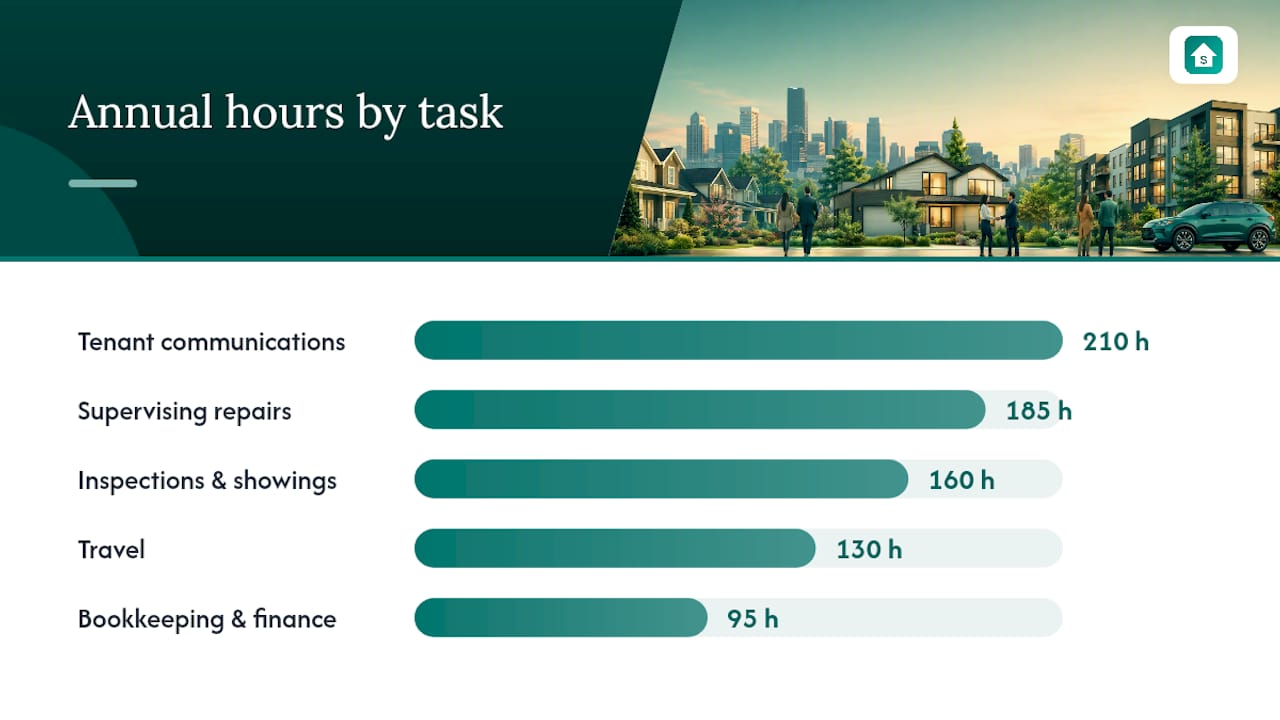
Step 3: 750-hour test. 780 hours exceeds 750. Both tests are met.
Step 4: Material participation. Maria made the aggregation election. Treating all four properties as one activity, her 780 hours exceed 500, satisfying Test 1 of Treas. Reg. §1.469-5T.
Step 5: Tax reporting. Maria’s combined rental loss for the year is a significant amount. Because she qualifies as a real estate professional and materially participates, the $28,000 loss is nonpassive. It appears on Schedule E Part I as a nonpassive loss, flows to Form 1040 line 8, and reduces her AGI by $28,000. She checks the real estate professional box on Schedule E line 43. Form 8582 is not needed for these four properties because no passive losses remain.
Example B: REPS met overall, but one property fails material participation
Taxpayer profile: James qualifies as a real estate professional with sufficient hours across three long-term rentals. He also owns a vacation rental in which he spent fewer hours during the year. He did not make the aggregation election.
Material participation by property:
| Property | Hours | Test met | Nonpassive? |
|---|---|---|---|
| 101 Main St (long-term) | 310 | Test 3 (>100 hrs, not less than others) | Yes |
| 44 Park Ave (long-term) | 275 | Test 3 | Yes |
| 9 River Rd (long-term) | 225 | Test 3 | Yes |
| Lakeside Cabin (vacation) | 55 | None | No (passive) |
Tax reporting: Losses from three long-term rental properties total a substantial amount and are nonpassive. They appear on Schedule E Part I as nonpassive losses. The Lakeside Cabin generates a loss. Because James failed material participation for that property, the $4,500 is passive. It flows to Form 8582, where it is suspended and carried forward to offset future passive income from the cabin or other passive activities.
James notes on Schedule E line 43 that he is a real estate professional. He attaches a statement identifying the three properties for which he met material participation and explaining that the vacation rental is reported separately as a passive activity.
Calculators that help you model REPS scenarios before you file
Start with a rental property hours tracker to confirm whether you clear the 750-hour threshold, then use a rental property tax impact calculator to estimate the change in taxable income. The two tools together let you test scenarios before committing to a filing position.
The free calculators at Cashflowcalcs cover the key numbers you need:
- Rental Property Calculator: Models rental income, operating expenses, net operating income, and cash flow for a single property. Use it to estimate the annual loss or gain for each property before you aggregate them for the REPS analysis. Every formula is shown, so you can verify the output.
- Rental Property Depreciation Calculator: Calculates annual depreciation under MACRS, including the effect of 100% bonus depreciation for property acquired after January 19, 2025 (as made permanent by the One Big Beautiful Bill Act). Depreciation is often the largest single component of a rental loss, so knowing this number precisely matters for your Schedule E entries.
- Rental Property Comparison Calculator: Compares up to two properties side by side on cash flow, cap rate, and return metrics. Useful when deciding which properties to include in an aggregation election or when evaluating whether adding a new property changes your overall REPS hour picture.
These calculators produce educational estimates, not tax advice. Export the results and save them with your contemporaneous records as a cross-reference for your Schedule E entries.
Run your REPS numbers with Cashflowcalcs before you file
Knowing whether you qualify is one thing. Seeing the actual dollar impact on your tax return is what drives the decision to claim the status, document the hours, and make the aggregation election.
The Rental Property Calculator at Cashflowcalcs gives you a fast, free way to model income, expenses, depreciation, and net loss for each property in your portfolio, with no sign-up and no downloads. Run the numbers for each property, export the results, and use them as a starting point for your Schedule E entries. The calculator shows its formula at every step, so you can trace each figure back to its source rather than accepting a black-box output.
For investors comparing multiple properties to decide which ones to include in an aggregation election, the Rental Property Comparison Calculator lets you put two properties side by side on the metrics that matter most.
All results are educational estimates. For your specific tax situation, confirm figures with a qualified CPA or tax advisor who specializes in real estate.
Sources
The rules governing real estate professional status come from a small set of primary authorities. Bookmark these for audit preparation and further reading:
- Publication 925 (Passive Activity and At-Risk Rules) | Internal Revenue Service
- 26 CFR § 1.469-5T - Material participation (temporary) | LII / Legal Information Institute
- 26 U.S.C. §469: Passive activity losses and credits limited | govinfo
When preparing for an audit, print or save each of these sources alongside your hour logs and property records. An auditor who sees that your documentation tracks the statutory language directly is more likely to accept your position without extended examination.
This article is general information, not a substitute for advice from a qualified financial advisor. Consult a qualified financial professional about your own circumstances before acting on anything here.
FAQ
What qualifies you as a real estate professional under IRS rules?
Both tests must be met; the rules come from IRC §469(c)(7).
Is real estate professional status worth claiming?
How do you prove real estate professional status to the IRS?
You prove it with contemporaneous records: dated calendar entries, contractor invoices, mileage logs, lease documents, and a narrative worksheet reconciling total hours by property to the applicable material participation test. Tax Court has accepted reconstructed travel logs when supported by independent corroborating evidence.
What is the difference between a real estate professional and a licensed Realtor?
A licensed Realtor holds a state-issued real estate sales or broker license and represents buyers or sellers in transactions. Real estate professional status is an IRS tax classification under IRC §469 that determines how rental losses are treated on your federal return. A licensed agent may or may not qualify for REPS, and a property investor with no license can qualify if they meet the hour and participation tests.
This article provides general educational information about IRS rules and is not tax or legal advice. Tax rules change and individual circumstances vary. Confirm your specific situation with a qualified CPA or tax attorney before filing.