Taxes
MACRS Depreciation Schedule: Build One Step by Step

A MACRS depreciation schedule is the IRS-prescribed, year-by-year table you use to recover an asset’s tax basis through annual deductions under the Modified Accelerated Cost Recovery System. To build one, you need five inputs: depreciable basis, placed-in-service date, property class (recovery period), applicable depreciation method, and the correct convention (Half-Year, Mid-Quarter, or Mid-Month). The governing authority is IRS Publication 946, which contains the official percentage tables and worksheets; you report the resulting deductions on Form 4562 (Depreciation and Amortization) when you file.
Before you start, gather these items:
- Depreciable basis: purchase price plus capitalized improvements, minus land value and any §179 or bonus depreciation you plan to elect
- Placed-in-service date: the date the asset was ready and available for use, not necessarily the purchase date
- Property class: the IRS recovery period assigned to your asset type (3, 5, 7, 10, 15, 20, 27.5, or 39 years under GDS)
- Method and convention: 200% or 150% declining balance vs. straight-line; Half-Year, Mid-Quarter, or Mid-Month
- Elections: whether you are claiming Section 179 expensing, bonus depreciation, or both
Cashflowcalcs offers a free, browser-based rental property depreciation calculator that produces IRS-style year-by-year schedules, shows every formula it uses, and includes a worked example so you can verify each number against Publication 946.
Table of Contents
- What is MACRS and why does the IRS use fixed recovery periods?
- What are the standard MACRS property classes and recovery periods?
- Which depreciation methods does MACRS use?
- How do the Half-Year, Mid-Quarter, and Mid-Month conventions work?
- How do you build a MACRS year-by-year depreciation schedule?
- Where do you find and read the IRS MACRS percentage tables?
- Section 179, bonus depreciation, listed property, and what happens when you sell
- How to use an online MACRS calculator effectively
- Common MACRS mistakes and how to avoid them
- Key Takeaways
- Why transparent calculators matter more than most investors realize
- Run your MACRS schedule free with Cashflowcalcs
- Useful sources
What is MACRS and why does the IRS use fixed recovery periods?
MACRS stands for Modified Accelerated Cost Recovery System. It replaced the Accelerated Cost Recovery System (ACRS) in 1986 and applies to virtually all tangible property placed in service after that year. Under MACRS, the IRS assigns each asset to a predetermined class with a fixed recovery period rather than letting taxpayers estimate useful life on their own. The Legal Information Institute describes the policy intent clearly: accelerated deductions front-load the tax benefit, improving cash flow for businesses that invest in capital assets.

The system operates under two sub-systems. The General Depreciation System (GDS) is the default for most personal and business property; it uses accelerated methods (200% or 150% declining balance) that produce larger deductions in the early years of an asset’s life. The Alternative Depreciation System (ADS) uses straight-line depreciation over longer recovery periods and is mandatory in specific situations, including foreign-use property, tax-exempt bond-financed property, and certain listed property.
One point that surprises many business owners: the IRS, not the taxpayer, determines how long an asset depreciates. Your equipment may still be running perfectly after several years, but the MACRS schedule will have fully recovered its tax basis by then regardless. That fixed-class-life structure is what makes MACRS recovery periods predictable and auditable.
What are the standard MACRS property classes and recovery periods?
The table below maps the most common GDS recovery periods to typical asset examples under 26 U.S.C. §168. Use it as a quick reference when classifying a purchase; confirm unusual items in Publication 946, Appendix B.
| GDS Recovery Period | Default Method | Common Examples |
|---|---|---|
| 3-year | 200% DB | Tractor units for over-the-road use, racehorses over 2 years old, certain special tools |
| 5-year | 200% DB | Automobiles, light trucks, computers and peripherals, office machinery, and appliances, carpet, and furniture in residential rental units |
| 7-year | 200% DB | Office furniture and fixtures, most agricultural machinery, and equipment with no assigned class life |
| 10-year | 200% DB | Single-purpose agricultural or horticultural structures, certain vessels, fruit- or nut-bearing trees and vines |
| 15-year | 150% DB | Land improvements (fences, sidewalks, parking lots, landscaping) and qualified improvement property |
| 20-year | 150% DB | Farm buildings other than single-purpose structures, and certain municipal sewers |
| 27.5-year | Straight-line | Residential rental buildings |
| 39-year | Straight-line | Nonresidential (commercial) real property |
A few special classes exist outside this standard table. Water utility property carries a 25-year GDS period, and railroad grading or tunnel bores are assigned a 50-year recovery period under §168(e)(3). When ADS applies, recovery periods extend for certain classes, with personal property that has no assigned class life defaulting to a 12-year ADS recovery period.
Before assigning a class, confirm two things: the exact placed-in-service date and the full depreciable basis. Both affect which percentage table row you use and how much you can deduct in year one.
Which depreciation methods does MACRS use?
MACRS uses three primary methods, and the applicable method depends on the property class and whether GDS or ADS governs.
- 200% declining balance (200% DB): Default for 3-, 5-, 7-, and 10-year GDS property. Applies twice the straight-line rate to the adjusted basis at the start of each year, then switches to straight-line when straight-line yields a larger deduction.
- 150% declining balance (150% DB): Required for 15- and 20-year GDS property, and available as an election for other classes. Uses 1.5 times the straight-line rate with the same switch rule.
- Straight-line: Mandatory for residential rental (27.5-year) and nonresidential real property (39-year) under GDS, and for all property under ADS. Spreads deductions evenly across the recovery period.
The switch from declining balance to straight-line happens automatically in the first year where straight-line on the remaining adjusted basis produces a larger allowance than the declining balance calculation. The IRS percentage tables in Publication 946 already incorporate this switch, so if you use the tables directly, you do not need to calculate the crossover year yourself.
ADS is mandatory in four main situations: property used predominantly outside the United States, property leased to a tax-exempt entity, property financed with tax-exempt bonds, and certain listed property where business use falls to 50% or below. Electing ADS voluntarily is also allowed, though it permanently locks in the longer recovery period for that asset class in that tax year.
Cash-flow comparison at a glance:
- 200% DB on a typical asset recovers a substantial portion of basis in the first two years of a medium-term class
- Straight-line on the same asset recovers an even portion each year over the recovery period
- The accelerated front-loading means a real dollar-for-dollar tax deferral in the early years, which is why most taxpayers default to GDS
How do the Half-Year, Mid-Quarter, and Mid-Month conventions work?
The convention determines what fraction of a year’s depreciation you can claim in the placed-in-service year and the final year of the schedule.
- Half-Year convention: The default for most personal property (3-, 5-, 7-, 10-, 15-, and 20-year classes). Treats all property as placed in service at the midpoint of the tax year, regardless of the actual date. You claim half a year’s depreciation in year one and half a year in the final year.
- Mid-Quarter convention: Mandatory when more than 40% of total depreciable tangible personal property placed in service during the year is placed in service in the fourth quarter. Each asset is treated as placed in service at the midpoint of the quarter in which it was actually placed in service. A Q4 asset gets only 1.5 months of depreciation in year one (12.5% of the year), while a Q1 asset gets 10.5 months (87.5%).
- Mid-Month convention: Applies exclusively to residential rental (27.5-year) and nonresidential real property (39-year). The asset is treated as placed in service at the midpoint of the month it actually enters service. A January closing gives you 11.5 months of depreciation in year one; a December closing gives you only 0.5 months.
Quick example: Half-Year vs. Mid-Quarter on a $20,000 asset (5-year, 200% DB):
Under Half-Year, year-one depreciation is 20% × $20,000 = $4,000. Under Mid-Quarter with a Q4 placement, the applicable percentage drops to 5%, giving you just $1,000 in year one. That $3,000 difference is real money, and it is a trap many investors walk into by loading up on equipment purchases in December.
Pro Tip: If you are buying personal property near year end, check whether your Q4 acquisitions will exceed 40% of all personal property placed in service that year. If they will, consider accelerating some purchases into Q3 to preserve the Half-Year convention and its larger first-year deduction.
How do you build a MACRS year-by-year depreciation schedule?

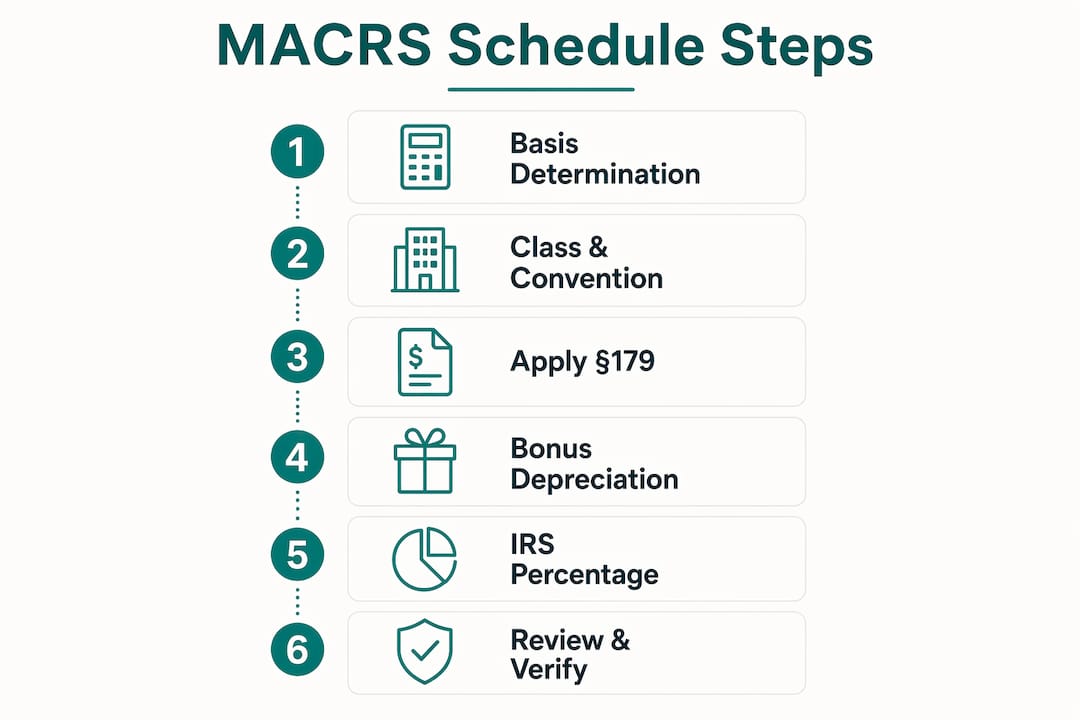
Follow these four steps for any asset, then verify the output against the IRS percentage tables in Publication 946.
Step 1: Determine depreciable basis. Start with the asset’s purchase price, add any capitalized closing costs or improvements, then subtract the value of land (land is never depreciable). For a rental property purchased for $300,000 with land valued at $60,000, the depreciable basis is $240,000.
Step 2: Select property class and convention. Match the asset to its GDS recovery period using Publication 946, Appendix B. Note the placed-in-service date and determine whether Half-Year, Mid-Quarter, or Mid-Month applies.
Step 3: Apply §179 and bonus depreciation first. The ordering rule is fixed: the §179 election reduces basis first, then bonus depreciation applies to the remaining basis, and MACRS runs on whatever is left. If you elect $5,000 of §179 on a $20,000 asset and then claim 100% bonus on the remaining $15,000, MACRS basis is $0 and no further schedule is needed.
Step 4: Apply the IRS percentage table. Multiply the MACRS basis by the table percentage for each year. The tables already account for the declining-balance-to-straight-line switch and the applicable convention.
Worked example 1: 5-year personal property (200% DB, Half-Year convention)
Asset: office equipment with a $20,000 depreciable basis, placed in service in 2025, with no §179 elected and bonus depreciation elected out of so the full MACRS schedule is visible. Using Table A-1 (200% DB, Half-Year), the schedule is:
| Year | IRS % (Table A-1) | Depreciation | Accumulated Depreciation | Remaining Basis |
|---|---|---|---|---|
| 1 | 20.00% | $4,000 | $4,000 | $16,000 |
| 2 | 32.00% | $6,400 | $10,400 | $9,600 |
| 3 | 19.20% | $3,840 | $14,240 | $5,760 |
| 4 | 11.52% | $2,304 | $16,544 | $3,456 |
| 5 | 11.52% | $2,304 | $18,848 | $1,152 |
| 6 | 5.76% | $1,152 | $20,000 | $0 |
Note that a 5-year asset takes six tax years to fully depreciate because the Half-Year convention splits the first and last years. The six percentages sum to 100%, and the deductions sum to the full $20,000 basis.
Worked example 2: 27.5-year residential rental property (straight-line, Mid-Month)
Asset: a residential rental building with a $240,000 depreciable basis (land already excluded), placed in service in January. Straight-line over 27.5 years produces an annual rate of 3.636%, and the Mid-Month convention gives 11.5 months in the January placement year (Table A-6, month 1).
| Year | Months Counted | IRS % (Table A-6, Month 1) | Depreciation |
|---|---|---|---|
| 1 (January placement) | 11.5 | 3.485% | $8,364 |
| 2 through 27 (each year) | 12 | 3.636% | $8,726 |
| 28 | 6.5 | 1.970% | $4,728 |
The schedule spans 28 tax years because the Mid-Month convention gives only 11.5 months in year one and pushes the remaining basis into a final partial year. The annual amounts sum to the full $240,000 basis (minor differences are IRS rounding in the published percentages).
Pro Tip: The IRS switches from declining balance to straight-line automatically in the year straight-line yields a larger deduction. For 5-year property using 200% DB, that crossover occurs in year 4, which is why the year-4 and year-5 percentages are equal. The Publication 946 tables already reflect this switch, so always use the table percentages rather than recalculating the crossover manually.
Where do you find and read the IRS MACRS percentage tables?
Publication 946 contains the official percentage tables in its appendix. Each table is labeled for a specific method, recovery period, and convention combination.
| Table | Method / Property | Convention |
|---|---|---|
| A-1 | 200% DB (3/5/7/10-year) and 150% DB (15/20-year) | Half-Year |
| A-2 | Same classes as A-1 | Mid-Quarter, placed in service in Q1 |
| A-3 | Same classes as A-1 | Mid-Quarter, placed in service in Q2 |
| A-4 | Same classes as A-1 | Mid-Quarter, placed in service in Q3 |
| A-5 | Same classes as A-1 | Mid-Quarter, placed in service in Q4 |
| A-6 | Straight-line, 27.5-year residential rental | Mid-Month (by month placed in service) |
| A-7a | Straight-line, 39-year nonresidential real | Mid-Month (by month placed in service) |
The four mid-quarter tables (A-2 through A-5) share the same property classes as A-1 but adjust the first-year percentage for the quarter in which the asset was placed in service. Table A-7a covers 39-year nonresidential property; the older Table A-7 applies to 31.5-year nonresidential property placed in service before May 13, 1993.
To read a table cell: find the row for the recovery year (Year 1, Year 2, etc.) and the column for the month placed in service (for real property) or the applicable quarter (for mid-quarter personal property). The percentage in that cell is multiplied by your MACRS basis to get that year’s deduction.
The MACRS Worksheet in Publication 946 walks you through the same calculation in a structured format. Form 4562, Part II and Part III, is where those deductions are reported on your tax return. The two documents work together: the worksheet is your calculation record; Form 4562 is the filed summary.
Publication 946 is updated annually. Download the current PDF directly from IRS.gov by searching “Publication 946” in the IRS publications search. Always use the version for the tax year in which the property was placed in service, since percentage tables and bonus depreciation rules can change year to year.
Section 179, bonus depreciation, listed property, and what happens when you sell
Ordering: §179 first, then bonus, then MACRS
The sequence is fixed by statute. You apply the §179 election first, which reduces the asset’s basis dollar-for-dollar up to the annual dollar cap (subject to a taxable income limitation). Bonus depreciation then applies to the remaining basis automatically, unless you elect out by property class. MACRS runs only on whatever basis is left after both elections. Combining §179 and bonus depreciation requires planning: §179 is capped by taxable income and cannot create a net operating loss, while bonus depreciation can.
100% bonus depreciation made permanent under OBBBA
For qualifying property acquired after January 19, 2025, the One Big Beautiful Bill Act (OBBBA) made 100% bonus depreciation permanent. This means most new (and used-but-new-to-you) personal property acquired after that date can be fully expensed in year one unless you elect out for a class of property. The practical effect: a $50,000 equipment purchase acquired and placed in service in mid-2025 could produce a $50,000 deduction in 2025 with no remaining MACRS schedule to maintain.
Listed property rules
Listed property includes passenger automobiles, computers used outside a regular business establishment, and certain other assets with significant personal-use potential. For these assets:
- Business use must exceed 50% to use GDS accelerated methods; if business use is 50% or below, ADS straight-line is mandatory.
- Luxury auto limits cap the annual depreciation deduction regardless of the asset’s actual cost (limits are updated annually in IRS Revenue Procedures).
- Business-use percentage must be documented with contemporaneous records, not reconstructed after the fact.
Disposition and depreciation recapture
When you sell or retire a depreciable asset, accumulated depreciation becomes taxable. For personal property (Section 1245 assets), all accumulated depreciation is recaptured as ordinary income. For real property (Section 1250 assets), the recapture rules are more nuanced: straight-line depreciation on residential rental property is taxed at a maximum 25% unrecaptured §1250 gain rate rather than ordinary rates. Use the Cashflowcalcs depreciation recapture calculator to estimate that tax before you sell.
Pro Tip: If you are selling a property and want to defer recapture, a 1031 exchange allows you to roll the accumulated depreciation into a replacement property rather than recognizing it as income in the year of sale. The exchange must meet strict timing and identification rules, so plan well in advance.
Partial dispositions and improvements each create their own MACRS schedule. If you replace a roof on a 39-year commercial building, the old roof’s remaining basis can be written off as a partial disposition, and the new roof starts its own 39-year schedule from the date it is placed in service.
How to use an online MACRS calculator effectively
A trustworthy MACRS calculator must show three things: the exact IRS percentage table it is drawing from, the step-by-step schedule with each year’s deduction, and the formula used to compute each line. Without those, you cannot reconcile the output to Publication 946 or defend the numbers during an audit.
Cashflowcalcs provides a free, browser-based depreciation tool suite that runs entirely in your browser with no sign-up required. Every calculator displays its formula and a worked example alongside the results, so you can follow the math rather than accepting a black-box answer. Your inputs stay private because nothing is transmitted to a server.
Demo workflow for the MACRS calculator:
- Enter the asset’s depreciable basis and placed-in-service date.
- Select the property class (recovery period) from the dropdown.
- Choose the depreciation method (200% DB, 150% DB, or straight-line) and convention.
- Enter any §179 election amount and indicate whether bonus depreciation applies.
- The calculator outputs a full year-by-year schedule showing the IRS percentage, annual deduction, accumulated depreciation, and remaining basis.
- Copy or export the schedule and reconcile it to the applicable Publication 946 table before transferring the year-one figure to Form 4562.
Pro Tip: After generating a schedule, spot-check year one and year two against the corresponding row in the Publication 946 table for your method and convention. If the numbers match, the rest of the schedule will too. If they differ, recheck the convention selection, which is the most common source of calculator-to-table discrepancies.
Common MACRS mistakes and how to avoid them
Getting the schedule wrong costs you deductions or creates audit exposure. These are the errors that show up most often.
- Misclassifying the asset: Assigning office furniture to 5-year property instead of 7-year, or treating a land improvement as part of the building’s 39-year basis, produces an incorrect schedule from line one. Always verify the class in Publication 946, Appendix B.
- Missing the mid-quarter trigger: If Q4 acquisitions exceed 40% of total personal property placed in service, mid-quarter is mandatory for every personal property asset placed in service that year, not just the Q4 purchases. Applying half-year when mid-quarter was required is a common audit flag.
- Applying bonus depreciation to ineligible property: Used property can qualify for bonus depreciation if it is new to the taxpayer, but certain assets (real property improvements under some elections, property with longer ADS lives) may be excluded. Confirm eligibility before claiming 100% bonus.
- Leaving disposed assets on the schedule: When you sell or scrap an asset, remove it from the depreciation schedule and recognize any remaining basis as a loss (or recapture gain). Continuing to depreciate a disposed asset is a material error.
- Failing to document listed property business use: The IRS requires contemporaneous records for listed property. A mileage log reconstructed at tax time does not meet the standard.
Audit documentation checklist:
- Purchase invoices or settlement statements (HUD-1 or ALTA closing disclosure for real property)
- Asset tags or serial numbers for equipment
- Evidence of the placed-in-service date (delivery receipt, first rental agreement, certificate of occupancy)
- The Publication 946 table and worksheet used to compute the schedule
- Business-use logs for listed property
Verification check: Sum all annual depreciation amounts in your schedule. The total must equal the original MACRS basis (after §179 and bonus elections). If it does not, recheck the percentage table selection or the basis figure.
Pro Tip: For year-end tax planning, run a projection in October or November to see whether your Q4 personal property purchases will trigger the mid-quarter convention. If they will, either accelerate purchases into Q3 or plan around the lower first-year percentages so the tax impact does not surprise you at filing time.
Key Takeaways
A MACRS depreciation schedule requires the correct basis, property class, method, and convention applied in the IRS-prescribed order before any deduction is defensible at audit.
| Point | Details |
|---|---|
| Gather five inputs first | You need depreciable basis, placed-in-service date, property class, method/convention, and any §179 or bonus elections before building a schedule. |
| Convention choice changes year-one deductions materially | Mid-Quarter on a Q4 asset can cut the first-year deduction to a fraction of what Half-Year would produce on the same asset. |
| Apply elections in the correct order | §179 reduces basis first, bonus depreciation applies next, and MACRS runs only on the remaining basis. |
| Use IRS percentage tables directly | Publication 946 tables (A-1 through A-7a and beyond) already incorporate the declining-balance-to-straight-line switch and the applicable convention. |
| Cashflowcalcs for verification | The free browser-based rental property depreciation calculator shows formulas and a worked example so you can reconcile output to Publication 946 before filing Form 4562. |
Why transparent calculators matter more than most investors realize
The conventional wisdom in real estate tax planning is to hand depreciation schedules to your CPA and not think about them again until April. That approach works until it does not. A misclassified asset, a missed mid-quarter trigger, or a bonus depreciation election applied to ineligible property can sit undetected for years and then surface as a significant adjustment in an IRS examination.
What actually protects you is understanding the schedule well enough to review it. That does not mean becoming a tax attorney. It means knowing which table your CPA used, why the year-one percentage is what it is, and whether the convention matches your placed-in-service date. A calculator that shows its work makes that review possible in minutes rather than hours.
The other underappreciated point: depreciation timing is a cash-flow decision, not just a compliance task. Choosing between 100% bonus expensing and a standard MACRS schedule on a $100,000 equipment purchase is a choice between a large deduction now and smaller deductions spread over five to seven years. The right answer depends on your current tax rate, your projected income in future years, and whether you expect rates to change. Running both scenarios in a transparent calculator before you file gives you the information to make that call deliberately.
Run your MACRS schedule free with Cashflowcalcs
Cashflowcalcs gives rental property investors a faster path from purchase price to IRS-ready depreciation schedule. The free rental property depreciation calculator handles both personal property and residential rental scenarios, applies the correct convention automatically, and displays every formula and IRS table percentage alongside the results. No sign-up, no download, and your numbers never leave your browser.
Once you have your depreciation schedule, plug the year-one figure directly into Form 4562 and keep the full schedule as your audit workpaper. For a complete picture of how depreciation affects your deal’s returns, pair the depreciation tool with the rental property calculator to model cash flow, cap rate, and cash-on-cash return in the same session. Both tools are free, and both show their work.
Useful sources
The following primary authorities should be your first stop when preparing or reviewing a MACRS schedule.
- IRS Publication 946 (How To Depreciate Property): The definitive IRS guide covering all MACRS rules, percentage tables (A-1 through A-20), the MACRS Worksheet, and instructions for listed property and elections. Updated annually; download the current PDF from IRS.gov.
- Form 4562 (Depreciation and Amortization): The tax form filed with your return to report §179 elections, bonus depreciation, and all MACRS deductions. Parts II and III cover MACRS specifically.
- 26 U.S.C. §168 (Accelerated Cost Recovery System): The statutory authority that sets recovery periods, applicable methods, and convention rules. Read alongside Publication 946 for the full legal framework.
- LII / Legal Information Institute (MACRS): Plain-language explanation of MACRS with links to the underlying code sections. Useful for understanding the policy rationale and method definitions.
- Cashflowcalcs depreciation tools: Browser-based calculators for rental property depreciation and depreciation recapture, each showing formulas and worked examples for verification against Publication 946.
This article is general educational information, not tax or legal advice. Confirm current rules, caps, and elections with IRS.gov or a qualified tax professional for your specific situation.