Taxes
1031 Exchange Rules for U.S. Real Estate Investors

A properly structured Section 1031 like-kind exchange lets a U.S. real estate investor defer capital gains tax by swapping investment or business-use real property for other qualifying real property while meeting strict deadlines and documentation requirements. The exchange defers tax, it does not eliminate it, and two absolute deadlines govern every transaction.
The three things you must confirm before proceeding are:
- Like-kind requirement: Both the relinquished and replacement properties must be U.S. real property held for investment or use in a trade or business. Personal residences and personal property do not qualify.
- Same-taxpayer rule: The same taxpayer (or entity) that sells the relinquished property must acquire the replacement property. Title changes between legs trigger disqualification.
- Qualified Intermediary (QI): You must engage a QI before the relinquished property closes. The QI holds sale proceeds so you never take constructive receipt of the funds. Touching the money ends the exchange.
The two absolute deadlines are 45 calendar days to identify replacement property in writing and 180 calendar days to close on it. Both clocks start on the date title transfers on the relinquished property. Neither deadline can be extended except in federally declared disaster zones under Rev. Proc. 2018-58.
Table of Contents
- What property qualifies for a like-kind exchange?
- How do the 45-day and 180-day deadlines actually work?
- How does boot affect your tax bill? A worked example
- What are the four main exchange structures?
- What are the related-party rules and holding period requirements?
- How do you execute a 1031 exchange step by step?
- How do you report a 1031 exchange on your tax return?
- Common mistakes that cause exchanges to fail
- Key Takeaways
- Run your 1031 exchange numbers before you meet your CPA
- Useful sources
- FAQ
What property qualifies for a like-kind exchange?
The “like-kind” standard for U.S. real property is broader than most investors expect. Under IRC §1031, any real property held for investment or used in a trade or business generally qualifies as like-kind to any other U.S. real property held for the same purpose. You can swap a single-family rental for an apartment complex, raw land for a warehouse, or a strip mall for a net-lease industrial building. The property types do not need to match.
What qualifies:
- Residential rental properties (single-family, multifamily)
- Commercial real estate (office, retail, industrial, warehouse)
- Raw or agricultural land held for investment
- Net-lease properties
- Delaware Statutory Trust (DST) interests in real property
What does not qualify:
- Primary residences or vacation homes used primarily for personal enjoyment
- Property held primarily for sale (dealer/inventory property)
- Stocks, bonds, partnership interests, or notes
- Personal property such as equipment, vehicles, or artwork (excluded since January 1, 2018, under the Tax Cuts and Jobs Act)
The TCJA change is worth underscoring: since 2018, Section 1031 applies only to real property. Investors who previously exchanged aircraft, heavy equipment, or artwork under the old rules no longer have that option.
Converting a vacation home or primary residence into rental property can make it eligible, but the IRS scrutinizes quick conversions. Practitioners recommend documenting at least two tax years of genuine rental activity before attempting an exchange. Keep lease agreements, rental income records, and property management contracts. A property converted to a rental and sold six months later is a high-audit-risk transaction regardless of how the taxpayer characterizes it.
How do the 45-day and 180-day deadlines actually work?

Both clocks start on the date title transfers on the relinquished property, and both count calendar days, not business days. If day 45 falls on a Saturday, the deadline does not move to Monday. Missing the written identification by midnight on day 45 is an automatic, irreversible failure of the exchange.
The three identification rules
You must identify replacement property in writing, signed, and delivered to your Qualified Intermediary or another appropriate party within the identification period. Telling your real estate agent or attorney is not sufficient. The IRS requires written, signed identification delivered to a non-disqualified party, and notice to a broker or attorney alone does not satisfy the rule.
You must follow exactly one of three identification rules: identify a limited number of properties with certain value considerations or acquire nearly all the value of identified properties. The rules balance simplicity, flexibility, and risk in property identification.
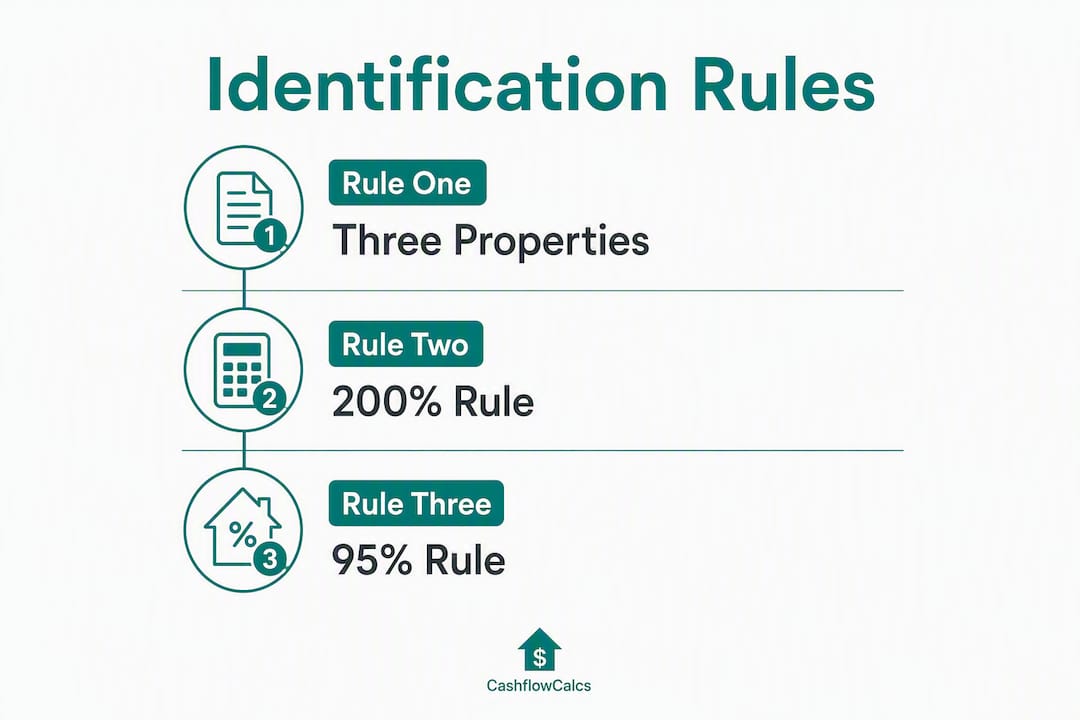
The three-property rule is the safest default. The 200% rule gives you more backup options when markets are competitive. The 95% exception is a last resort and carries significant execution risk.
The 180-day deadline and tax return interactions
The closing deadline is the earlier of a set number of days after the transfer or the due date of your federal income tax return for that year, including extensions. If you close the sale of your relinquished property in November or December, your 180-day window may be cut short by the April 15 return deadline unless you file an extension.
Filing Form 4868 (individuals) or Form 7004 (partnerships and S corporations) extends the return due date and restores the full 180 days. Many advisors file extensions automatically for any client with a Q4 disposition.
Pro Tip: Identify three backup properties, including a DST interest as a final backstop, and deliver your written identification well before day 45. Waiting until day 44 leaves no room for delivery confirmation issues or last-minute deal failures.
How does boot affect your tax bill? A worked example
Key definitions
Realized gain is the total economic gain from the sale: sale price minus adjusted basis. Recognized gain is the portion that becomes taxable because of boot or a failed exchange. Boot is any cash or non-like-kind property you receive, including net debt relief (when the mortgage on the replacement property is lower than the mortgage on the relinquished property). Deferred gain is the portion you successfully defer into the replacement property’s basis.
Debt relief creates what practitioners call mortgage boot. If you sell a property with higher mortgage debt than the replacement property, the net debt reduction is treated as boot received, which can be taxable even if no cash changes hands.
Worked numeric example
| Line | Item | Amount |
|---|---|---|
| A | Sale price (relinquished property) | , |
| B | Adjusted basis (relinquished property) | $300,000 |
| C | Realized gain (A minus B) | $500,000 |
| D | Mortgage on relinquished property | , |
| E | Net proceeds to QI (A minus D) | , |
| F | Purchase price (replacement property) | , |
| G | Mortgage on replacement property | , |
| H | Cash reinvested from QI proceeds | , |
| I | Mortgage boot (D minus G) | $50,000 |
| J | Cash boot received | , |
| K | Total boot (I plus J) | $50,000 |
| L | Recognized gain (lesser of C or K) | $50,000 |
| M | Deferred gain (C minus L) | $450,000 |
| N | Basis in replacement property (F minus M) | $300,000 |
How to read this table: The investor realized $500,000 in gain but only recognizes $50,000 because the replacement mortgage is $50,000 lower than the relinquished mortgage. The remaining $450,000 of gain is deferred and embedded in the replacement property’s $300,000 carryover basis. That low basis means higher depreciation recapture and capital gains exposure when the replacement property is eventually sold.
Step-by-step calculation checklist
- Calculate realized gain: sale price minus adjusted basis.
- Identify all boot received: cash retained plus net mortgage relief (relinquished mortgage minus replacement mortgage).
- Recognized gain equals the lesser of total boot or total realized gain.
- Deferred gain equals realized gain minus recognized gain.
- Basis in replacement property equals purchase price minus deferred gain (or equivalently, adjusted basis of relinquished property plus recognized gain plus additional cash paid, minus boot received).
- Verify that all QI proceeds were reinvested and that the replacement mortgage is at least equal to the relinquished mortgage to avoid mortgage boot.
Pro Tip: Match or exceed the relinquished property’s debt level on the replacement. If you cannot find a property requiring that much financing, adding cash to make up the difference eliminates mortgage boot.
Use the free 1031 Exchange Calculator at Cashflowcalcs to model these numbers for your own deal before meeting with your CPA.
Depreciation recapture and NIIT: The exchange defers capital gains tax, but it also carries forward the accumulated depreciation from the relinquished property. When you eventually sell the replacement property without another exchange, that depreciation is subject to recapture at up to 25% (Section 1250 unrecaptured gain), and net investment income may be subject to the 3.8% Net Investment Income Tax. Use the depreciation recapture calculator to estimate that future exposure now.
What are the four main exchange structures?
Most investors default to the delayed exchange without realizing three other structures exist, each suited to different deal circumstances.

Simultaneous exchange: Both properties close on the same day. Rarely practical in modern real estate because coordinating two closings to the same moment is logistically difficult, and lenders often cannot accommodate it. No QI is technically required, but most practitioners use one anyway for documentation purposes.
Delayed (deferred) exchange: The standard structure. You sell the relinquished property, the QI holds the proceeds, you identify replacement property within 45 days, and you close within 180 days. This is what most investors mean when they say “1031 exchange.”
Reverse exchange: You acquire the replacement property before selling the relinquished property. An Exchange Accommodation Titleholder (EAT) takes title to one of the properties and parks it while you complete the other side. Reverse exchanges are common in competitive markets where you cannot afford to lose a replacement property while waiting to sell. They are more expensive (EAT fees, additional legal work) and require lender cooperation since the EAT holds title.
- Useful when: you find the replacement property first and cannot risk losing it.
- Tradeoff: higher cost, more complex documentation, and the same 45/180-day deadlines apply from the date the EAT acquires the parked property.
Improvement (build-to-suit) exchange: The QI or EAT holds the replacement property while improvements are constructed during the exchange period. The improvements must be substantially complete and the property must be transferred to you within the 180-day window. Any improvements not completed by day 180 do not count toward the exchange value.
- Useful when: you want to add value to a replacement property before taking title.
- Tradeoff: construction timelines must fit within 180 days, which is tight for significant projects. Use the fix and flip calculator to budget improvement costs before committing to this structure.
All four structures share the same identification and closing deadlines. Reverse and improvement exchanges add parking costs and legal complexity that can run several thousand dollars above a standard delayed exchange.
What are the related-party rules and holding period requirements?
Section 1031(f) related-party rules
Exchanging with a related party, defined broadly under IRC §267 and §707 to include family members, controlled entities, and certain partnerships, triggers additional requirements under Section 1031(f). The transferee in a related-party exchange must hold the exchanged property for at least two years. If either party disposes of the property within that window, the gain deferred in the exchange becomes immediately taxable.
The anti-abuse rules also apply to indirect workarounds. Structuring a transaction to route around the related-party rules through intermediary entities or staggered transfers can result in disallowance of the entire exchange.
Key related-party cautions:
- Buying from a related party: the related party must hold the proceeds for two years.
- Selling to a related party: you must hold the replacement property for two years.
- Death or involuntary conversion of either party within the two-year window may provide relief, but the rules are fact-specific.
Holding period and investor intent
There is no statutory minimum holding period for the relinquished property, but the IRS and Tax Court look for evidence of investment intent. Two tax years of documented rental or business use is the common practitioner benchmark. A property purchased and sold within the same tax year with minimal rental activity will face scrutiny.
The IRS also evaluates title continuity. The same taxpayer or entity must appear on both sides of the exchange. An individual cannot sell as a sole owner and buy through a newly formed LLC without risking disqualification, unless the LLC is a disregarded entity owned entirely by that individual.
Converting exchanged property to a primary residence
IRC §121 allows a $250,000 ($500,000 for married couples) exclusion on gain from the sale of a primary residence, but combining §121 with a prior §1031 exchange requires careful planning. If you convert a replacement property to your primary residence, the deferred gain from the exchange does not qualify for the §121 exclusion for the portion attributable to the exchange period. Immediate conversion after acquiring the replacement property is a well-documented audit trigger.
Pro Tip: Keep contemporaneous records of every rental agreement, tenant communication, advertising listing, and property management invoice. These documents establish investment intent and are your first line of defense in an audit.
How do you execute a 1031 exchange step by step?
Ordered execution checklist
- Engage a QI before listing the property. The QI agreement must be in place before the relinquished property closes. Waiting until after closing disqualifies the exchange.
- Execute the exchange agreement. The QI prepares documents that restrict you from receiving, pledging, or borrowing against the sale proceeds.
- Close on the relinquished property. Proceeds go directly to the QI, never to you.
- Deliver written identification by day 45. The identification must be signed, dated, and received by the QI (or another non-disqualified party) by midnight on day 45.
- Negotiate and execute a purchase contract on the replacement property.
- Close on the replacement property by day 180 (or the tax return due date, whichever is earlier). The QI wires funds directly to the closing.
- File Form 8824 with your federal tax return for the year the relinquished property transferred.
Selecting and vetting a QI
The QI is not regulated at the federal level, so due diligence matters. Ask any prospective QI:
- Are exchange funds held in a separate, segregated trust or escrow account in your name?
- Do you carry fidelity bond and errors-and-omissions insurance?
- Are you independent (not your attorney, accountant, agent, or employee from the prior two years)?
- Can you provide a sample exchange agreement and identification notice template?
- What are your wire transfer and document fees in addition to the base exchange fee?
Typical QI fee ranges
These are indicative market ranges. Fees vary by QI, transaction complexity, and state.
Documents to retain
Keep the following for at least seven years after the exchange closes: the exchange agreement, both closing statements (HUD-1 or settlement statements), the written identification notice with proof of delivery, all QI account statements, and the completed Form 8824 with supporting worksheets.
How do you report a 1031 exchange on your tax return?
The exchange is reported on Form 8824, filed with your federal income tax return for the tax year in which the relinquished property transferred. If you sold the relinquished property in 2025 but did not close on the replacement until 2026, you still file Form 8824 with your 2025 return.
Form 8824 requires:
- Descriptions of both properties and their addresses
- Dates of transfer (relinquished) and acquisition (replacement)
- The identification rule used (three-property, 200%, or 95%)
- Fair market values of both properties
- Realized gain, recognized gain, and deferred gain
- Boot received (cash and mortgage relief)
- Basis calculation for the replacement property
- Relationship between the parties (for related-party disclosure)
Extensions and Q4 closings
When the relinquished property closes in October, November, or December, the April 15 return due date may truncate the 180-day window. Filing Form 4868 (individuals) or Form 7004 (partnerships and S corporations) extends the return due date to October 15 and restores the full 180 calendar days. Most tax advisors recommend filing an extension automatically for any Q4 disposition, even if the return would otherwise be ready on time.
Recordkeeping for audit readiness: Retain both closing statements, the exchange agreement, the signed identification notice with a delivery timestamp, all QI correspondence and account statements, and any appraisals or valuations used to establish fair market value.
Common mistakes that cause exchanges to fail
Most exchange failures are preventable. These are the errors that practitioners see most often.
- Missing the day-45 identification deadline. The IRS counts calendar days with no exceptions for weekends or holidays. Failure to deliver written identification by midnight on day 45 ends the exchange permanently. No cure exists.
- Constructive receipt of proceeds. If you receive, pledge, borrow against, or otherwise benefit from the sale proceeds before the exchange completes, the exchange fails and the full gain is taxable in the year of sale.
- Title or taxpayer mismatch. The entity or individual on the deed of the relinquished property must match the entity or individual acquiring the replacement property. An LLC that sells cannot have an individual buy, even if that individual is the sole member, unless the LLC is a disregarded entity.
- Improper identification. Verbal identification, email to a broker, or notice to your attorney does not satisfy the written-delivery requirement. The identification must be signed and received by the QI or another non-disqualified party.
- Identifying too many properties without following a rule. Listing four properties without confirming that their aggregate value stays within 200% of the relinquished property’s value violates the identification rules and voids the exchange.
- Inadequate documentation of investment intent. Converting a personal residence to a rental and immediately attempting an exchange, or selling a replacement property shortly after acquisition, invites IRS scrutiny and potential disallowance.
When to stop and call a CPA or tax attorney immediately: late-year closings where the 180-day window may be truncated, any transaction involving related parties, reverse or improvement exchanges, and any situation where the taxpayer entity structure differs between the two legs.
Key Takeaways
A 1031 exchange defers capital gains tax only when you follow all three core requirements: like-kind U.S. real property, the same taxpayer on both sides, and a QI holding proceeds through both closings.
| Point | Details |
|---|---|
| Two absolute deadlines | Identify replacement property in writing within 45 calendar days; close within 180 calendar days of the relinquished property transfer. |
| Boot triggers taxable gain | Any cash retained or net mortgage relief received is taxable up to the total realized gain; match or exceed the relinquished debt to avoid mortgage boot. |
| Same taxpayer, same title | The entity or individual on both deeds must match; title changes between legs are a leading audit trigger. |
| File an extension for Q4 sales | Form 4868 or Form 7004 extends the return due date and restores the full 180-day window for late-year dispositions. |
| Cashflowcalcs 1031 calculator | Use the free 1031 Exchange Calculator to model boot, basis carryover, and recognized vs. deferred gain before meeting your CPA. |
Run your 1031 exchange numbers before you meet your CPA
The worked example illustrates how mortgage boot results in a portion of realized gain becoming taxable income, while the remaining gain is deferred and embedded in the replacement property’s carryover basis. Your numbers will differ, and small changes in debt levels or purchase price can shift the recognized gain significantly. The free 1031 Exchange Calculator at Cashflowcalcs lets you model boot, basis carryover, and recognized versus deferred gain directly in your browser, with no sign-up and no downloads. Every formula is visible so you can verify the math yourself.
Once you have confirmed the exchange makes sense, use the rental property calculator to evaluate whether the replacement property actually cash flows at the new basis and financing terms. Bring both outputs to your CPA or tax attorney as a starting point for the filing conversation.
This article is for educational purposes only and is not tax or legal advice. Consult a qualified CPA or tax attorney before filing or structuring any exchange transaction.
Useful sources
These primary and practitioner sources provide the definitive language for 1031 exchange rules and reporting:
- IRS Like-Kind Exchanges: Real Estate Tax Tips: The IRS’s own summary of when like-kind exchange treatment applies, what triggers gain recognition, and the general rules for real property exchanges.
- IRS Fact Sheet FS-2008-18: Like-Kind Exchanges Under IRC Section 1031: The most detailed IRS plain-language explanation of the 45/180-day deadlines, QI requirements, identification rules, and boot treatment. Start here.
- 2025 Instructions for Form 8824 (IRS): Line-by-line instructions for completing Form 8824, including the post-TCJA real-property-only rule and basis computation worksheets.
- IRC §1031 (Cornell Law School LII): The full statutory text of Section 1031, including the related-party rules under §1031(f) and the identification and closing deadline provisions.
- IRS Publication 544: Sales and Other Dispositions of Assets: Covers gain and loss treatment for all property dispositions, including the nontaxable exchange rules that interact with §1031.
- American Bar Association: Exchanges Under Code Section 1031: Practitioner-level guidance on related-party rules, anti-abuse provisions, and complex exchange structures.
- Rev. Proc. 2018-58: The IRS revenue procedure governing disaster-related deadline extensions for 1031 exchanges. Deadlines are absolute except in federally declared disaster zones covered by this procedure. Consult the IRS disaster relief page for current declarations.
For complex transactions, including reverse exchanges, improvement exchanges, related-party transfers, or any situation involving entity restructuring, consult a qualified tax attorney or CPA before proceeding.
FAQ
What is the three-property rule for a 1031 exchange?
The three-property rule lets you identify up to three replacement properties of any fair market value within the 45-day identification window. It is the simplest and most commonly used identification method.
What is the downside of a 1031 exchange?
The exchange defers tax, not eliminates it. The deferred gain carries forward in the replacement property’s lower basis, meaning higher depreciation recapture and capital gains exposure when you eventually sell. Boot received (cash or net mortgage relief) is taxable in the year of the exchange, and missing either the 45-day or 180-day deadline causes the full gain to become taxable immediately.
What is the two-year rule for a 1031 exchange?
The two-year rule applies to related-party exchanges under IRC §1031(f). When you exchange with a related party, the transferee must hold the exchanged property for at least two years; disposing of it earlier triggers recognition of the originally deferred gain.
How do you avoid capital gains with a 1031 exchange?
You defer capital gains by reinvesting all sale proceeds through a QI into like-kind U.S. real property, matching or exceeding the relinquished property’s debt level, delivering written identification to the QI within 45 days, and closing on the replacement within 180 days. The gain is not eliminated; it is deferred until you sell the replacement property without another exchange.
Does a 1031 exchange reset depreciation?
No. The replacement property carries over the adjusted basis of the relinquished property (reduced by deferred gain), so accumulated depreciation does not reset. Future depreciation deductions are calculated on the carryover basis, and the prior depreciation remains subject to recapture at up to 25% when the replacement property is eventually sold.