Taxes
Rental Property Taxes in 2026: The Complete Landlord Guide

Rental property income is taxed as ordinary income, but you can reduce your taxable income substantially using allowable deductions, depreciation, and timely filing on the right IRS forms. Most landlords report rental activity on Schedule E (Form 1040), netting income against deductible expenses before the remainder flows into their individual tax return.
Here is what you need to know at a glance:
- Rental income includes cash rent, advance rent, services received in lieu of rent, tenant-paid expenses, and forfeited security deposits.
- Deductible expenses cover mortgage interest, property tax, insurance, repairs, management fees, advertising, utilities, and depreciation.
- Key forms: Schedule E (income and expenses), Form 4562 (depreciation), Form 8582 (passive activity loss limits), and Form 8949/Schedule D (capital gains on sale).
- Passive activity loss rules generally limit rental losses to offset only passive income unless you qualify for the $25,000 special allowance or meet the real estate professional test.
- Selling triggers depreciation recapture (taxed up to 25%) and capital gains tax, but a Section 1031 like-kind exchange can defer both.
Pro Tip: Keep a separate bank account for each rental property. Commingled personal and rental funds are one of the most common audit red flags the IRS identifies in Schedule E returns.
Key Takeaways
Rental property income is taxed as ordinary income on Schedule E, but depreciation, deductible expenses, and passive loss rules give landlords meaningful tools to reduce current-year tax liability.
| Point | Details |
|---|---|
| Report on Schedule E | Most landlords file Schedule E (Form 1040); Schedule C applies only when substantial services are provided. |
| Depreciation is 27.5 years | Residential rental property depreciates straight-line over 27.5 years; the mid-month convention applies in year one. |
| 100% bonus depreciation available | The OBBBA made 100% bonus depreciation permanent for qualifying property placed in service after January 19, 2025, but state conformity varies. |
| Passive loss limits apply | Rental losses are passive by default; the $25,000 special allowance phases out between $100,000 and $150,000 MAGI. |
| Cashflowcalcs runs the numbers free | The Cashflowcalcs depreciation, recapture, capital gains, and 1031 calculators are free, browser-based, and show their formulas. |
Table of Contents
- What actually counts as rental income?
- How rental income is taxed at the federal level
- Where and how to report rental income on your tax return
- Which expenses are deductible and how to tell repairs from improvements
- How depreciation works for residential rental property
- Passive activity loss rules and the real estate professional exception
- Short-term rentals and mixed personal use: what the rules actually say
- Tax consequences when you sell a rental property
- Records to keep and how to reduce audit risk
- Worked examples: rental income, depreciation, and a sale with recapture
- Free calculators to model your rental property taxes
- Sources
- FAQ
What actually counts as rental income?
Rental income is broader than the monthly check your tenant deposits. The IRS taxes cash or the fair market value of property or services you receive for the use of real estate, and that definition catches several items landlords routinely overlook.
Items that must be reported as rental income:
- Regular rent payments, the obvious one, reported in the year received (cash basis).
- Advance rent, if a tenant pays first and last month’s rent upfront, both months are income in the year you receive the payment, even if the lease period extends into a future tax year.
- Lease cancellation fees, a payment to break a lease early is rental income in the year you receive it.
- Services in lieu of rent, if a tenant paints the unit instead of paying one month’s rent, the fair market value of that work is taxable income.
- Tenant-paid expenses, if your lease requires the tenant to pay the water bill and they do, that amount is income to you (and the corresponding expense is deductible).
- Forfeited security deposits, a deposit you keep because the tenant caused damage or broke the lease is income. A deposit you return in full is never income.
Items that are NOT rental income:
- A refundable security deposit held in trust and returned at lease end.
- Loan proceeds from a cash-out refinance (debt, not income).
Most individual landlords use the cash method of accounting, which means you report income when you actually receive it and deduct expenses when you pay them. Uncollected rent is not deductible under the cash method, you simply never report it as income in the first place.
Joint ownership adds one more layer. The split follows the ownership percentage, not who manages the property day-to-day.
How rental income is taxed at the federal level
Rental profit, gross rental income minus all allowable deductions and depreciation, flows directly into your individual taxable income and is taxed at ordinary federal income tax rates. There is no separate “rental income tax rate”; the profit simply stacks on top of your other income and is taxed at your marginal bracket.
Federal ordinary income tax brackets (2026, single filer, illustrative):
| Taxable Income | Rate |
|---|---|
| $0 to $12,000 | 10% |
| $12,001 to $48,000 | 12% |
| $48,001 to $103,000 | 22 |
| $103,001 to $197,000 | 24 |
| $197,001 to $250,000 | 32 |
| $250,001 to $626,000 | 35 |
| Over $626,000 | 37 |
Rental income generally counts as net investment income unless you are a qualifying real estate professional who materially participates.
A rental activity typically needs to rise to the level of a trade or business, and the IRS’s safe harbor (Revenue Procedure 2019-38) requires at least 250 hours of rental services per year and separate books and records. Short-term rentals with average guest stays of seven days or fewer are often treated as a business automatically, which can help or hurt depending on your situation.
State income taxes add another layer. Most states tax rental income as ordinary income, but the rates and conformity rules vary widely. Texas and Florida impose no state income tax. Several states, including California and New York, do not conform to federal bonus depreciation rules, meaning you may need to add back accelerated federal depreciation on your state return and depreciate the asset on a slower state schedule. Always model your state liability separately.
Where and how to report rental income on your tax return
The primary form for most landlords is Schedule E (Supplemental Income and Loss), which attaches to Form 1040. You complete one column per property (up to three properties per Schedule E page; add additional pages for more properties). The net income or loss from Schedule E flows to line 5 of Schedule 1, which then feeds into your Form 1040.
When Schedule C applies instead. If you provide substantial services to tenants beyond ordinary property management (daily cleaning, meals, concierge services), the IRS treats the activity as a business rather than a rental. Most traditional landlords stay on Schedule E; the Schedule C trigger is most common for bed-and-breakfast operations and some short-term rental hosts.
Supporting forms you will likely need:
- Form 4562 (Depreciation and Amortization), required in the first year you claim depreciation on a property and in any year you place new depreciable assets in service. It documents the asset, placed-in-service date, basis, recovery period, and first-year depreciation amount.
- Form 8582 (Passive Activity Loss Limitations), required when your rental losses exceed passive income and you need to compute how much of the loss is currently deductible versus suspended.
- Form 8949 and Schedule D, required in the year you sell a rental property to report the realized gain, depreciation recapture, and resulting capital gains tax.
- Form 4797 (Sales of Business Property), used alongside Form 8949 to report the ordinary income portion of depreciation recapture on a sale.
Estimated tax payments. Rental income is not subject to withholding, so if you expect to owe $1,000 or more in federal tax after subtracting withholding and credits, you must make quarterly estimated payments. The standard due dates are April 15, June 16, September 15, and January 15 of the following year. Underpayment triggers a penalty calculated at the federal short-term rate plus 3 percentage points.
Pro Tip: Set up a simple spreadsheet or property management software entry for each property at the start of the year. Log every income receipt and expense payment in real time rather than reconstructing them from bank statements in March. The IRS’s Schedule E instructions require a property-by-property breakdown, and scrambling to allocate mixed expenses at year-end is where errors happen.
Which expenses are deductible and how to tell repairs from improvements
The IRS allows landlords to deduct ordinary and necessary operating expenses, including mortgage interest, property taxes, maintenance, advertising, insurance, and utilities. Repairs that keep the property in good operating condition are deductible in the year paid; however, if you are considering nontraditional financing options for landlords, you might explore a reverse mortgage for rental property to access cash without selling. Improvements that add value, extend the property’s useful life, or adapt it to a new use must be capitalized and recovered through depreciation.
Commonly deductible operating expenses:
- Mortgage interest (reported on Form 1098 from your lender)
- Property taxes paid to state and local governments
- Landlord insurance premiums (hazard, liability, flood)
- Repairs and maintenance (patching drywall, fixing a leaking faucet, repainting after tenant damage)
- Property management fees
- Advertising and tenant screening costs
- Utilities paid by the landlord
- Legal and professional fees directly related to the rental
- Supplies (cleaning materials, light bulbs, smoke detector batteries)
- Vehicle and travel expenses for rental management (at the IRS standard mileage rate or actual expenses, with a mileage log required)
The repairs vs. improvements test. Publication 527 frames the distinction around three questions: Does the work restore the property to its previous condition? Does it adapt the property to a new use? Does it materially add to the property’s value? If the answer to any of those is yes, you likely have a capital improvement. Replacing a broken window pane is a repair. Replacing all windows with energy-efficient double-pane units is an improvement.
| Expense | Treatment | Rationale |
|---|---|---|
| Fixing a leaking pipe | Deductible repair | Restores existing condition |
| Replacing entire plumbing system | Capital improvement | Adds value, extends useful life |
| Repainting interior after tenant move-out | Deductible repair | Routine maintenance |
| Adding a new deck | Capital improvement | Adds value to property |
| Replacing a broken HVAC unit | Deductible repair | Restores prior function |
| Installing central air where none existed | Capital improvement | Adapts property, adds value |
| Patching roof leak | Deductible repair | Restores existing condition |
| Full roof replacement | Capital improvement | Extends useful life materially |
The de minimis safe harbor lets you expense items costing $2,500 or less per invoice (or $5,000 with an applicable financial statement) without capitalizing them. This is a practical tool for landlords buying appliances, fixtures, or small equipment. See the de minimis safe harbor guide for a step-by-step walkthrough of how to apply the election.

Prepaid expenses follow a 12-month rule: you can deduct a prepaid expense in the year paid only if the benefit does not extend beyond 12 months or the end of the tax year following payment. A 14-month insurance policy paid in December requires you to prorate and defer the portion covering the period beyond 12 months.
Pro Tip: For every expense, capture four fields: date paid, amount, vendor name, and a one-line description of the business purpose. That four-field record is exactly what an IRS auditor will ask for, and having it in a spreadsheet row means you can produce it in minutes rather than hunting through receipts.
How depreciation works for residential rental property
Depreciation lets you recover the cost of your rental building over time, reducing taxable income each year without a cash outlay. The IRS assigns residential rental property a 27.5-year recovery period under the Modified Accelerated Cost Recovery System (MACRS), using the straight-line method and the mid-month convention.
How to determine your depreciable basis:
- Start with the purchase price of the property.
- Add closing costs that increase basis (title insurance, recording fees, legal fees related to the purchase, transfer taxes paid by the buyer).
- Subtract the value allocated to land. Land is never depreciable. A common approach is to use the county assessor’s land-to-improvement ratio from the property tax bill to split the purchase price.
- The resulting figure is your depreciable basis in the building.
Mid-month convention. In the first and last year of ownership, MACRS treats the property as placed in service (or disposed of) at the midpoint of the month, regardless of the actual date. A property placed in service in March gets 9.5 months of depreciation in year one (March 15 through December 31).
First-year depreciation formula (straight-line, mid-month):
Annual depreciation = Depreciable basis / 27.5
First-year depreciation = Annual depreciation × (months in service including half of placed-in-service month / 12)
You report depreciation on Form 4562 in the first year and in any subsequent year you place new assets in service.
OBBBA bonus depreciation (post-January 19, 2025). The One Big Beautiful Bill Act made 100% bonus depreciation permanent for qualifying property placed in service after January 19, 2025. Bonus depreciation applies to tangible personal property with a MACRS class life of 20 years or less, think appliances, carpeting, certain land improvements, and furniture. The building structure itself (27.5-year life) does not qualify, but a cost segregation study can reclassify qualifying components into shorter-life categories.
Cost segregation. A cost segregation study is an engineering-based analysis that identifies building components eligible for 5-, 7-, or 15-year depreciation instead of 27.5 years. Cost segregation combined with bonus depreciation can reclassify commonly 20%-30% of a property’s value into shorter-life asset classes, allowing that portion to be expensed immediately. For a $500,000 property, that could mean $100,000-$150,000 of immediate deductions in year one.

State conformity caveat. Several states, including California, do not conform to federal bonus depreciation. You may need to add back the accelerated federal deduction on your state return and depreciate the asset on the state’s slower schedule. Always run a state add-back schedule alongside your federal model.
Depreciation recapture at sale. Depreciation is a deferral, not a permanent exclusion. Plan your hold period with that exit cost in mind.
Passive activity loss rules and the real estate professional exception
Rental activities are passive by default under IRS rules, which means losses can generally only offset other passive income, not wages or business income. If your rental expenses exceed rental income, the excess loss is suspended and carried forward to future years, it does not reduce your W-2 income dollar for dollar.
The $25,000 special allowance. There is a meaningful exception for active participants. If you actively participate in managing your rental (approving tenants, setting rents, approving repairs) and your modified adjusted gross income (MAGI) is $100,000 or less, you can deduct up to $25,000 of rental losses against non-passive income. The allowance phases out at $0.50 for every dollar of MAGI above $100,000, reaching zero at $150,000 MAGI.
Example: A landlord with $120,000 MAGI and $18,000 of rental losses. The landlord can deduct $15,000 ($25,000 minus $10,000) against ordinary income and carries forward the remaining $3,000.
At-risk rules. Even before the passive loss rules apply, the at-risk rules under Section 465 limit deductible losses to the amount you have economically at risk in the activity. For most landlords with recourse mortgages, this is not a binding constraint, but non-recourse financing from unrelated lenders can create at-risk limitations.
The real estate professional exception. If you qualify as a real estate professional under Section 469(c)(7), your rental activities are not automatically passive. To qualify:
- More than half of your personal services during the year must be in real property trades or businesses in which you materially participate.
- You must perform more than 750 hours of services in those real property trades or businesses.
Meeting both tests allows you to treat rental losses as non-passive, potentially deducting them against wages and other active income. You still need to materially participate in each rental activity (or make a grouping election to treat all rentals as one activity).
Form 8582 is required whenever passive loss limitations apply. The Schedule E instructions walk through the computation, and Publication 925 provides the detailed passive activity rules. Suspended losses are not lost permanently, they release in full when you sell the property in a fully taxable transaction.
Short-term rentals and mixed personal use: what the rules actually say
Short-term rentals (STRs), properties rented for average stays of seven days or fewer, sit in a different part of the tax code than traditional long-term rentals, and the rules shift based on how much you personally use the property.
That classification limits your deductible rental expenses to the amount of rental income, you cannot create a loss. If personal use stays at or below that threshold, the property is treated as a rental and full expense deductions apply (subject to passive loss rules).
The 14-day exclusion. On the flip side, if you rent a property for 14 days or fewer during the year and use it personally for any amount of time, you report zero rental income and claim zero rental deductions. This is a clean exclusion, most useful for vacation homes rented out occasionally.
Expense allocation for mixed-use properties. When a property crosses the personal-use threshold, you must allocate expenses between rental and personal use. The IRS method divides expenses by total days of use (rental days / total days used). Mortgage interest and property taxes attributable to personal use days go to Schedule A as itemized deductions; the rental portion goes to Schedule E, capped at rental income.
Pro Tip: Track every day of personal use in writing, including days spent doing maintenance. The IRS counts a day of personal use only when the primary purpose is personal enjoyment, not repair or maintenance. A weekend spent replacing flooring does not count against your 14-day limit.
Schedule C and self-employment tax. If you provide hotel-like services (daily cleaning, meals, concierge), the activity may require Schedule C reporting, which subjects net profit to self-employment tax. Most STR hosts who simply provide the space and standard amenities stay on Schedule E.
Platform reporting. Platforms like Airbnb and Vrbo issue Form 1099-K when gross payments exceed $600 in a calendar year (the threshold that applies for 2026 under current IRS guidance). The IRS receives a copy. Your reported income must reconcile with the 1099-K, so keep records of every booking, cleaning fee, and platform service fee charged to you.
Tax consequences when you sell a rental property
Selling a rental property triggers two separate tax events: capital gains tax on the appreciation and depreciation recapture on the deductions you claimed over the years. Understanding both before you list the property lets you plan the timing and structure of the sale.
Computing your adjusted basis and realized gain:
- Start with your original purchase price (including closing costs that increased basis).
- Add capital improvements made during ownership.
- Subtract all depreciation claimed (or allowable) over the holding period.
- The result is your adjusted basis.
- Realized gain = Net sale proceeds (sale price minus selling costs) minus adjusted basis.
Example: You purchased a rental for $300,000 (building basis $250,000 after land allocation), claimed $45,455 of depreciation over 5 years ($250,000 / 27.5 × 5), and sold for $380,000 with $15,000 in selling costs. Adjusted basis = $300,000 + $0 improvements minus $45,455 = $254,545. Net proceeds = $380,000 minus $15,000 = $365,000. Realized gain = $365,000 minus $254,545 = $110,455.
Section 1031 like-kind exchange. A 1031 exchange lets you defer both capital gains tax and depreciation recapture by reinvesting the proceeds into a like-kind replacement property. Key rules:
- You must identify the replacement property within 45 days of closing the relinquished property.
- You must close on the replacement property within 180 days.
- The replacement property must be of equal or greater value to fully defer the gain.
- A qualified intermediary must hold the proceeds between the two closings, you cannot touch the funds.
Pro Tip: Model the sale before you list. Use the Cashflowcalcs Capital Gains Tax Calculator and the Depreciation Recapture Calculator to see your estimated tax bill at different sale prices, then compare that against a 1031 exchange scenario using the 1031 Exchange Calculator. Knowing the number before you negotiate puts you in a much stronger position.
Records to keep and how to reduce audit risk
Good recordkeeping is not just about compliance, it is the difference between a clean audit and a costly one. The IRS expects documentary evidence for every income item and every deduction claimed on Schedule E, and the IRS’s own guidance specifically calls out receipts, canceled checks, and logs as the baseline standard.
Records to retain for each rental property:
- Signed leases and lease amendments
- Rent receipts or bank deposit records showing each payment received
- All expense receipts, invoices, and vendor contracts
- Bank statements for the rental property account
- Forms 1099 received (1099-K from platforms, 1099-INT from escrow accounts)
- Canceled checks or electronic payment confirmations
- Mileage logs for vehicle use (date, destination, business purpose, miles driven)
- Depreciation schedules and Form 4562 copies
- Closing disclosure from purchase (establishes original basis)
- Records of capital improvements (invoices, permits, before/after photos)
- Insurance policies and premium payment records
How long to keep records:
- 3 years from the date you filed the return (or 2 years from when you paid the tax, whichever is later), the standard audit window for most returns.
- 6 years if you underreported income by more than 25% of gross income.
- Indefinitely for records related to the property’s basis (purchase documents, improvement records, depreciation schedules), you need these until you sell and for 3 years after the sale return is filed.
Common audit triggers for rental returns:
- Large losses claimed year after year without apparent rental income growth
- Claiming the real estate professional exception without adequate documentation of hours
- Deducting personal expenses as rental expenses (especially for vacation properties)
- Inconsistent income reporting when a 1099-K from a platform does not match Schedule E
- Unusually high repair deductions relative to rental income
Organizational approach. Create a digital folder for each property labeled with the address and tax year. Inside, maintain subfolders for income, expenses, leases, and depreciation. Scan every paper receipt the day you receive it. A consistent naming convention (YYYY-MM-DD_VendorName_Amount) makes it easy to find any document in seconds.
Worked examples: rental income, depreciation, and a sale with recapture
The numbers below are fully computed and arithmetically reconciled. They are educational illustrations, not tax advice, your actual results will depend on your specific facts, basis, and tax situation.
Example 1: Annual rental income and net taxable income
This property generates a $3,878 Schedule E loss. Whether that loss is currently deductible depends on your MAGI and passive activity status.
Example 2: First-year depreciation calculation
Property purchased March 10 for $310,000. Placed in service March 10.
Report this on Form 4562 in the first year. In years 2 through 27, the full $9,244 annual deduction applies. In year 28, the remaining half-month of depreciation completes the recovery.
Example 3: Sale with depreciation recapture
Same property from Example 2, sold after 8 full years. Total depreciation claimed: $7,318 (year 1) + $9,244 × 7 (years 2-8) = $7,318 + $64,708 = $72,026. No capital improvements were made.
| Item | Calculation | Amount |
|---|---|---|
| Original purchase price | Given | $310,000 |
| Capital improvements | None | $0 |
| Total depreciation claimed | Computed above | ($72,026) |
| Adjusted basis | $310,000 minus $72,026 | $237,974 |
| Gross sale price | Given | $420,000 |
| Selling costs (agent, closing) | Given | ($18,000) |
| Net sale proceeds | $420,000 minus $18,000 | $402,000 |
| Realized gain | $402,000 minus $237,974 | $164,026 |
| Depreciation recapture (taxed up to 25%) | $72,026 | $72,026 |
| Long-term capital gain | $164,026 minus $72,026 | $92,000 |
Pro Tip: Run your own numbers before you commit to a sale price. The Cashflowcalcs Rental Property Calculator helps you model ongoing cash flow, while the Rental Property Depreciation Calculator computes your annual deduction and cumulative depreciation claimed. All calculators are free, run in your browser, and require no sign-up.
Free calculators to model your rental property taxes
Knowing the rules is half the work. Running your actual numbers is the other half, and that is where Cashflowcalcs earns its place in your workflow.
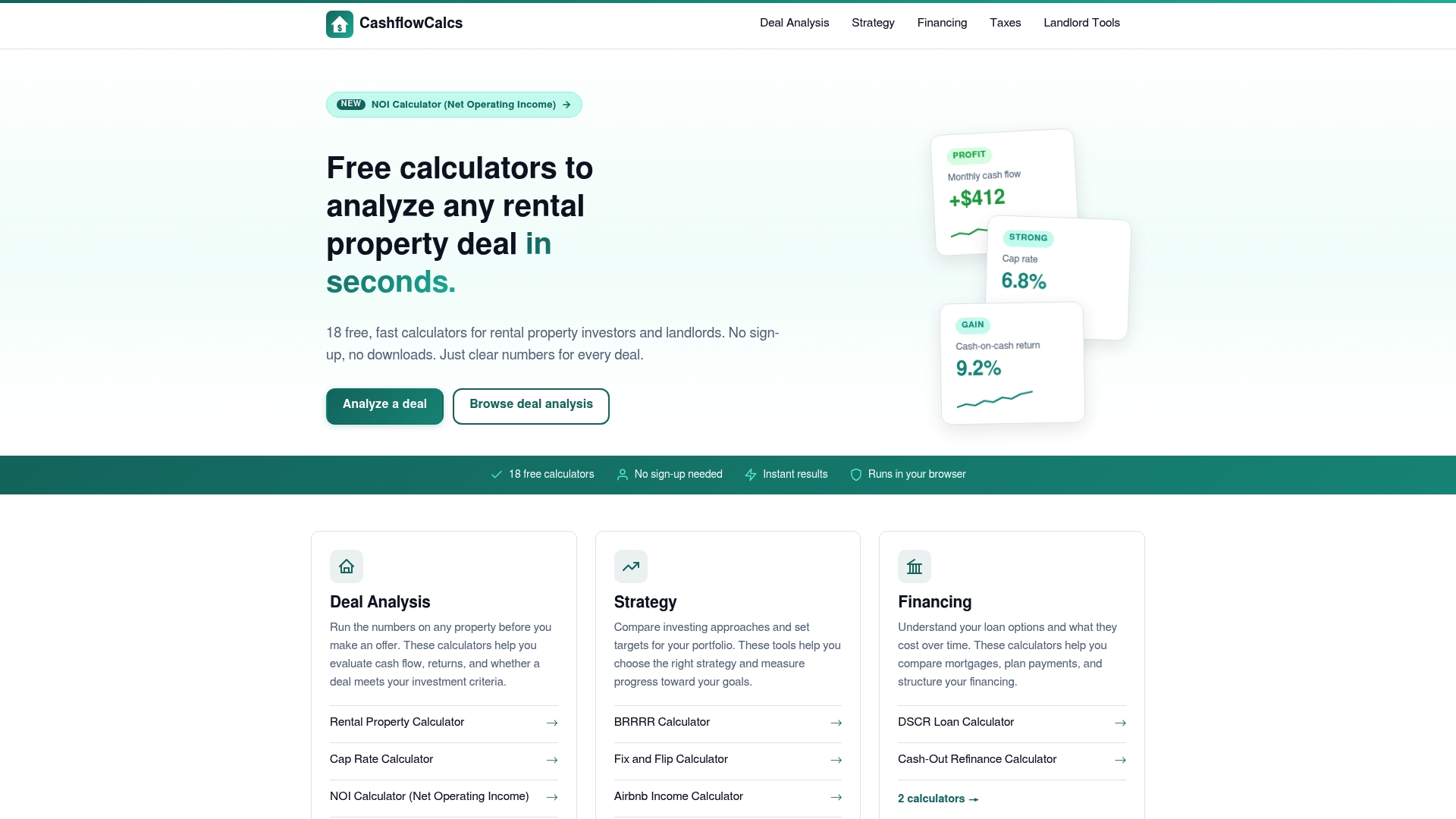
Every calculator in the Cashflowcalcs suite is free, requires no account, and runs entirely in your browser, your numbers never leave your device. Each one shows the formula and a worked example so you can verify the math rather than accepting a black-box result. For rental property tax planning specifically, four tools stand out.
The Rental Property Depreciation Calculator computes your annual MACRS deduction, cumulative depreciation, and remaining basis in seconds. Enter your purchase price, land value, placed-in-service date, and closing costs, and it handles the mid-month convention math for you. The Depreciation Recapture Calculator takes those cumulative figures and estimates your Section 1250 recapture tax at sale. For exchange planning, the 1031 Exchange Calculator models the deferral benefit and equity requirements side by side. And if you are comparing two properties or a hold-versus-sell decision, the Rental Property Comparison Calculator puts both scenarios on one screen.
These tools produce educational estimates, not tax advice. For your specific situation, consult a licensed CPA or tax professional who specializes in real estate.
Sources
The following primary and authoritative sources underpin the guidance in this article. Verify current rules directly with the IRS before filing.
- Topic No. 414, Rental income and expenses | Internal Revenue Service
- OBBBA 2025, Depreciation Provisions
- Bonus Depreciation for Rental Property: Rules, Examples & Eligibility 2026 | Baselane
FAQ
How is rental property income taxed in the US?
You report it on Schedule E (Form 1040), netting income against deductible expenses and depreciation before the result flows into your individual return.
What expenses can landlords deduct on a rental property?
Landlords can deduct mortgage interest, property taxes, insurance, repairs, management fees, advertising, utilities, and depreciation. Capital improvements must be capitalized and depreciated rather than deducted in the year paid.
What is the $25,000 rental loss allowance?
Landlords who actively participate in managing their rental and have a modified adjusted gross income of $100,000 or less can deduct up to $25,000 of rental losses against non-passive income. The allowance phases out completely at $150,000 MAGI.
What happens to taxes when you sell a rental property?
A Section 1031 exchange can defer both if you reinvest in a like-kind property within the required timelines.
What is the 14-day rule for vacation rentals?
If you rent a property for 14 days or fewer during the year and use it personally, you report no rental income and claim no rental deductions.
This article provides general educational information about US rental property taxation and is not a substitute for professional tax advice. Tax rules change frequently. Consult a licensed CPA or tax professional for guidance specific to your situation, and verify current rules at IRS.gov before filing.