Taxes
De Minimis Safe Harbor: A Practical Guide for Landlords

The de minimis safe harbor lets eligible taxpayers immediately expense low-cost tangible property purchases instead of capitalizing and depreciating them over years. Under Treasury Regulation §1.263(a)-1(f), the thresholds are set separately for taxpayers with an Applicable Financial Statement (AFS) and those without one, with the amount for non-AFS taxpayers having been increased effective for tax years beginning on or after January 1, 2016. The election is annual, affirmative, and requires a titled statement attached to your original timely filed federal return for the year the amounts are paid.
Key facts at a glance:
- The threshold for taxpayers with an AFS applies per invoice or item as substantiated by the invoice, with a certain dollar limit.
- A lower threshold applies to most small businesses, sole proprietors, and individual landlords without an AFS, also applied per invoice or item.
- The election must be made on the original return (including extensions); an amended return generally cannot cure a missing statement.
- These thresholds and election requirements are established under Treasury Regulation §1.263(a)-1(f) and were updated by Notice 2015-82.
If you own rental property and regularly buy appliances, fixtures, or supplies of relatively low cost, this Bank Statement Loans in Real County, TX | Self-Employed election can simplify your tax return and help you expense those costs more quickly than depreciating them over time.
Table of Contents
- What the de minimis safe harbor covers and why it exists
- Current thresholds and who qualifies for each tier
- What counts as an invoice or item under the threshold rules
- How to make the de minimis safe harbor election correctly
- How the safe harbor interacts with capitalization rules, Section 179, and bonus depreciation
- What records to keep to support amounts expensed under the election
- Worked examples: rental investor and small business
- Common errors, audit red flags, and how to avoid them
- Key Takeaways
- Run your rental numbers with Cashflowcalcs
- Authoritative sources and further reading
- FAQ
What the de minimis safe harbor covers and why it exists
The tangible property regulations, finalized by the Treasury Department and the IRS in September 2013 and effective for tax years beginning on or after January 1, 2014, created a comprehensive framework for deciding when a cost must be capitalized under §263(a) versus deducted as a repair or ordinary business expense under §162. Before those regulations, taxpayers and their advisors had to navigate decades of case law and revenue rulings to make that call on every purchase.

The safe harbor lives in §1.263(a)-1(f) and works alongside, not instead of, the broader capitalization rules. It does not affect inventory (costs subject to §263A still require capitalization regardless of dollar amount), land, or certain rotable and temporary spare parts. Those categories stay under their own rules even if the per-item cost is well below the threshold.
Two other safe harbors in the same regulatory package are worth knowing. The routine maintenance safe harbor covers recurring activities that keep property in its ordinarily efficient operating condition, such as scheduled HVAC servicing or periodic roof inspections. Unlike the de minimis election, the routine maintenance safe harbor is not capped by a dollar threshold, but it does require a one-time accounting method change on Form 3115 to adopt it. The small taxpayer safe harbor (§1.263(a)-3(h)) lets qualifying small businesses with average annual gross receipts of $10 million or less expense certain building improvements up to the lesser of $10,000 or 2% of the building’s unadjusted basis per year. Knowing which safe harbor fits a given expense saves you from misapplying any one of them.
Current thresholds and who qualifies for each tier
The two-tier structure of the safe harbor reflects a straightforward principle: taxpayers whose financial statements are independently reviewed or audited have demonstrated that their capitalization policies are consistent and do not materially distort income, so the IRS allows them a higher ceiling.
| Taxpayer Type | Application Rule | Policy Requirement |
|---|---|---|
| With AFS | Per invoice or per item as substantiated by invoice and subject to a $5,000 threshold | Written accounting procedures recommended on the first day of the tax year |
| Without AFS | Per invoice or per item as substantiated by invoice and subject to a $2,500 threshold | Written policy recommended; unwritten practice acceptable but should be documented |

What counts as an AFS?
An Applicable Financial Statement is a financial statement that carries a level of independent assurance. Concrete examples include:
- A financial statement filed with the SEC (Form 10-K, for example)
- A financial statement audited by an independent CPA and accompanied by an audit opinion
- A financial statement required to be provided to a federal or state government agency (other than the SEC or IRS)
What does not qualify as an AFS: QuickBooks reports, internally prepared profit-and-loss statements, bank statements, tax returns, or reviewed (as opposed to audited) financial statements. Most individual landlords and small LLCs fall into the non-AFS tier and work with the $2,500 ceiling.
Accounting policy timing
For AFS taxpayers, the written accounting procedures must be in place as of the first day of the tax year. Tax practitioners recommend dating the policy document before January 1 of the year in which you intend to claim the election. Non-AFS taxpayers are not required to have a written policy, but documenting one before year-start is strong audit protection. A one-page capitalization policy that states your expensing threshold and is signed and dated before the tax year begins costs almost nothing to prepare and can save significant headaches if the IRS ever asks.
Pro Tip: If you manage multiple rental properties through separate LLCs, each entity needs its own capitalization policy document dated before January 1. A single policy at the parent level does not automatically cover subsidiaries or disregarded entities for audit purposes.
What counts as an invoice or item under the threshold rules
The safe harbor applies on a per-invoice or per-item basis, and that distinction matters more than most taxpayers realize.
- Per-invoice rule: If a vendor issues a single invoice for multiple items and the total is under your threshold, the entire invoice qualifies, provided no single item on the invoice exceeds the threshold when the invoice itemizes costs.
- Per-item rule: When an invoice itemizes individual items with separate prices, each item is tested against the threshold independently. A $4,000 invoice listing a $1,800 refrigerator and a $2,200 range would qualify both items under the $2,500 non-AFS threshold.
- Materials and supplies: Incidental materials and supplies (items costing $200 or less, or items with an economic useful life of 12 months or less) are deductible without the election. Non-incidental materials and supplies follow a different timing rule. The de minimis election can still apply to materials and supplies that exceed those amounts but fall under your threshold.
Unit-of-property issues
The IRS looks at economic substance, not just how a vendor formats a bill. If you purchase components that together form a single unit of property, the IRS may treat the total cost as one amount even if the vendor splits it across multiple invoices. A landlord who buys a central HVAC system in three separate purchase orders to stay under the threshold is engaging in exactly the kind of invoice-splitting the regulations warn against.
Pro Tip: Keep the original vendor invoice for every purchase you expense under this election. If the IRS questions a deduction, the invoice is your primary substantiation. A credit card statement alone is not sufficient because it does not show what was purchased or how items were priced.
The IRS guidance on unit-of-property is clear that the regulation looks to economic reality. Splitting one purchase across multiple invoices to manufacture qualification is an audit red flag, not a planning strategy.
How to make the de minimis safe harbor election correctly
The election is straightforward, but the procedural requirements are strict. Missing any one of them can disqualify the entire election for the year.
Step-by-step election checklist
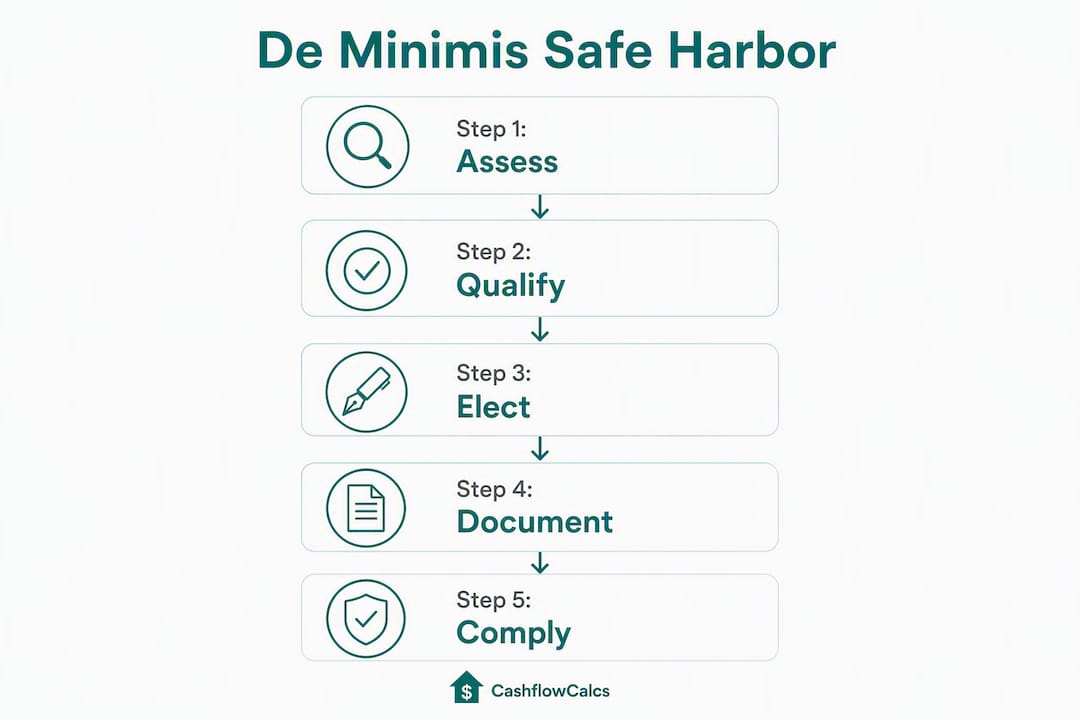
- Confirm your threshold tier. Determine whether you have an AFS as of the first day of the tax year. If yes, your ceiling is $5,000; if no, it is $2,500.
- Verify your accounting policy is in place. AFS taxpayers need a written policy dated before January 1. Non-AFS taxpayers should have one too, even if not strictly required.
- Identify qualifying amounts paid during the year. Review all tangible property purchases and confirm each falls at or below your threshold per invoice or per item.
- Prepare the election statement. The statement must be titled exactly: “Section 1.263(a)-1(f) de minimis safe harbor election.” It must include your name, address, and taxpayer identification number (TIN), plus a statement that you are making the election for the tax year.
- Attach the statement to your original return. For individuals, this is Form 1040 with Schedule E (rental income) or Schedule C (business income). For partnerships or S corporations, it attaches to Form 1065 or Form 1120-S. The return must be filed by the due date including extensions.
- Expense the qualifying amounts on the return. Report them as ordinary business expenses on the appropriate schedule, not as capitalized assets.
Software and filing notes
Most tax software can generate the election statement automatically when you indicate you are making the election. Before you file, confirm the statement is actually attached to the return, not just saved in a draft. For e-filed returns, the statement is transmitted as a PDF attachment or as a structured data element depending on the software. Paper filers attach it as a separate page behind the return.
Making or not making the election is not a change in accounting method, so you do not need to file Form 3115 to start or stop using it. You simply elect or do not elect each year.
Pro Tip: If you use tax software, search for “de minimis” or “safe harbor” in the program’s help section before filing. TaxSlayer, for example, walks Schedule C filers through the election in the deductions section. Verify the generated statement includes all four required elements: title, name, address, and TIN.
How the safe harbor interacts with capitalization rules, Section 179, and bonus depreciation
Choosing between the de minimis election, Section 179, and bonus depreciation is not always obvious, and the right answer depends on the item’s cost, your tax situation, and whether recapture risk matters.
Comparing the three approaches
- De minimis safe harbor: Treats qualifying costs as ordinary business expenses. No depreciation schedule, no recapture. Works for items at or below $2,500 (non-AFS) or $5,000 (AFS). Annual election, no Form 3115 required.
- Section 179: Allows immediate expensing of qualifying property above the de minimis threshold, up to the annual Section 179 limit (subject to income limitations and phase-outs). Recapture applies if business use drops below 50% before the end of the recovery period.
- Bonus depreciation: Under the One Big Beautiful Bill Act, 100% bonus depreciation is now permanent for qualifying property acquired after January 19, 2025. Like Section 179, it creates a depreciation deduction that is subject to recapture rules if the property’s business use later drops.
A key advantage of the de minimis election that practitioners at LegalClarity highlight: because qualifying costs are treated as ordinary expenses rather than depreciated assets, there is no depreciation recapture when you sell the property or convert it to personal use. For a rental investor who buys a $2,000 appliance, expensing it under the safe harbor means no recapture calculation at sale. Capitalizing that same appliance and taking bonus depreciation means tracking it and potentially recapturing the deduction at ordinary income rates.
The routine maintenance safe harbor, by contrast, covers recurring activities regardless of dollar amount but requires a one-time Form 3115 to adopt. If you have a recurring expense that exceeds your de minimis threshold, the routine maintenance safe harbor may be the better fit, provided the activity meets the “recurring” and “expected to perform” tests under §1.263(a)-3(i).
For rental investors modeling the tax impact of expensing versus depreciating, running both scenarios through a calculator before filing can clarify which approach produces the better after-tax outcome for a given year.
What records to keep to support amounts expensed under the election
Good recordkeeping is what separates a clean audit from a stressful one. The IRS does not require a specific format, but it does require that you can substantiate every amount you expense under the election.
Core records to maintain
- Itemized vendor invoices showing the description, quantity, and unit price of each item purchased
- Proof of payment (canceled check, bank statement, credit card statement) cross-referenced to the invoice
- Vendor descriptions that confirm the item is tangible property, not a service or inventory item
- Allocation documentation when multiple items appear on one invoice and some qualify while others do not
- Written capitalization policy dated before January 1 of the tax year, signed by an authorized person
- The election statement as filed, retained with a copy of the return
Retention and organization
The IRS generally has three years from the filing date to audit a return, but that window extends to six years if income is understated by more than 25%. Keeping records for at least seven years is a practical standard for most taxpayers. Organize by tax year in a folder structure that mirrors your return: one subfolder per property or business unit, with invoices sorted by date.
Book-to-tax consistency matters here. If you expense an item on your financial statements, you must expense it on your tax return under the election. Capitalizing an item on your books while expensing it on your taxes (or vice versa) creates a book-to-tax difference that can draw scrutiny and undercuts the purpose of the safe harbor, which is to align financial accounting with tax treatment for small purchases.
Pro Tip: Set up a dedicated expense category in your accounting software (QuickBooks, Wave, or similar) labeled “De Minimis Safe Harbor Expenses” and code qualifying purchases there throughout the year. At year-end, the total in that category should match the amounts you report on the election. This makes the election statement easy to prepare and gives you a clean audit trail.
Worked examples: rental investor and small business
The following two examples show how the safe harbor applies in practice. All figures are computed and reconcile arithmetically.
Example A: Rental property investor (non-AFS, $2,500 threshold)
A landlord owns a single-family rental and receives one invoice from a home improvement store for four items purchased in the same trip.
| Item | Cost | Threshold Test ($2,500) | Tax Treatment |
|---|---|---|---|
| Bathroom vanity | , | , < $2,500, passes | Expensed under de minimis |
| Ceiling fan (bedroom) | , | , < $2,500, passes | Expensed under de minimis |
| Exterior door lock set | , | , < $2,500, passes | Expensed under de minimis |
| Replacement water heater | , | , < $2,500, passes | Expensed under de minimis |
| Total invoice | $4,655 | N/A, tested per item | All four items expensed |
Because the invoice itemizes each item with a separate price, the per-item rule applies. All four items fall below $2,500 individually, so all four qualify. The landlord expenses $4,655 in the current year rather than depreciating it over 5 or 27.5 years. No depreciation recapture applies at sale.
Example B: Small business owner (non-AFS, $2,500 threshold)
A sole proprietor without an AFS purchases two pieces of equipment in the same tax year.
| Item | Cost | Threshold Test ($2,500) | Tax Treatment Options |
|---|---|---|---|
| Label printer | , | , < $2,500, passes | Expense under de minimis (preferred) |
| Industrial shelving unit | , | , > $2,500, fails | Capitalize; consider Section 179 or bonus depreciation |
The label printer qualifies and is expensed immediately. The shelving unit exceeds the threshold, so it does not qualify for the safe harbor. It is not automatically capitalized, but under standard §263(a) analysis it likely must be. The owner can then elect Section 179 or bonus depreciation to recover the cost in year one, accepting the recapture risk that comes with those elections.
For rental investors who want to model how expensing versus capitalizing affects their overall return, the rental property depreciation calculator at Cashflowcalcs shows the depreciation schedule for a capitalized asset alongside the immediate deduction from expensing, so you can compare the two paths with example figures. These calculators are educational tools, not tax advice; confirm your specific treatment with a qualified tax professional.
Common errors, audit red flags, and how to avoid them
Most de minimis safe harbor problems are procedural, not substantive. The rules are clear; the mistakes happen in execution.
- Forgetting to attach the election statement. This is the most common error and the most costly. The election is not automatic, and an omitted statement generally cannot be fixed by amending the return. Review your filed return before the due date to confirm the statement is there.
- Inconsistent book-tax treatment. Expensing an item on your tax return while capitalizing it on your financial statements (or the reverse) creates a mismatch the IRS can identify. The safe harbor is designed to align book and tax treatment; use it consistently.
- Artificial invoice splitting. Asking a vendor to issue two invoices for what is economically one purchase to get under the threshold is a well-known audit trigger. The IRS evaluates the unit of property and the economic substance of the transaction, not just the paper form of the invoice.
- Misclassifying inventory or land. The safe harbor does not apply to inventory subject to §263A or to land. Expensing these items under the election is an error that can result in adjustments plus interest and penalties.
- Applying the election inconsistently across years. The election must be applied consistently to all qualifying items in the tax year. Cherry-picking only the most favorable items in some years and not others is not permitted under the regulations.
- Missing the accounting policy deadline. AFS taxpayers who do not have a written policy in place on January 1 cannot retroactively create one for that year. Non-AFS taxpayers who want audit protection should date their policy before the year begins.
- Relying on a credit card statement as the invoice. A credit card statement shows the amount and the vendor but not the item description or unit price. The IRS expects an itemized invoice. Keep the original receipt or vendor invoice, not just the payment record.
If an examiner raises the de minimis election during an audit, the first step is to produce the filed election statement and the supporting invoices. If the statement was not filed, consult a CPA or tax attorney before responding to the IRS, because the options for correcting the omission are limited and depend on the specific facts.
Key Takeaways
The de minimis safe harbor is one of the most practical tax elections available to landlords and small business owners: it turns small-dollar tangible property purchases into immediate deductions with no depreciation schedule and no recapture risk.
| Point | Details |
|---|---|
| Know your threshold | $5,000 per invoice or item with an AFS; $2,500 per invoice or item without one, per Notice 2015-82. |
| Attach the statement | File the titled election statement with your original return; an amended return generally cannot fix a missing statement. |
| Document your policy | Date a written capitalization policy before January 1 of the tax year, even if you are a non-AFS taxpayer. |
| Weigh your options | For items above the threshold, compare Section 179 and bonus depreciation, keeping recapture risk in mind. |
| Use Cashflowcalcs | Model the tax impact of expensing versus depreciating rental property costs with the free depreciation and tax calculators at Cashflowcalcs. |
Run your rental numbers with Cashflowcalcs
Knowing the de minimis threshold is one thing; seeing how it changes your actual cash flow is another. The free rental property calculator at Cashflowcalcs lets you plug in your income, expenses, and financing details to see net cash flow in real time, and the taxes calculators let you compare the year-one tax impact of expensing a $2,200 appliance under the safe harbor versus depreciating it over 5 years.
Every calculator runs entirely in your browser with no sign-up required, and each one shows its formula and a worked example so you can verify the math yourself. For rental investors who want to understand how small-dollar expense decisions ripple through their returns, these tools make the comparison concrete and fast. The results are educational estimates; confirm your specific tax treatment with a qualified CPA or tax advisor before filing.
Visit Cashflowcalcs to access the full suite of free rental property and tax calculators.
This article is general information, not tax or legal advice. Tax rules can change, and your specific facts may affect how these rules apply to you. Consult a qualified tax professional for guidance on your situation.
Authoritative sources and further reading
The following primary and practitioner sources support the guidance in this article:
- IRS Tangible Property Final Regulations (IRS.gov), Primary authority for the de minimis safe harbor under §1.263(a)-1(f). The definitive source for threshold rules, exclusions, and election requirements.
- Notice 2015-82 (IRS Internal Revenue Bulletin 2015-50), Primary authority for the increase in the non-AFS threshold from $500 to $2,500, effective for tax years beginning on or after January 1, 2016. Includes audit-protection language for prior years.
- The Tax Adviser: “The De Minimis and Routine Maintenance Safe Harbors” (AICPA, 2024), Practitioner commentary from a CPA-authored explainer covering policy requirements, routine maintenance comparisons, and compliance best practices.
- LegalClarity: De Minimis Safe Harbor 1.263(a)-1(f): Rules and Election, Practitioner analysis of the election mechanics, recapture comparison with Section 179, and the consequences of a missing election statement.
- TaxSlayer Support: How to Claim the De Minimis Safe Harbor Election for Schedule C, Practical software guidance for individual filers using TaxSlayer to generate and attach the election statement.
- Drake Tax Knowledge Base: Tangible Property Regulations Safe Harbor Elections, Practitioner-focused reference on unit-of-property rules and invoice-splitting audit risks.
FAQ
What is the de minimis safe harbor under $2,500?
The de minimis safe harbor lets taxpayers without an Applicable Financial Statement immediately expense tangible property purchases up to $2,500 per invoice or per item, rather than capitalizing and depreciating them. This threshold was increased effective for tax years beginning on or after January 1, 2016, as detailed in Notice 2015-82.
Is the $800 de minimis still in effect?
The current non-AFS threshold is $2,500 per invoice or item, raised from the original $500 by Notice 2015-82. You may be thinking of the U.S. Customs de minimis value for imported goods, which is a separate rule with no connection to the IRS tangible property regulations.
What is the safe harbor rule for 2026?
The thresholds are $5,000 per invoice or item for taxpayers with an AFS and $2,500 per invoice or item for those without one. The election remains annual, and the statement must be attached to the original timely filed federal return for the year the amounts are paid.
Can I use the de minimis safe harbor on my rental property Schedule E?
Yes. Rental property owners report income and expenses on Schedule E, and the de minimis election applies to tangible property purchases made in connection with the rental activity. Attach the election statement to your Form 1040 and expense qualifying items directly on Schedule E rather than depreciating them.
What happens if I forget to attach the election statement?
Forgetting the statement generally disqualifies the election for that tax year, and an amended return usually cannot fix the omission. If you discover the error before the original due date (including extensions), you can file a superseding return with the statement attached. After that window closes, consult a tax professional about your options.