Financing
Prepayment Penalty Mortgage: What U.S. Borrowers Need to Know

A mortgage prepayment penalty is a fee some lenders charge when you pay off your loan early through a sale, refinance, or lump-sum payoff, usually within the first one to three years. The Consumer Financial Protection Bureau regulates how these fees work, the Truth in Lending Act (TILA) and Regulation Z cap them on most conventional loans, and the Dodd-Frank Act limits how long and how large they can be.
Before you assume you have one, or panic that you do, take three steps:
- Check your Note, any Addendum to the Note, and your Closing Disclosure. Penalty terms are sometimes buried in a separate addendum rather than the main Note.
- Get a written payoff quote from your servicer. It should itemize any penalty and show the calculation, not just a lump total.
- Compare a no-penalty alternative. If you’re still shopping, ask your lender to quote the same rate structure without a prepayment clause.
Key Takeaways
A mortgage prepayment penalty is legal on many conventional and non-QM loans within a capped window, but it’s banned on FHA, VA, and USDA loans and limited by both federal and state rules.
| Point | Details |
|---|---|
| Check your documents first | Review the Note, any Addendum, and the Closing Disclosure before assuming a penalty applies. |
| Know the federal caps | Dodd-Frank rules generally limit penalties to 2% of the balance in years one and two, 1% in year three. |
| Government loans are exempt | FHA, VA, and USDA loans cannot carry a prepayment penalty under federal law. |
| State law can be stricter | Roughly eleven states ban prepayment penalties on residential first mortgages outright. |
| Model the cost before you act | Run your payoff scenario through a calculator to see net proceeds before you sell or refinance. |
Table of Contents
- What Is a Prepayment Penalty Mortgage Clause and When Does It Apply?
- How Do Lenders Calculate a Mortgage Payoff Penalty?
- Which Loans Can Legally Include a Prepayment Penalty?
- Do State Laws Limit or Ban Prepayment Penalties?
- How Can You Avoid or Negotiate a Prepayment Penalty?
- What Should You Do If You’re Charged a Prepayment Penalty?
- What Does a Prepayment Penalty Actually Cost? A Worked Example
- Should You Shop Around Before Accepting a Loan With a Penalty?
- Where to Read the Law or File a Complaint
- Sources
- FAQ
What Is a Prepayment Penalty Mortgage Clause and When Does It Apply?
A prepayment penalty clause is contract language that lets your lender charge you for paying off the loan faster than scheduled. It typically activates on three events: selling the home, refinancing with a different lender, or paying off the full balance in one lump sum. Some contracts also count large one-time principal reductions above a certain threshold of the original balance in a single year as a triggering event even if you keep the loan open.
Lenders split these clauses into two categories, and the difference matters a lot if you’re planning to sell versus refinance.
- Hard prepayment penalty: Applies no matter how you pay off the loan, whether you sell the house or refinance it.
- Soft prepayment penalty: Applies only if you refinance, so selling the property usually doesn’t trigger the fee.
According to Bankrate, this hard versus soft distinction shapes how much flexibility a borrower actually has, since a soft penalty leaves selling on the table as a penalty-free exit.
Some loans carry prepayment penalties only during the first few years, and the fee is designed to recover the interest income the lender expected to earn over that window. Small, routine extra principal payments usually don’t trigger it. Large one-time payoffs, sales, or refinances often do.
You’ll find this language in three places: the promissory Note, an Addendum to the Note if one exists, and the Closing Disclosure you received before you signed. If a document with “Addendum” in the title showed up in your closing packet, read it closely.
How Do Lenders Calculate a Mortgage Payoff Penalty?
Lenders use one of three common formulas, and knowing which one applies to your loan changes the math significantly.
- Percentage of outstanding balance. A flat rate, often 2%, applied to whatever principal remains when you pay off. On a $280,000 balance, a 2% penalty comes to $5,600.
- Months of interest. The lender charges a set number of months’ worth of interest, commonly six. At a 6.5% rate on a $280,000 balance, monthly interest runs about $1,517, so six months comes to roughly $9,100.
- Step-down or sliding scale. The percentage shrinks each year you hold the loan. A common structure is 2% in year one, 2% in year two, and 1% in year three, then nothing after that.
On that same $280,000 balance, a step-down schedule would cost $5,600 if you pay off in year one or two, and $2,800 if you wait until year three.
Which method applies depends entirely on your Note, and lenders aren’t required to use the same formula across products. A soft penalty on an investor loan might use months-of-interest, while a conventional loan with a hard penalty might use the step-down structure.
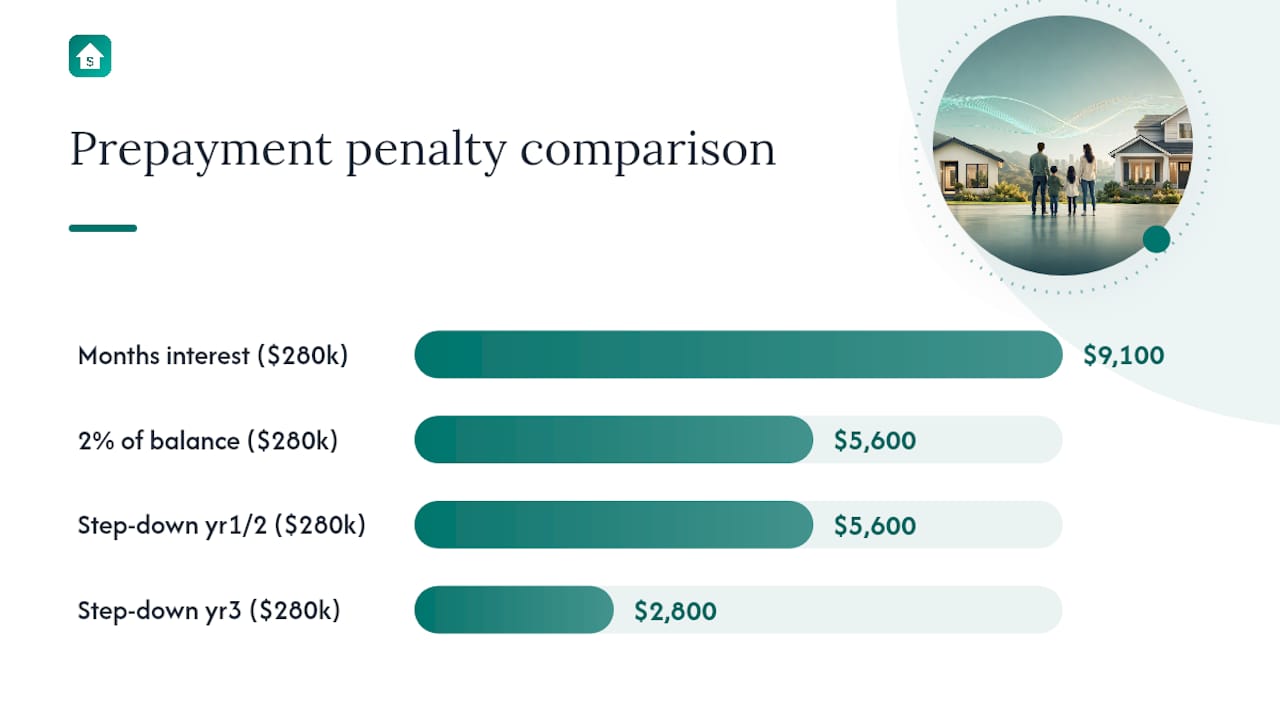
Federal limits set a ceiling on the percentage-of-balance approach: for many conventional loans, Dodd-Frank rules generally cap penalties at 2% of the outstanding balance in the first two years and 1% in the third year, with nothing allowed after that.
Pro Tip: Always request a written, itemized payoff quote before you close on a sale or refinance. It should show the exact penalty formula applied, not just a final number, so you can verify the lender did the math correctly against your Note.
Which Loans Can Legally Include a Prepayment Penalty?
Government-backed loans, meaning FHA, VA, and USDA mortgages, cannot carry a prepayment penalty under federal rules. If you have one of those loan types, this entire issue doesn’t apply to you.
Prepayment penalties survive mainly on certain conventional loans and non-qualified mortgage (non-QM) products. Bankrate confirms these penalties are prohibited on FHA, VA, and USDA loans and permitted mainly on specific conventional and non-QM products.
For loans where a penalty is legally allowed, TILA and Regulation Z, implementing the Dodd-Frank Act’s Ability-to-Repay and Qualified Mortgage rules, set firm limits:
- Penalties can only apply during the first three years of the loan.
- The maximum is 2% of the outstanding balance in years one and two, dropping to 1% in year three.
- Lenders offering a loan with a prepayment penalty must also offer the borrower an alternative loan structure without one, so you always have a comparison point.
Section 1639 of Title 15 of the U.S. Code backs these limits with statutory language restricting prepayment penalties and treating certain unfavorable refund calculations as penalties in their own right.
Qualified mortgages, the standard loans most homebuyers get, follow these caps closely. Non-QM loans, portfolio loans, and investor products often sit outside that framework. Nolo notes that prepayment penalties are rare on standard consumer mortgages but more common, and often steeper, on investor and portfolio loan products, since these loans don’t always qualify for the same consumer protections. If you’re financing a rental property with a DSCR loan or another investor-focused product, expect a longer look at the penalty terms than you’d get on an owner-occupied purchase.
Do State Laws Limit or Ban Prepayment Penalties?
Federal law sets the ceiling, but state law can lower it further, and it varies a lot depending on where you live. Some states have decided that consumer mortgages simply shouldn’t carry these fees at all, regardless of what federal caps allow.
A Connecticut legislative research report found that eleven states generally prohibit prepayment penalties on residential first mortgages, though the specific rules and exceptions differ by jurisdiction. Some states ban penalties outright on owner-occupied homes but allow them on investment properties. Others cap the penalty period shorter than the federal three-year window.
- Check your specific state’s statute before assuming a federal cap is the final word.
- State bans often apply only to certain loan types (owner-occupied, first-lien, residential), so investor and commercial loans may fall outside the protection.
- When state and federal rules conflict, the more borrower-protective rule usually controls.
This isn’t legal advice, and state statutes change. See the sources section below for where to look up your specific state’s rule.
How Can You Avoid or Negotiate a Prepayment Penalty?
The best time to deal with a prepayment penalty is before you sign anything. Ask your loan officer directly: Does this loan include a prepayment penalty? Where exactly is it disclosed? What formula does it use? Is there a version of this loan without the penalty?
That last question matters most. Federal rules require lenders offering a penalty-bearing loan to also offer a no-penalty alternative, so you have leverage to ask for a side-by-side quote.
- Ask upfront whether a no-penalty version of the same loan is available.
- If a penalty is already in your Note, ask the lender or servicer if they’ll waive it, especially if you’re refinancing with them.
- Consider accepting a slightly higher interest rate in exchange for removing the penalty clause entirely.
- Get any waiver or removal agreement in writing before you close.
If you already have a loan with a penalty, timing can save you real money. Waiting until the penalty period expires (commonly three years) before selling or refinancing avoids the fee altogether. And routine, moderate extra principal payments usually fall under a common exclusion, often up to 20% of the balance per year, so paying down debt faster doesn’t necessarily trigger anything. Check your Note for the exact threshold.
What Should You Do If You’re Charged a Prepayment Penalty?
If a payoff quote or closing statement shows a prepayment fee you didn’t expect, work through these steps in order:
- Request an itemized payoff quote that shows the exact calculation, not just a total.
- Pull your Note, any Addendum, and your Closing Disclosure and compare the fee against what those documents actually say.
- Ask your servicer in writing for an explanation of the formula used and the dates the penalty period covers.
- Request a waiver, particularly if the fee seems miscalculated or the penalty period has technically expired.
- Escalate to the loan owner or investor if your servicer can’t resolve the discrepancy.
If the dispute involves a real dollar amount and the servicer won’t budge, you have formal options.
- File a complaint with the CFPB if you believe the penalty violates disclosure rules or federal caps.
- Contact your state’s mortgage regulator if state law may have been violated.
- Consider legal counsel or mediation for large disputed fees that resist resolution.
One timing detail worth knowing: Regulation Z requires a new three-business-day waiting period whenever a prepayment penalty is added or the loan’s APR or product changes late in the process. If a penalty appeared on your Closing Disclosure that wasn’t on your original Loan Estimate, that waiting period should have applied, and its absence is worth raising with the CFPB.
What Does a Prepayment Penalty Actually Cost? A Worked Example
Say you hold a $320,000 mortgage balance with a step-down prepayment penalty: 2% in year one, 2% in year two, 1% in year three, and nothing after that. You get an offer to sell the property in year two.

At $6,400, that penalty comes straight out of your sale proceeds. If your home sells for $410,000 with $12,000 in typical closing costs and the $320,000 payoff, your net proceeds before the penalty would be $78,000. Subtract the $6,400 fee and you’re left with $71,600.
That’s real money, and it’s exactly the kind of number you want to see before you accept an offer or lock in a refinance rate, not after. Running the numbers through the Rental Property Calculator lets you model net proceeds against different sale prices and penalty scenarios in your browser, with no sign-up and no data leaving your device. If you’re weighing a refinance instead of a sale, the Cash-Out Refinance Calculator shows how a penalty factors into your break-even math.
- Every calculator shows its formula, so you can check the math against your own Note rather than trusting a black box.
- These figures are educational estimates, not tax or legal advice. Confirm your actual penalty terms with your loan documents and servicer.
Should You Shop Around Before Accepting a Loan With a Penalty?
Yes, and it’s worth doing before you sign, not after. If you’re comparing loan offers for a rental purchase or refinance, the Rental Property Comparison Calculator lets you run two financing scenarios side by side, one with a prepayment penalty and one without, so you can see whether the lower rate on a penalty-bearing loan actually pays off given your expected hold time. For investor loans specifically, tools like the DSCR Loan Calculator help you model debt-service coverage alongside financing terms that are more likely to carry penalty clauses. If you’re shopping non-QM or private-lender products, resources like Texas Bank Statement Loans’ calculator tools can help you see how those lenders typically present payoff and penalty math. All of Cashflowcalcs’ tools run free, in your browser, with no sign-up required and every formula shown. These results are educational estimates, not financial, tax, or legal advice.
Where to Read the Law or File a Complaint
- CFPB: What is a prepayment penalty? covers the basic definition and common exclusions.
- CFPB: Can I be charged a penalty? explains where to find penalty terms in your paperwork, and is also where you file a complaint.
- CFPB Ability-to-Repay and Qualified Mortgage rule details disclosure requirements.
- Federal Register: Regulation Z final rule is the primary legal text on re-disclosure timing.
- 15 U.S.C. § 1639 is the statutory source for federal limitations.
- Connecticut legislative research report on state prepayment laws offers a state-by-state starting point.
- Bankrate: What Is A Mortgage Prepayment Penalty? explains common lender practices.
- Nolo: When are prepayment penalties allowed on new mortgages? covers non-QM and investor loan differences.
This article is general information, not a substitute for advice from a qualified financial advisor. Consult a qualified financial professional about your own circumstances before acting on anything here.
Sources
- Can I be charged a penalty for paying off my mortgage early? | Consumer Financial Protection Bureau
- What is a prepayment penalty? | Consumer Financial Protection Bureau
- What Is A Mortgage Prepayment Penalty? | Bankrate
- Federal Register: Ability-to-Repay and Qualified Mortgage Standards under TILA (Regulation Z) final rule (2026)
- 15 U.S.C. § 1639 - Limitations on terms of consumer mortgage transactions
FAQ
What happens if I pay an extra $200 a month on my 30-year mortgage?
Extra principal payments of that size rarely trigger a prepayment penalty, since most clauses exempt routine additional payments and only target large lump-sum payoffs, sales, or refinances. Check your Note for the exact annual threshold, often around 20% of the balance.
In which states are prepayment penalties illegal?
State rules vary, but a Connecticut legislative research report found roughly eleven states generally prohibit prepayment penalties on residential first mortgages. Confirm your specific state’s current statute, since exceptions for investor or non-owner-occupied loans are common.
How do I pay off a $300,000 mortgage in 5 years?
That requires significantly higher monthly payments than a standard mortgage schedule, and if your loan has a prepayment penalty, it typically expires after year three anyway. Review your Note for the penalty window before making large accelerated payments in years one through three.
Which types of mortgages do not have prepayment penalties?
FHA, VA, and USDA loans cannot include prepayment penalties under federal rules. Most standard qualified conventional mortgages also don’t carry one, though non-QM, portfolio, and investor loan products often do.