Financing
Best DSCR Lenders for Real Estate Investors in 2026

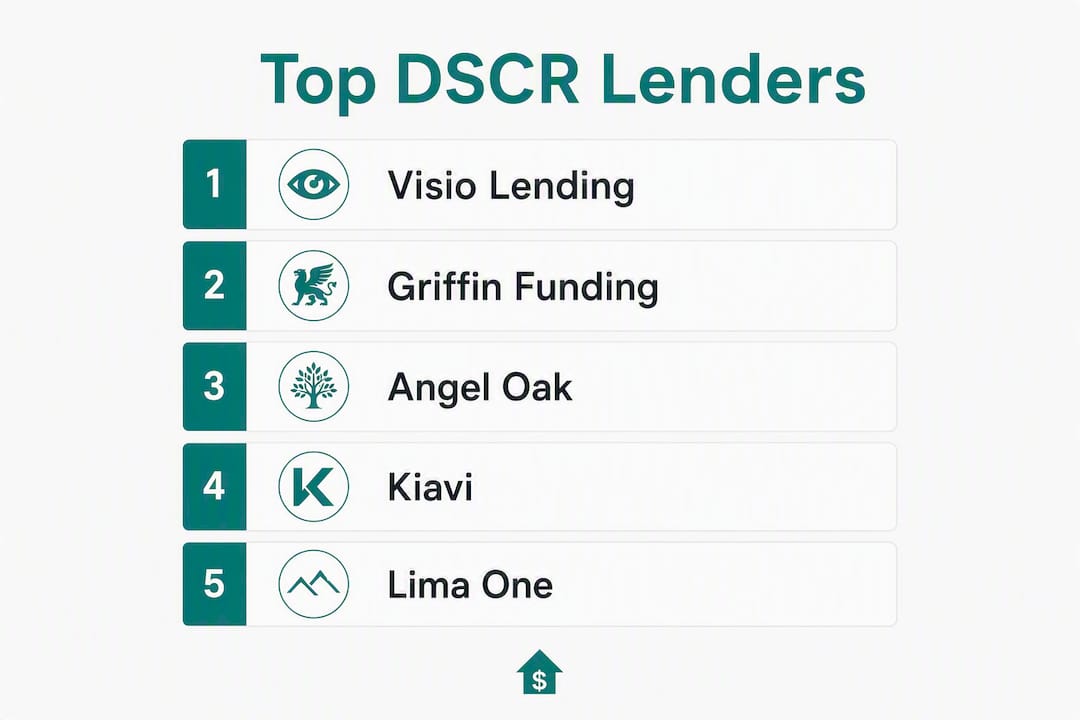
For most buy-and-hold investors, the strongest starting point among the best DSCR lenders is Visio Lending for pure rental-property focus, Griffin Funding for competitive pricing on best-tier single-family files, and Lima One Capital for BRRRR or rehab-to-rent strategies. The nine lenders below cover every common investor profile: long-hold SFR, short-term rental, BRRRR, jumbo, and fast-close. Shopping three to five lenders on the same deal can save a notable amount on rate, which adds up quickly on a 30-year hold. Before you call anyone, run your numbers through the Cashflowcalcs DSCR Loan Calculator to confirm your property clears the minimum ratio.
Quick TL;DR by investor type:
- Long-hold SFR, best pricing: Griffin Funding
- Institutional non-QM capacity or larger loan sizes: Angel Oak Mortgage Solutions
- Fastest digital workflow: Kiavi
- DSCR-specialty underwriting, buy-and-hold or STR: Visio Lending
- BRRRR and rehab-to-rent: Lima One Capital
- Fast close on smaller SFR deals: LendingOne
- Transparent program details, broad state coverage: theLender
- Quick term sheet, multiple product options: Asteris Lending
- Flexible underwriting in select states: Easy Street Capital
DSCR stands for Debt Service Coverage Ratio. Lenders qualify you on property cash flow rather than personal income, so no W-2s, tax returns, or DTI analysis are required. The formula is simple: Gross Monthly Rent / Monthly PITIA = DSCR. A ratio at or above 1.0 means the property covers its own debt service; most lenders want 1.20 or higher for standard programs.
Table of Contents
- How the best DSCR lenders compare: key specs at a glance
- Lender-by-lender profiles: strengths, limits, and who should call first
- How to choose the right DSCR lender for your deal
- What to expect on rates, fees, and closing timelines
- How DSCR is calculated: formula and a worked example
- Key Takeaways
- Run your DSCR numbers before you call a single lender
- FAQ
How the best DSCR lenders compare: key specs at a glance
The table below covers the dimensions that matter most when triaging lenders for a specific deal. Read headline rate ranges as indicative starting points for best-tier files; your actual quote depends on FICO score, LTV, property type, and where the 10-year U.S. Treasury yield sits at lock time. Rates can lag market moves by several weeks, so a rate you see today may not reflect what you lock next month. State availability is a hard disqualifier: verify licensing before spending money on an appraisal.
| Lender | Best for | Typical headline rate (2026) | Min DSCR | Max LTV | Min credit score | Loan types | Typical funding speed | State availability |
|---|---|---|---|---|---|---|---|---|
| Griffin Funding | Long-hold SFR, competitive pricing | 6.50-7.25% (best tier) | 1.20 | 70-75% | 680+ | Purchase, R/T refi, cash-out, 30-yr fixed, ARM | 25-35 days | Varies by program |
| Angel Oak Mortgage Solutions | Institutional non-QM, larger loans | 6.50-6.875% (best tier) | 1.20 | 70-75% | 660+ | Purchase, R/T refi, cash-out, 30-yr fixed, ARM | 25-35 days | Broad national |
| Kiavi | Fast digital workflow, SFR | Varies by program | 1.20 | 70-75% | 660+ | Purchase, R/T refi, cash-out, rental DSCR | 14-25 days | Select states |
| Visio Lending | Buy-and-hold, STR market rent | 5.95-6.75% | 1.20 | 70-75% | 680+ | Purchase, R/T refi, cash-out, vacation rental | 25-35 days | Broad national |
| Lima One Capital | BRRRR, rehab-to-rent, portfolio | 7.50-8.50% | 1.20 | 70-75% | 660+ | Purchase, R/T refi, cash-out, bridge, rental | 25-35 days | Broad national |
| LendingOne | Fast close, smaller SFR deals | 7.50-8.25% | 1.20 | 70-75% | 660+ | Purchase, R/T refi, cash-out, bridge, DSCR | 14-25 days | Select states |
| theLender | Transparent programs, broad coverage | Varies by program | 1.20 | 70-75% | 660+ | Purchase, R/T refi, cash-out, 30-yr fixed, ARM | 25-35 days | Broad national |
| Asteris Lending | Quick term sheet, multiple products | Varies by program | 1.20 | 70-75% | 660+ | Purchase, R/T refi, cash-out, DSCR programs | 14-25 days | Varies by program |
| Easy Street Capital | Flexible underwriting, select states | Varies by program | 1.20 | 70-75% | 640+ | Purchase, R/T refi, cash-out, DSCR | 25-35 days | Select states only |
Rate note: Best-tier 30-year fixed DSCR rates in mid-2026 start near 5.95-6.75%, mid-tier files run 6.50-7.50%, and lower-tier files reach 7.50-8.50% or higher. Wholesale panel pricing for the week of June 29, 2026 showed strongest-tier 30-year fixed around 6.50-6.875%, with weaker-tier files reaching 8.25-9.25%. Always request a fee sheet alongside the rate quote.
Lender-by-lender profiles: strengths, limits, and who should call first
Griffin Funding

Griffin Funding operates as a wholesale and non-QM lender with a strong track record on investor-focused DSCR programs. Its pricing tends to be competitive on best-tier files (higher credit scores, moderate LTV, SFR), and the team is experienced with investor workflows including LLC vesting and portfolio structures.
Best for: Long-hold SFR investors who have strong credit and want conventional DSCR pricing on 30-year fixed or ARM products.
Pros: Competitive rate on clean files; experienced investor workflow; broad product menu including cash-out DSCR. Cons: Pricing advantage narrows on moderate credit; state availability varies by program, so confirm early.
Who should call first: An investor with a 700+ FICO, 70-75% LTV, and a stabilized SFR generating at least 1.20 DSCR.
Angel Oak Mortgage Solutions
Angel Oak is one of the largest institutional non-QM originators in the country. Its credit box is broad, accommodating investors who fall outside conventional guidelines, and its product depth supports larger loan sizes that smaller lenders may not touch.
Best for: Investors who need institutional capacity, larger loan amounts, or a credit profile that sits outside the tightest non-QM tiers.
Pros: Deep institutional product menu; handles larger loans; broad credit acceptance. Cons: Pricing may not be the sharpest on vanilla best-tier files; turnaround can run 25-35 days on complex files.
Who should call first: An investor with a 5+ unit portfolio or a loan size above $1.5M who needs a lender with real institutional underwriting depth.
Kiavi
Kiavi built its platform around speed and digital-first workflows. The online submission process is clean, initial pricing comes back quickly, and the platform is designed for investors who want to move fast without chasing a loan officer for updates.
Best for: Investors who value a streamlined online application and faster initial decisioning on SFR rental loans.
Pros: Digital workflow reduces friction; fast initial pricing; investor-friendly interface. Cons: State availability is more limited than some national lenders; confirm your state before starting an application.
Who should call first: A tech-comfortable investor buying a stabilized SFR in a state where Kiavi is licensed who wants a quick initial quote without a phone call.
Visio Lending
Visio Lending is one of the few lenders that built its entire product line around DSCR and buy-and-hold rental investors. It handles both long-term and short-term rental profiles, and its underwriting team understands market rent assumptions in a way that generalist lenders often do not.
Best for: Buy-and-hold investors and STR operators where the underwriting allows market rent assumptions from a Form 1007 appraisal.
Pros: DSCR-specialty underwriting; STR program available; strong product focus on investor use cases. Cons: Not the right fit for investors who also need bridge or construction financing alongside their rental loan.
Who should call first: A landlord adding a third or fourth SFR to a portfolio, or an Airbnb operator who needs a lender that understands short-term rental income. Use the Cashflowcalcs Airbnb Income Calculator to model STR income before your call.
Lima One Capital
Lima One offers one of the broadest product menus among investor lenders, covering rental DSCR, bridge loans, and construction financing under one roof. That breadth makes it the natural fit for BRRRR operators who need a rehab loan and a rental refinance from the same lender.
Best for: BRRRR investors and portfolio builders who need rehab-to-rent or construction-adjacent financing alongside a permanent DSCR product.
Pros: Full product suite from bridge to rental; understands BRRRR workflow; portfolio loan options. Cons: Rates on rental DSCR may not be the sharpest compared to pure-play DSCR lenders; reserve requirements scale up on larger loans.
Who should call first: An investor running a BRRRR strategy who wants to refinance out of a bridge loan into a 30-year DSCR rental loan with the same lender. The Cashflowcalcs BRRRR Calculator can help you model the refinance numbers before you submit.
LendingOne
LendingOne focuses on operational speed for smaller SFR deals. Its underwriting is designed for turnkey investor files, and it targets quick closings as a core differentiator. That said, lenders advertising 14-day closings often close in about a month or longer on typical files, so ask for recent comparable-file timelines rather than relying on marketing claims.
Best for: Investors who need a fast close on a smaller SFR deal and have a clean, turnkey file ready to submit.
Pros: Operational focus on speed; clear investor product menu; bridge and DSCR under one roof. Cons: Speed claims should be verified with a written submission checklist and an assigned underwriter; state availability is not fully national.
Who should call first: An investor with a clean SFR file in a competitive market who needs a reliable 25-day close and has all documents ready at submission.
theLender
theLender publishes clear product matrices online, which makes it easier to pre-screen your deal before picking up the phone. Broad state coverage and transparent program pages reduce the guesswork that slows down the early stages of lender selection.
Best for: Investors who want to self-research program details and confirm state availability before engaging a loan officer.
Pros: Transparent program pages; broad state coverage; clear product matrices for investor files. Cons: Less name recognition than some larger platforms; confirm current pricing directly, as published matrices may lag live rates.
Who should call first: An investor who prefers to do their homework online before committing to a lender conversation, particularly if they are in a state where larger lenders have limited availability.
Asteris Lending
Asteris Lending positions itself in the wholesale and institutional channel, with a focus on quick term sheet delivery and investor-friendly overlays. It suits investors who work through brokers or who want multiple product options priced quickly.
Best for: Investors who want a fast initial term sheet and access to multiple product structures, particularly those working through a mortgage broker.
Pros: Fast term sheet delivery; developer and investor channel relationships; multiple product options. Cons: Less direct consumer-facing presence; best accessed through a broker relationship in many cases.
Who should call first: An investor working with a mortgage broker who wants competitive wholesale pricing and a quick initial indication before committing to a full application.
Easy Street Capital
Easy Street Capital markets flexible DSCR underwriting and a local touch in the states where it operates. Its credit minimum tends to be slightly more accessible than some competitors, which can matter for investors who are building their credit profile alongside their portfolio.
Best for: Investors in states where Easy Street is licensed who need flexible underwriting or have a credit profile that sits below the 660-680 threshold most lenders require.
Pros: Flexible underwriting; lower credit floor in some programs; local underwriting approach. Cons: State availability is limited; not a national option; confirm licensing for your property’s state before proceeding.
Who should call first: An investor with a 640-660 FICO in a state where Easy Street operates who needs a lender willing to look at the deal holistically rather than applying rigid overlays.
Pro Tip: Ask every lender on your shortlist how they calculate rent for the DSCR ratio: signed lease, appraised market rent (Form 1007), or the lower of the two. A mismatch between a high signed lease and a lower appraised market rent can push your DSCR below the minimum after you have already paid for the appraisal.
How to choose the right DSCR lender for your deal
The single most useful rule of thumb: prioritize lender fit for your property type and underwriting behavior over the lowest headline rate. A lender optimized for long-term SFR may not underwrite a short-term rental or a 5-9 unit building well, regardless of how competitive its rate sheet looks.
Decision checklist
Work through these criteria before submitting to any lender:
- State licensing: Confirm the lender is licensed in the state where the property is located. Licensing is required even for loans held in an LLC, and it is the most common immediate disqualifier. Check NMLS Consumer Access at nmlsconsumeraccess.org.
- Property type appetite: Confirm the lender underwrites your specific property type (SFR, 2-4 unit, 5-9 unit, STR, condo, rural).
- DSCR calculation method: Ask whether they use the signed lease, appraised market rent (Form 1007), or the lower of the two.
- Acceptable rent evidence: Confirm what documentation they accept for vacant properties or new acquisitions.
- Reserve requirements: Expect 2 months PITIA for small loans, rising to 6 months for loans above $1.5M and 12 months for loans above $2.5M. Model reserves into your cash position before submitting.
- Seasoning requirements: Ask whether the lender requires a minimum ownership period before a cash-out refinance.
- LLC vesting: Confirm the lender accepts title in an LLC and whether that triggers any pricing adjustment.
- Foreign national programs: If applicable, confirm whether the lender has a foreign national DSCR product.
- Prepayment penalty structure: Understand the step-down schedule (common structures are 5-4-3-2-1 or 3-2-1) and how it affects your exit strategy.
- Minimum DSCR and credit score: Confirm both minimums match your file before ordering an appraisal.
Questions to ask on the first call
- What is your minimum DSCR, and do you allow a DSCR below 1.0 with compensating factors?
- Do you use the signed lease, Form 1007 market rent, or the lower of the two?
- What is your minimum credit score for this product?
- What is your maximum LTV for a cash-out refinance on a non-owner-occupied property?
- Do you lend to LLCs, and does vesting in an LLC affect pricing?
- What are your reserve requirements for this loan size?
- What is your current average close time on a file similar to mine?
- Can you provide a written submission checklist and assign a dedicated underwriter at submission?
- What is your prepayment penalty structure?
- Are you licensed in [state where property is located]?
- What appraisal form do you require (1004, 1007, 216)?
- What is your rate lock period and what does an extension cost?
Red flags that should disqualify a lender
- Refuses to provide a written fee sheet alongside the rate quote
- Cannot name a dedicated underwriter or provide a submission checklist
- Gives inconsistent answers about rent calculation method across two conversations
- Advertises a 14-day close but cannot provide recent comparable-file timelines
- Charges a non-refundable application fee before issuing a Loan Estimate
Application document checklist
- Signed lease agreement or rent schedule (for occupied properties)
- Last 3-6 months of bank statements (for reserves verification)
- Entity documents (operating agreement, articles of organization) if vesting in an LLC
- Property insurance declaration page
- Current mortgage statement (for refinances)
- Government-issued ID
- Completed 1003 loan application
Pro Tip: Operational reliability is better measured by evidence than marketing claims. Ask for a written submission checklist, an assigned underwriter at submission, and recent close timelines on comparable files. A lender that cannot produce all three is telling you something important about how your file will be handled.
What to expect on rates, fees, and closing timelines
DSCR headline rates in 2026 span a wide range depending on credit tier, LTV, and product type. Best-tier 30-year fixed files start near 5.95-6.75%, mid-tier files run 6.50-7.50%, and lower-tier files reach 7.50-8.50% or above. Wholesale panel pricing for the week of June 29, 2026 showed strongest-tier 30-year fixed around 6.50-6.875%, with weaker-tier files reaching 8.25-9.25%.
Headline rate is only part of the cost. Advertised par rates often hide the cost of required points, and calculating the net effective rate across your expected hold period is the only honest way to compare two offers.
Net effective rate: a worked example
Assume a $400,000 DSCR loan at a par rate of 7.25% with 1.5 points required to get that rate.
| Item | Amount |
|---|---|
| Loan amount | $400,000 |
| Par rate | 7.25% |
Compare that to a competing offer at 7.50% with zero points: total interest over the same 3-year hold is $87,516, with no upfront cost. The zero-point offer is cheaper over a 3-year hold by roughly $3,360, even though its headline rate is higher. The break-even on buying down the rate with 1.5 points in this example is approximately 5.5 years.
Common fees on a $400,000 DSCR loan
- Origination fee: 1-2% of loan amount ($4,000-$8,000)
- Appraisal: $500-$800 for SFR; higher for multifamily or STR
- Title insurance and settlement: $1,500-$3,000 depending on state
- Flood certification: $15-$30
- Courier and wire fees: $50-$150
- Rate lock extension (if needed): 0.125-0.25% per 15-day extension
Total closing costs on a DSCR loan can add several thousand dollars before prepaid interest and escrow setup.
Realistic closing timelines
Lenders advertising 14-day closings commonly close in 30-45 days on typical files. A realistic timeline looks like this:
- Day 1-3: Application submitted, initial pricing issued
- Day 3-7: Appraisal ordered
- Day 7-18: Appraisal received, underwriting review begins
- Day 18-25: Conditional approval issued, conditions cleared
- Day 25-35: Clear to close, closing scheduled
A 30-day rate lock is standard. If your file is complex or the appraisal is delayed, budget for a lock extension. For deals where timing is critical, ask your lender about a 45-day lock upfront.
Rate sensitivity note: DSCR rates are tied to the 10-year U.S. Treasury yield and often lag market movements by 30-60 days. A rate that looks attractive today may shift before you lock. Get your rate lock in writing and confirm the extension cost before you order the appraisal.
How DSCR is calculated: formula and a worked example
A DSCR loan qualifies you on the property’s income rather than your personal income. No W-2s, no tax returns, no DTI calculation. The lender’s single question is: does this property generate enough rent to cover its own debt service?
The standard formula:
DSCR = Gross Monthly Rent / Monthly PITIA
PITIA stands for Principal, Interest, Taxes, Insurance, and Association dues (if applicable). A DSCR of 1.0 means rent exactly covers the payment. Most lenders require 1.20 or higher for standard programs, though some allow as low as 1.0 with compensating factors. For a deeper look at how lenders underwrite these loans, the Brookmont Capital DSCR underwriting guide walks through the full process.
Worked example
| Input | Value |
|---|---|
| HOA dues | $0 |
| DSCR | -/ $2,480 = 0.97 |
At a DSCR of 0.97, this property does not meet the 1.0 minimum most lenders require. To clear a 1.20 minimum, the property would need gross monthly rent of at least $2,976, or the loan amount would need to drop to roughly $280,000 (reducing P&I to approximately $1,863 and total PITIA to $2,213, giving a DSCR of 1.085, still short of 1.20). Adjusting the purchase price or negotiating a lower loan amount are the two levers available to the investor.
Use the Cashflowcalcs DSCR Loan Calculator to run your own numbers in seconds, no sign-up required. Every calculation shows the formula and a worked example so you can verify the result.
DSCR formula: Gross Monthly Rent / Monthly PITIA = DSCR ratio. A ratio at or above 1.20 clears most standard programs. The rent figure used matters: some lenders use the signed lease, others use appraised market rent (Form 1007), and some use the lower of the two. Confirm which method your lender uses before ordering an appraisal, because a mismatch can disqualify a file after you have already paid for it.
This article is educational information, not legal, tax, or financial advice. Verify current lender guidelines, rates, and licensing with a licensed mortgage loan originator before making any financing decision.
Key Takeaways
Choosing the right DSCR lender comes down to matching lender underwriting behavior to your property type, strategy, and credit profile, not just chasing the lowest headline rate.
| Point | Details |
|---|---|
| Match lender to strategy | Buy-and-hold investors fit Visio Lending or Griffin Funding; BRRRR operators fit Lima One Capital best. |
| Net effective rate beats headline rate | Points can add to your true cost; calculate break-even across your expected hold period. |
| State licensing is a hard filter | Verify NMLS licensing before ordering an appraisal; it is the most common immediate disqualifier. |
| Reserve requirements scale with loan size | Expect 2 months PITIA for small loans, up to 12 months for loans above $2.5M. |
| Cashflowcalcs DSCR Calculator | Run your rent and PITIA inputs free at Cashflowcalcs before contacting any lender, no sign-up needed. |
Useful sources for verifying lender licensing and current rates
Licensing and rate data change frequently. Confirm both before submitting any application.
- NMLS Consumer Access, verify that any DSCR lender is licensed in your property’s state before proceeding
- PeerSense DSCR loan rates, current rate bands by credit tier for DSCR products
- Cashflowcalcs DSCR Loan Calculator, reproduce DSCR math and net effective rate calculations in your browser, free and no sign-up
- Brookmont Capital: DSCR loans for investment property, deeper reading on DSCR qualification criteria and underwriting considerations
Verifying licensing early saves you the cost of an appraisal on a deal that a lender cannot legally close in your state. Pull-through timelines are worth confirming too: ask for recent comparable-file close dates, not just the advertised best-case number.
Run your DSCR numbers before you call a single lender
The nine lenders above cover every major investor profile, from a first-time SFR buyer to a BRRRR operator refinancing a renovated fourplex. But none of them can tell you whether your deal actually works before you pick up the phone. That is where Cashflowcalcs fills the gap.
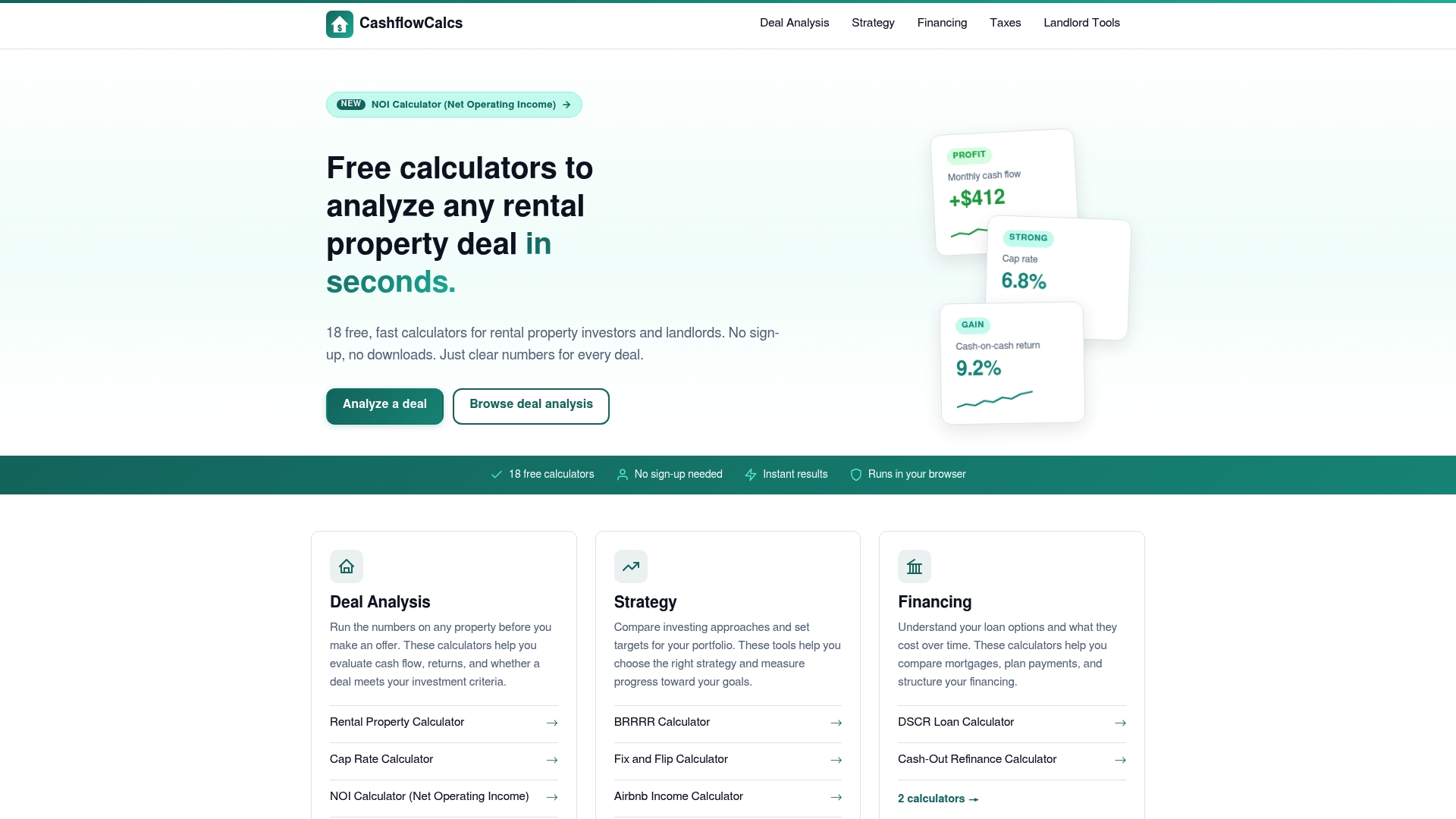
Cashflowcalcs is a free, browser-based suite of calculators built specifically for US rental property investors. The DSCR Loan Calculator lets you enter your rent and PITIA figures and see your ratio instantly, with the formula shown so you can verify every number. The Rental Property Calculator goes further, modeling cash flow, cap rate, and cash-on-cash return so you know whether the deal pencils before you spend money on an appraisal or a rate lock. Everything runs in your browser, nothing is saved, and there is no sign-up. Run the numbers first, then call the lender that fits your profile.
FAQ
What is the minimum DSCR most lenders require?
Most DSCR lenders require a minimum ratio of 1.20, though some programs allow as low as 1.0 with compensating factors such as a lower LTV or a higher credit score. Confirm the minimum with each lender before ordering an appraisal.
Do DSCR loans require tax returns or W-2s?
No. DSCR loans qualify borrowers on the property’s rental income rather than personal income, so lenders typically do not require W-2s, tax returns, or a DTI calculation. The key document is evidence of rent (signed lease or appraised market rent from Form 1007).
How do lenders calculate rent for a DSCR loan?
Lenders use one of three methods: the signed lease, appraised market rent from a Form 1007, or the lower of the two. The method matters because a high signed lease that exceeds appraised market rent can push your DSCR below the lender’s minimum after the appraisal comes back.
What credit score do you need for a DSCR loan?
Most lenders set a minimum of 660-680 for standard DSCR programs, with best-tier pricing typically starting at 700 or above. Some lenders, including Easy Street Capital, offer programs with minimums as low as 640 for select products.
How long does a DSCR loan take to close?
Advertised timelines of 14 days are best-case scenarios. Most files close in 30-45 days from application to funding. Ask your lender for recent comparable-file close times and a written submission checklist to get a realistic estimate for your specific deal.