Financing
Due-on-Sale Clause: What US Property Owners Must Know

A due-on-sale clause is a contract provision in your mortgage that lets the lender demand full repayment of the loan the moment you sell or transfer the property without prior written consent. If you are planning any kind of transfer, your first move is to pull your promissory note and deed of trust, locate the clause language, and contact your lender in writing before the transfer closes. The two governing authorities are 12 U.S.C. §1701j-3 (the Garn-St Germain Depository Institutions Act of 1982) and its implementing regulation, 12 C.F.R. part 191; the Cornell Law School Wex entry provides a reliable plain-language overview of both.
Key Takeaways
A due-on-sale clause gives lenders the right to accelerate your mortgage on any unauthorized transfer, and federal law under 12 U.S.C. §1701j-3 both authorizes enforcement and defines the limited exemptions that protect qualifying residential transfers.
| Point | Details |
|---|---|
| Federal law controls enforcement | The Garn-St Germain Act (12 U.S.C. §1701j-3) preempts state restrictions and authorizes lenders to enforce due-on-sale clauses. |
| Statutory exemptions are narrow | Transfers to a spouse, children, or into a qualifying inter vivos trust may be protected; LLC transfers are not. |
| Instrument type does not matter | A quitclaim deed triggers the clause just as a warranty deed does; the transfer of interest is what counts. |
| Rising rates increase enforcement risk | Lenders are more likely to accelerate when they can redeploy capital at higher market rates. |
| Cashflowcalcs models your refinance cost | The free financing calculators at Cashflowcalcs show monthly payment and cash flow impact of a refinance with no sign-up required. |
Table of Contents
- What is a due-on-sale clause and why do lenders include it?
- What federal law governs due-on-sale clauses?
- Which transfers typically trigger a due-on-sale clause?
- When can a lender NOT enforce a due-on-sale clause?
- What can a lender do if it chooses to enforce the clause?
- Practical checklist: what to do before, during, and after a planned transfer
- Sample clause wording and three worked scenarios
- Investor example: model enforcement versus refinancing costs
- Run your refinance scenarios with Cashflowcalcs
- Sources
- FAQ
What is a due-on-sale clause and why do lenders include it?
A due-on-sale clause, sometimes called a mortgage acceleration clause or due-on-transfer clause, is a standard provision in most US residential and commercial mortgage instruments. It gives the lender the right to accelerate the loan, meaning to call the entire remaining balance due immediately, if the borrower transfers ownership or any interest in the property without lender approval.
Lenders include the clause for three concrete reasons:
- Interest-rate protection. When market rates rise, an older low-rate loan becomes a liability for the lender. The clause prevents a buyer from assuming a 3% loan in a 7% market, forcing the new owner to refinance at current rates.
- Credit and collateral control. The lender underwrote the loan based on the original borrower’s creditworthiness. A transfer to an unknown buyer changes the risk profile without the lender’s knowledge.
- Loan portfolio management. Lenders price and package loans for secondary markets. Unauthorized assumptions disrupt that process.
A short example illustrates the stakes. Suppose you bought a rental property in 2021 with a $400,000 mortgage at 3.25%. You now want to sell via a subject-to transfer, leaving your loan in place. The buyer takes title but your loan stays on the books at 3.25% while current 30-year rates sit near 7%. The lender has every financial incentive to call that loan due the moment it discovers the transfer.
What federal law governs due-on-sale clauses?
The Garn-St Germain Act: 12 U.S.C. §1701j-3
The Garn-St Germain Depository Institutions Act of 1982 is the controlling federal statute. It preempts any state law or regulation that would prohibit or restrict a lender from enforcing a due-on-sale clause in a covered loan. Before 1982, several states had laws limiting enforcement; Garn-St Germain wiped those out at the federal level.
The statute’s core definition reads:
The statute also encourages lenders to permit assumptions at the existing contract rate or at a rate between the contract and market rates, but that is permissive guidance, not a borrower’s guaranteed right.
The OCC implementing regulation: 12 C.F.R. part 191
The Office of the Comptroller of the Currency (OCC) issued 12 C.F.R. part 191 to implement the statute’s procedural rules. Key points for borrowers and investors:
| Regulatory Rule | What It Means in Practice |
|---|---|
| Lender may request successor’s financial information | Lender can require the transferee to submit a credit application before deciding whether to permit assumption |
| Customary credit standards apply | Lender evaluates the successor using the same underwriting criteria it applies to new borrowers |
| Lender must respond within a defined window | For owner-occupied residential loans, the regulation sets a process for notice and credit decisions; failing to respond to a lender’s information request can itself enable enforcement |
| Scope: residential loans on fewer than five dwelling units | Part 191’s procedural protections apply primarily to qualifying residential loans, not large commercial portfolios |
Which transfers typically trigger a due-on-sale clause?
The clause is triggered by the transfer of any ownership interest, not just a traditional arm’s-length sale. The type of deed used, whether a quitclaim deed or a warranty deed, is generally irrelevant to the lender. As ASR Law Firm explains, what matters is the transfer of legal interest, not the instrument that carries it.
Transfers that commonly trigger enforcement include:
- Outright sale to a third party without lender consent or a formal assumption agreement
- Subject-to transfers (subject to mortgage), where the buyer takes title but the existing loan stays in the seller’s name
- Contract-for-deed or installment land contract, where the buyer takes equitable interest before legal title passes
- Leaseholds exceeding three years that include a purchase option
- Transfer of beneficial interest in a trust where the borrower is no longer the primary beneficiary and occupant
- Transfer to an LLC or other business entity, even one the borrower controls (see note below)
- Partial interest transfers, such as adding a co-owner to the deed
A note on LLC transfers. Transferring a mortgaged rental property into an LLC is a common asset-protection strategy, but it generally creates a technical default under the mortgage. The Garn-St Germain safe harbors do not cover transfers to business entities. As Denha & Associates notes, lenders often tolerate such transfers while payments remain current, but they retain the full right to accelerate. That tolerance can evaporate quickly in a rising-rate environment.
Freedom Mortgage’s guidance on quitclaim deeds reinforces this: a quitclaim deed transfers title but does not remove the original borrower’s mortgage liability, and the lender is not a party to the deed.
When can a lender NOT enforce a due-on-sale clause?
The Garn-St Germain Act lists specific transfers for which a lender on a qualifying residential loan (fewer than five dwelling units) may not exercise the due-on-sale clause. These statutory safe harbors are:
- Transfer by devise, descent, or operation of law upon the death of a joint tenant or tenant by the entirety
- Transfer to a relative resulting from the death of the borrower
- Transfer to a spouse or children where the transferee will occupy the property
- Transfer resulting from a divorce or legal separation where the spouse becomes an owner
- Transfer into an inter vivos trust where the borrower remains a beneficiary and continues to occupy the property
- Leasehold of three years or less that does not include a purchase option
- Transfer to a subordinate lien holder (such as a second mortgage or home equity lender)
These exemptions are statutory floors, not ceilings. A lender may choose to be more permissive, but it cannot enforce the clause against a transfer that fits one of these categories.
Two important scope limits apply. First, the exemptions cover qualifying residential loans, so commercial loans and loans on larger multifamily properties may not receive the same protection. Second, even a transfer that fits an exemption category may have conditions attached, such as the occupancy requirement for inter vivos trusts. A common misconception is that any transfer to a family member or trust automatically avoids the clause; the statute’s conditions must actually be met.
When a transfer does qualify for an exemption, consulting an estate attorney before completing the transfer helps confirm the conditions are satisfied and documented correctly.
What can a lender do if it chooses to enforce the clause?
When a lender discovers an unauthorized transfer, it has several options, and the sequence matters.
The typical enforcement path looks like this. The lender first sends a notice of default or a demand letter identifying the unauthorized transfer. It may then request financial information from the successor or transferee to evaluate whether a formal assumption is possible under customary credit standards. Under 12 C.F.R. part 191, failing to provide requested information within the regulatory window can itself enable the lender to proceed with enforcement.
If the lender decides not to permit assumption, the options escalate:
- Accelerate the loan and demand the full remaining balance
- Require refinancing by the new owner at current market rates
- Refuse assumption and require the original borrower to pay off the loan
- Initiate foreclosure if the accelerated balance is not paid
Historically, lenders have been slow to enforce when payments are current and rates are low. That calculus changes when rates rise sharply, as lenders can recover the capital and redeploy it at higher yields.
Practical checklist: what to do before, during, and after a planned transfer
Before the transfer
- Obtain your complete loan file: the promissory note, deed of trust or mortgage, and any loan modification agreements.
- Search the documents for “due-on-sale,” “due-on-transfer,” or “acceleration” language and read the exact wording.
- Confirm whether your loan is a qualifying residential loan under the Garn-St Germain statute (fewer than five dwelling units).
- Identify whether your planned transfer fits any statutory exemption.
- Consult a real estate attorney, especially for LLC transfers, subject-to transactions, or any transfer that does not clearly fit an exemption.
During the transfer process
- Contact your lender in writing before the transfer closes, requesting written permission or formal assumption terms.
- If the lender offers an assumption, submit a complete credit application for the transferee and respond promptly to all information requests.
- Consider refinancing the property in the transferee’s name as a clean alternative to assumption.
- Structure the transfer to match a statutory exemption where that is genuinely available, and document the conditions (for example, occupancy for an inter vivos trust).
After the transfer
- Maintain all mortgage payments on time; current payments reduce the practical likelihood of enforcement even when a technical default exists.
- Monitor all lender correspondence and respond immediately to any notice of default or information request.
- Keep funds available to refinance quickly if the lender accelerates; a delayed response to acceleration can lead to foreclosure.
- Track any credit reporting changes if the lender reports a default.
Pro Tip: A written waiver or a formal assumption agreement signed by the lender is the only reliable protection against later enforcement. Informal tolerance, meaning the lender simply does not act, is not a waiver and can be reversed at any time. Always get lender consent in writing before completing a transfer.
For heirs navigating a transfer after a borrower’s death, the inherited property sale checklist covers the practical steps from estate administration through title transfer.
Sample clause wording and three worked scenarios
Typical clause language
Most residential mortgages contain language similar to this:
“If all or any part of the Property or any Interest in the Property is sold or transferred (or if Borrower is not a natural person and a beneficial interest in Borrower is sold or transferred) without Lender’s prior written consent, Lender may require immediate payment in full of all sums secured by this Security Instrument.”
Plain-language meaning: any transfer of ownership or beneficial interest, by any method, triggers the lender’s right to demand full repayment unless the lender has given written consent in advance.
Three worked scenarios
The table below shows the legal standing, likely lender response, and recommended action for three common transfer types.
| Scenario | Transfer Type | Legal Standing | Likely Lender Response | Recommended Action |
|---|---|---|---|---|
| 1. Divorce transfer to spouse | Quitclaim deed to spouse per divorce decree; spouse will occupy | Statutory exemption applies (Garn-St Germain §1701j-3(d)(6)) | Lender may not enforce; spouse assumes occupancy obligation | Document the divorce decree and occupancy; notify lender in writing |
| 2. Transfer to borrower’s LLC | Deed to single-member LLC for asset protection | Technical default; no statutory exemption for business entities | Lender retains right to accelerate; may tolerate if payments current | Seek written lender consent before transfer; consider DSCR refinance into LLC name |
| 3. Subject-to investor purchase | Buyer takes title; seller’s loan stays in place | Technical default; no exemption; lender not notified | High enforcement risk, especially in rising-rate environment | Buyer and seller both face risk; formal assumption or refinance is the safer path |
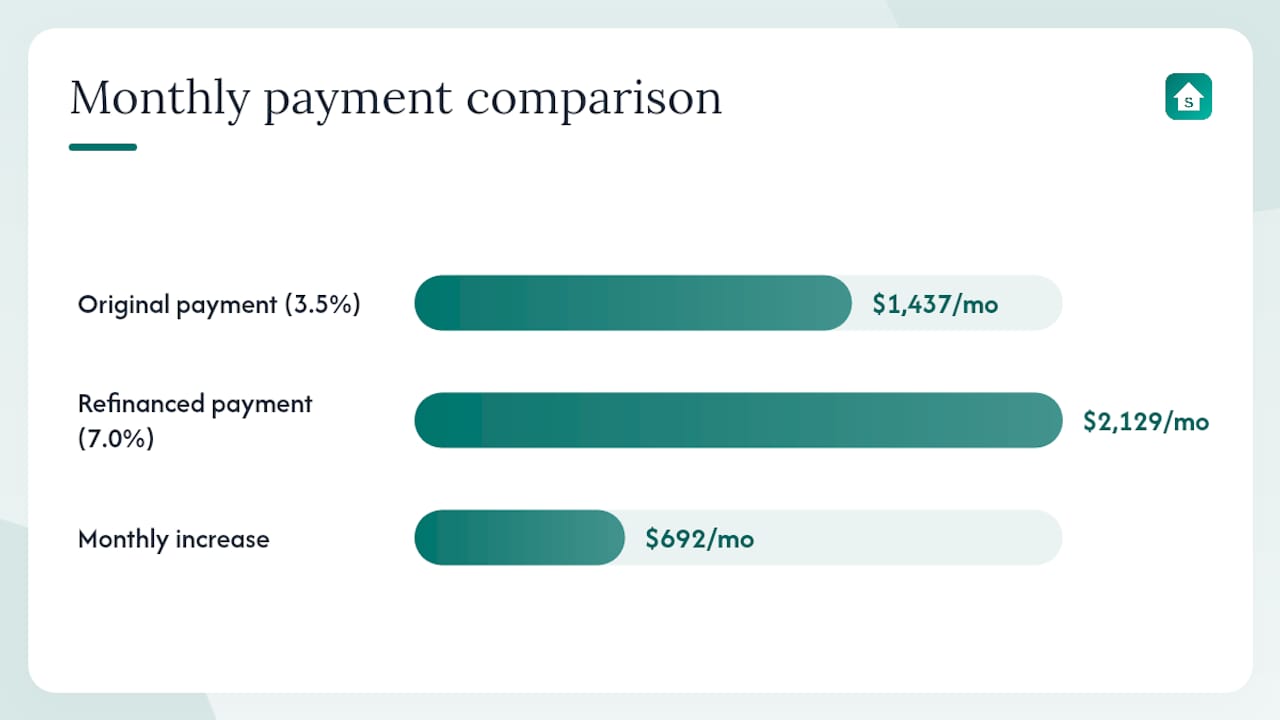
Scenario 2 numeric example. Suppose the LLC transfer involves a $320,000 remaining balance at 3.5%. The lender accelerates. Refinancing at a current rate of 7.0% on a 30-year term raises the monthly payment from roughly $1,437 to roughly $2,129, an increase of $692 per month. Over 12 months, that is $8,304 in additional carrying cost. Knowing that figure in advance helps you decide whether the asset-protection benefit of the LLC justifies the refinance cost or whether a different structure makes more sense.
Investor example: model enforcement versus refinancing costs
When a lender calls a loan, you face a binary choice: pay off the balance in full or refinance immediately. Running the numbers before a transfer closes can prevent a forced decision under pressure.
A straightforward comparison for a $320,000 remaining balance:
- Option A: Pay off the loan. Full payoff requires $320,000 plus any prepayment penalty (check your note) and closing costs to clear title, typically $1,500-$2,500 in recording and title fees.
- Option B: Refinance at current market rate. A new 30-year loan at 7.0% on $320,000 carries a monthly principal and interest payment of approximately $2,129. Closing costs for a standard refinance run roughly 2%-3% of the loan amount, or $6,400-$9,600 on this balance. The break-even on those closing costs depends on how long you hold the property.
To model your specific numbers, the Cashflowcalcs financing calculators let you input your remaining balance, current rate, new rate, and loan term to see the monthly payment difference and total interest cost side by side. No sign-up is required and the formulas are shown so you can verify every output.
This example is illustrative only. Consult a licensed attorney and a qualified mortgage professional before making any decision about a transfer, assumption, or refinance.
Run your refinance scenarios with Cashflowcalcs
When a due-on-sale clause puts a refinance on the table, the numbers need to work before you commit. Cashflowcalcs offers free, browser-based financing calculators that model refinance costs, monthly payment changes, and cash flow impact in seconds, with no account, no download, and no black-box outputs. Every calculator shows its formula and a worked example so you can check the math yourself.
For investors weighing whether to refinance into a DSCR loan after an LLC transfer, the DSCR loan calculator shows whether the rental income covers the new debt service at current rates. Pair it with the rental property calculator to see how a higher monthly payment affects your cash-on-cash return before you sign anything.
Results are educational estimates, not legal or financial advice. Confirm all figures with your lender and a qualified attorney.
Sources
The following primary and secondary sources are the most reliable references for due-on-sale clause research:
- 12 U.S. Code § 1701j-3 - Preemption of due-on-sale prohibitions | LII / Legal Information Institute
- § 191.1 Authority, purpose, and scope (and related sections) | Code of Federal Regulations (12 C.F.R. part 191)
- Risks In Transferring Mortgage Property By Deed Without Lender Permission | Denha & Associates, PLLC
- Due-on-sale clause | ASR Law Firm (explanatory page)
- Quitclaim Deed: What It Is and How It Works | Freedom Mortgage
- Garn-St Germain Depository Institutions Act of 1982 (Congressional text) | FRASER / St. Louis Fed
For investors also considering the tax side of property transfers, the Cashflowcalcs real estate tax blog covers 1031 exchanges, capital gains, and depreciation recapture in the same practical format.
This article is general information, not a substitute for advice from a qualified lawyer. Consult a qualified legal professional about your own circumstances before acting on anything here.
FAQ
What is the purpose of a due-on-sale clause?
A due-on-sale clause protects the lender’s interest-rate position and credit standards by requiring full loan repayment if the property is transferred without consent, preventing buyers from assuming below-market loans without lender approval.
Will a quitclaim deed trigger a due-on-sale clause?
Yes. The type of deed used does not determine whether the clause is triggered; any transfer of a legal interest in the property can activate it, and a quitclaim deed does not remove the original borrower’s mortgage liability.
Do all conventional loans have a due-on-sale clause?
Most conventional residential mortgages include a due-on-sale clause as standard language, though the exact wording varies by lender and loan program. FHA and VA loans have their own assumption rules that differ from conventional loan terms.
What does a due-on-sale clause look like in a mortgage?
A typical clause states that if any part of the property or any interest in it is sold or transferred without the lender’s prior written consent, the lender may require immediate payment in full of all sums secured by the mortgage instrument.
Can I transfer my rental property to an LLC without triggering the clause?
Generally no. Transfers to an LLC do not qualify for any Garn-St Germain statutory exemption, creating a technical default even if you retain full control of the entity. Lenders often tolerate such transfers while payments are current, but they retain the right to accelerate, particularly when market rates rise.