Taxes
Section 1250 Recapture: Tax Rates, Calculation & Planning

When you sell a depreciated rental property, the IRS splits your gain into buckets, and the one most investors miss is the unrecaptured Section 1250 gain: the portion of your long-term gain attributable to straight-line depreciation you claimed on real property, taxed at a federal maximum of 25% rather than ordinary income rates. That 25% is a ceiling, not a flat charge. If your marginal ordinary income rate is below 25%, you pay the lower rate on that bucket. The gain flows first through Form 4797 (Sales of Business Property), then carries to Schedule D and the Schedule D Unrecaptured Section 1250 Gain Worksheet. A separate, smaller bucket, actual §1250 ordinary-income recapture, applies only when accelerated depreciation exceeded straight-line, which is rare under modern MACRS rules. You can run the numbers on your own property right now with the Cashflowcalcs Depreciation Recapture Calculator before reading further.
The 25% cap on unrecaptured §1250 gain is one of the most misunderstood figures in real estate taxation. Many investors budget for a 15% long-term capital gains rate on their entire profit, then discover at closing that a significant slice of that gain is taxed at up to 25% instead.
Table of Contents
- What Is Section 1250 Recapture and How Did the Rules Evolve?
- How Do Section 1245 and Section 1250 Recapture Differ?
- How Do You Calculate Unrecaptured Section 1250 Gain?
- When Does Section 1250 Produce Ordinary Income vs. the 25% Bucket?
- What Tax Rates Apply and Where Do You Report the Gain?
- How Does Depreciation Recapture Work in Partnerships and LLCs?
- What Are the Best Strategies to Defer or Reduce §1250 Recapture?
- Common Mistakes That Lead to Surprise Tax Bills
- How to Reproduce the Worked Example in the Cashflowcalcs Calculator
- Key Takeaways
- The Tradeoff Most Investors Underestimate
- Run Your Own Numbers with the Cashflowcalcs Depreciation Recapture Calculator
- Useful Sources
What Is Section 1250 Recapture and How Did the Rules Evolve?
IRC §1250 covers depreciable real property: buildings, structural components, and improvements. Under IRS Publication 544, §1250 property includes residential rental buildings (depreciated over 27.5 years under MACRS) and nonresidential commercial buildings (depreciated over 39 years). Both use the straight-line method.
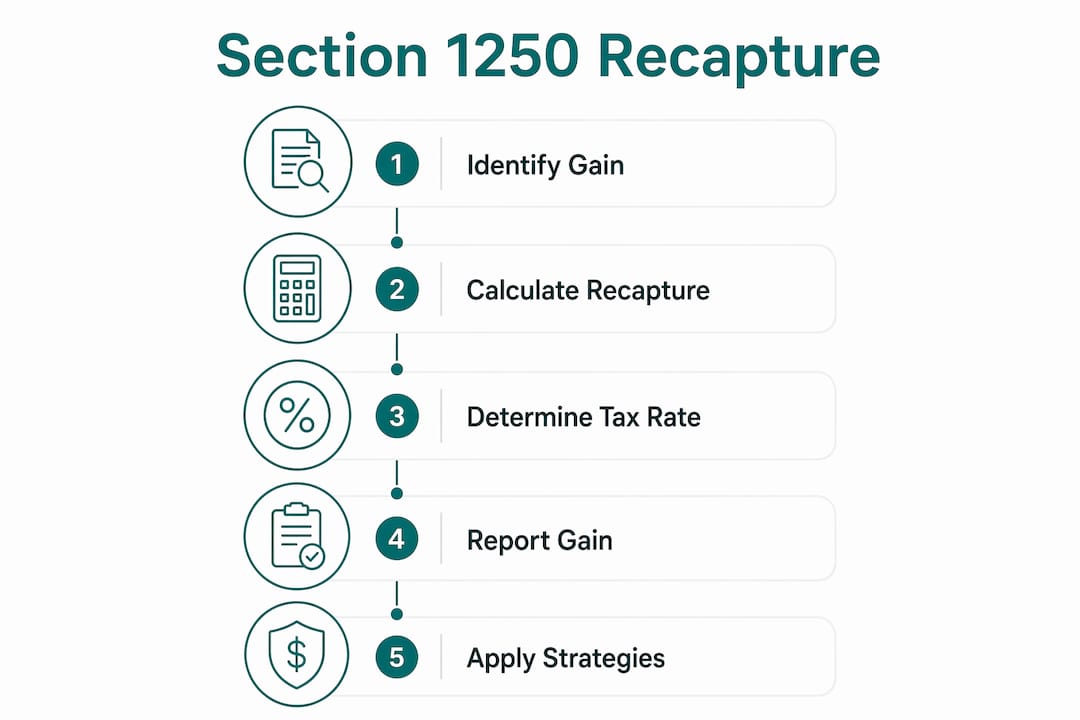
The statute’s original purpose was to recapture the excess of accelerated depreciation over what straight-line would have produced, taxing that excess as ordinary income. Pre-1987 assets placed in service under ACRS or older methods could use accelerated schedules, so genuine §1250 ordinary-income recapture was common. The Tax Reform Act of 1986 changed that. MACRS mandated straight-line for all real property placed in service after 1986, which means the “excess” is typically zero for modern buildings. Ordinary-income §1250 recapture is rarely relevant today for properties acquired in the last few decades.
What replaced it as the operative concept is unrecaptured Section 1250 gain: the portion of your long-term capital gain that equals accumulated straight-line depreciation, taxed at up to 25% under IRC §1(h). It is not ordinary income. It is a special capital-gain bucket that sits between ordinary income and the standard long-term capital gains rates.
Here are the core terms you need to keep straight:
- §1250 property: Depreciable real property (buildings, structural components, and land improvements).
- §1245 property: Depreciable personal property and certain other assets (equipment, machinery, 5/7/15-year components from cost segregation).
- Unrecaptured §1250 gain: The lesser of accumulated straight-line depreciation and realized gain; taxed at a maximum 25% federal rate.
- §1231 gain: The broader category of gain from business property held more than one year; §1250 and §1245 recapture are carved out of §1231 gain.
How Do Section 1245 and Section 1250 Recapture Differ?
The distinction matters most when you have done a cost-segregation study or used bonus depreciation. Here is a side-by-side comparison:
| Feature | §1245 Property | §1250 Property |
|---|---|---|
| Typical asset types | Equipment, appliances, 5/7/15-yr components | Buildings, structural components, 27.5/39-yr |
| Depreciation method | Accelerated (MACRS, bonus) | Straight-line (MACRS post-1986) |
| Recapture character | Ordinary income (all depreciation taken) | Unrecaptured §1250 gain (up to 25% cap) |
| Tax rate on recapture | Taxpayer’s marginal ordinary rate | Maximum 25% federal rate |
| Common trigger | Sale of equipment or reclassified components | Sale of rental or commercial building |

The critical wrinkle: when a cost-segregation study reclassifies structural components into 5-, 7-, or 15-year property and you take bonus depreciation on those components, they become §1245 property. All the accelerated depreciation on those reclassified pieces is recaptured as ordinary income at your full marginal rate, not at the 25% cap. That is a higher rate for most investors in the 32% or 35% bracket.
Example summary: A $1.2 million apartment building undergoes a cost-segregation study. The study identifies $180,000 of components (flooring, fixtures, land improvements) that qualify as 5- and 15-year property. You take 100% bonus depreciation on those components in year one. When you sell five years later, that $180,000 is §1245 recapture taxed at ordinary income rates, not the 25% §1250 cap. The remaining building depreciation stays in the unrecaptured §1250 bucket.
Pro Tip: Flag cost-segregation and bonus-depreciation amounts as a separate line in your underwriting model from day one. Label them “§1245 exposure” and apply your marginal ordinary rate to that bucket when projecting exit taxes. Mixing them into the §1250 bucket understates your tax bill at sale.
How Do You Calculate Unrecaptured Section 1250 Gain?
The formula is straightforward. Unrecaptured §1250 gain equals the lesser of (a) total accumulated straight-line depreciation allowed or allowable on the property, or (b) the recognized gain on sale. This rule prevents the recapture bucket from exceeding your actual gain.
Step-by-step calculation
- Determine original cost basis. Start with purchase price plus acquisition costs and capital improvements.
- Subtract accumulated depreciation. Use the total depreciation claimed (or allowable) over the holding period to arrive at your adjusted basis.
- Compute realized gain. Sale price minus adjusted basis equals total realized gain.
- Identify ordinary §1250 recapture (if any). For post-1986 MACRS property, this is almost always zero. For pre-1987 assets, calculate the excess of accelerated over straight-line depreciation.
- Determine unrecaptured §1250 gain. Take the lesser of accumulated straight-line depreciation and realized gain. Subtract any ordinary §1250 recapture already recognized.
- Remaining gain is §1231/LTCG. Subtract unrecaptured §1250 gain (and any ordinary recapture) from total realized gain to get the portion taxed at standard long-term capital gains rates.
Worked example
Assume a residential rental property bought for $400,000, with $20,000 of capital improvements and $100,000 of accumulated straight-line depreciation, sold for $520,000.
| Input / Calculation | Amount |
|---|---|
| Original purchase price | $400,000 |
| Capital improvements | $20,000 |
| Total cost basis | $420,000 |
| Accumulated straight-line depreciation (residential) | $100,000 |
| Adjusted basis at sale | $320,000 |
| Sale price | $520,000 |
| Realized gain | $200,000 |
| Ordinary §1250 recapture (MACRS straight-line, post-1986) | $0 |
| Unrecaptured §1250 gain (lesser of depreciation and gain) | $100,000 |
| Remaining §1231 / long-term capital gain | $100,000 |
The $100,000 of unrecaptured §1250 gain flows to Form 4797 Part III, then to Schedule D and the Unrecaptured Section 1250 Gain Worksheet, where it is taxed at up to 25%. The remaining $100,000 is taxed at your applicable long-term capital gains rate.
You can enter these exact numbers into the Cashflowcalcs Depreciation Recapture Calculator to verify each intermediate value and see the final tax split.
When Does Section 1250 Produce Ordinary Income vs. the 25% Bucket?
Most investors selling MACRS real property face only the unrecaptured §1250 gain bucket. But there are situations where ordinary-income recapture still applies.
Conditions that produce ordinary-income §1250 recapture
- The property was placed in service before 1987 and depreciated using an accelerated method (ACRS, sum-of-years-digits, or declining balance).
- The property received rehabilitation tax credits and the credit recapture rules apply.
- Cost-segregation reclassification converted structural components to §1245 property, and accelerated or bonus depreciation was taken on those components.
- The property is a low-income housing project with specific recapture provisions under older law.
Conditions that produce unrecaptured §1250 gain (the common case)
- The property is residential rental real estate placed in service after 1986, depreciated straight-line over 27.5 years.
- The property is nonresidential real estate placed in service after 1986, depreciated straight-line over 39 years.
- You have a realized gain on sale that equals or exceeds accumulated depreciation.
- No cost-segregation study was performed, or the study did not reclassify components into shorter MACRS classes.
Quick decision test
Ask three questions: (1) Was the property placed in service after 1986? (2) Was only straight-line depreciation used on the building shell? (3) Was no bonus depreciation taken on reclassified components? If all three answers are yes, your recapture exposure is entirely in the unrecaptured §1250 bucket, taxed at a maximum 25%.
What Tax Rates Apply and Where Do You Report the Gain?
The 25% rate is a ceiling, not a flat charge. If your ordinary marginal rate is below 25%, the unrecaptured §1250 gain is taxed at that lower rate. A taxpayer in the 22% bracket pays 22% on the unrecaptured bucket, not 25%.

Tax outcomes by bracket
The rate on the unrecaptured §1250 bucket is the lesser of your ordinary marginal rate and 25%. The rate on the remaining long-term capital gain is set by the 0% / 15% / 20% capital-gains breakpoints, which depend on your total taxable income rather than your ordinary bracket alone.
| Taxpayer’s Ordinary Marginal Rate | Rate on Unrecaptured §1250 Gain | Rate on Remaining LTCG |
|---|---|---|
| 10% or 12% | 10% or 12% (your marginal rate) | 0%, then 15% above the LTCG threshold |
| 22% or 24% | 22% or 24% (your marginal rate) | 15% |
| 32% or 35% | 25% (capped) | 15%, or 20% above the top LTCG threshold |
| 37% | 25% (capped) | 20% |
The reporting workflow follows a specific sequence. Form 4797 handles the initial §1231/§1250 computation. Part III of Form 4797 is where you report the sale of depreciable real property and calculate any ordinary recapture. The remaining gain transfers to Schedule D as a long-term capital gain. From there, the Schedule D Unrecaptured Section 1250 Gain Worksheet isolates the 25%-capped bucket and computes the actual tax. The worksheet is embedded in the Schedule D instructions, not a standalone IRS form.
One practical note: the Net Investment Income Tax (3.8%) can stack on top of the unrecaptured §1250 gain for higher-income taxpayers, pushing the effective rate above 25% for those in that threshold. That is a separate calculation on Form 8960.
How Does Depreciation Recapture Work in Partnerships and LLCs?
Partnerships and multi-member LLCs add a layer of complexity because the recapture does not stay at the entity level. When a partnership sells §1250 property, the gain is computed on Form 1065, and each partner’s share flows through Schedule K-1 (specifically Box 9c for unrecaptured §1250 gain). Each partner then reports that amount on their own Schedule D and runs the Unrecaptured Section 1250 Gain Worksheet on their individual return.
The most common partnership error is misallocating accumulated depreciation among partners. If a partner joined the partnership after the property was placed in service, their share of accumulated depreciation may differ from their percentage ownership interest. Failing to track this correctly produces an incorrect K-1 and an understated or overstated recapture amount on the partner’s return.
The reporting flow looks like this: Partnership sells property → Form 1065 computes §1231 gain and §1250 recapture → Schedule K-1 Box 9c reports each partner’s unrecaptured §1250 share → Partner enters that amount on their Schedule D → Partner completes the Unrecaptured Section 1250 Gain Worksheet.
After a 1031 exchange at the partnership level, the deferred recapture carries into the replacement property’s basis. Partners who exit the partnership before the replacement property is sold may never recognize that deferred amount, while remaining partners carry the full liability forward. This asymmetry is worth flagging in any partnership operating agreement.
Pro Tip: If you receive a K-1 with an amount in Box 9c, do not skip the Unrecaptured Section 1250 Gain Worksheet on your personal return. Many tax software programs populate it automatically, but verify the number against the partnership’s depreciation schedule to confirm the allocation is correct.
What Are the Best Strategies to Defer or Reduce §1250 Recapture?
You have several tools available, and each involves a real tradeoff between timing, liquidity, and long-term tax cost.
| Strategy | Timing | Liquidity Impact | Complexity | Long-Term Tax Outcome |
|---|---|---|---|---|
| 1031 like-kind exchange | Defer indefinitely | Low (equity stays in property) | Moderate to high | Deferred liability grows with replacement property depreciation |
| Hold to death (step-up) | Eliminate at death | None (no sale) | Low | Recapture eliminated; heirs get stepped-up basis |
| Installment sale | Spread over years | Partial (receive payments over time) | Moderate | Recapture recognized in year of sale; only LTCG spreads |
| Harvest in low-bracket year | Recognize now at lower rate | Full (cash out) | Low | Pay your lower marginal rate (below 25%) instead of 25% if your bracket allows |
| Selective cost-segregation use | Accelerate deductions now | None | High | Increases §1245 ordinary recapture exposure at sale |
A few points worth unpacking. A 1031 exchange defers recognition of both the unrecaptured §1250 gain and any §1245 recapture, but the liability transfers into the replacement property’s basis. If you continue taking depreciation on the replacement property, the deferred recapture balance grows. The exchange buys time, not elimination.
The installment sale is frequently misunderstood. Ordinary §1250 recapture and §1245 recapture must be recognized in full in the year of sale, regardless of how payments are structured. Only the remaining §1231 gain and unrecaptured §1250 gain can be spread across payment years. Plan accordingly when modeling cash flow at closing.
Cost segregation deserves a separate note. The near-term cash flow benefit from accelerated depreciation is real, but it converts a portion of your future recapture from the 25%-capped §1250 bucket into fully ordinary §1245 recapture. For an investor in the 35% bracket, that is a 10-percentage-point increase on those components. Model both scenarios, with and without cost segregation, before committing.
Pro Tip: Use the Cashflowcalcs 1031 Exchange Calculator alongside the Depreciation Recapture Calculator to compare the after-tax proceeds of a straight sale against a deferred exchange. Running both scenarios takes less than five minutes and often changes the decision.
Common Mistakes That Lead to Surprise Tax Bills
The most widespread error is treating all depreciation recapture as ordinary income. Most investors selling post-1986 MACRS real property face the 25%-capped unrecaptured §1250 bucket, not ordinary income rates. Overstating the tax cost leads to missed opportunities; understating it leads to cash shortfalls at closing.
- Misclassifying cost-segregation components: Treating bonus-depreciation components as §1250 property understates ordinary recapture. Each reclassified component needs its own recapture character tracked separately.
- Using the wrong basis: Failing to add capital improvements to basis, or failing to subtract depreciation “allowed or allowable” (even if you forgot to claim it), produces an incorrect gain calculation. The IRS uses “allowed or allowable,” so unclaimed depreciation still reduces your basis.
- Ignoring the installment sale recapture rule: Spreading payments over years without recognizing ordinary and §1245 recapture in year one is a reporting error that draws IRS scrutiny.
- Misreporting on Form 4797: Entering the sale on the wrong part of Form 4797 (Part I vs. Part III) changes how the gain is characterized and can misstate both ordinary income and the §1250 bucket.
- Skipping the K-1 Box 9c worksheet: Partners who receive unrecaptured §1250 gain on a K-1 and do not complete the Schedule D worksheet understate their tax on that bucket.
Pro Tip: Maintain an asset-level depreciation schedule that tracks original cost, improvements, accumulated depreciation, and MACRS class for every component. Reconcile it to your tax return annually. When you sell, hand this schedule to your CPA alongside the cost-segregation report. It cuts preparation time and eliminates the most common recapture errors.
Audit red flags in this area include large, unexplained basis adjustments on Form 4797, inconsistent depreciation amounts across years, and bonus depreciation claims with no supporting cost-segregation documentation. Keep the cost-segregation report attached to your tax workpapers permanently.
How to Reproduce the Worked Example in the Cashflowcalcs Calculator
The Cashflowcalcs Depreciation Recapture Calculator is built to walk through the same sequence covered in the worked example above. Here is how to map the inputs:
Enter the original purchase price ($400,000) and capital improvements ($20,000) to set the cost basis. Enter accumulated depreciation ($100,000) to let the calculator derive your adjusted basis ($320,000). Enter the sale price ($520,000). The calculator computes realized gain ($200,000), identifies ordinary §1250 recapture ($0 for post-1986 MACRS), and isolates the unrecaptured §1250 gain ($100,000) as the lesser of accumulated depreciation and realized gain. The remaining $100,000 long-term capital gain appears as a separate output.
Each intermediate value is displayed with its formula so you can verify the math rather than accept a black-box result. The output labels map directly to Form 4797 Part III and the Schedule D worksheet, so you can transfer numbers to your return with confidence.
For partnership situations, enter each partner’s proportional share of accumulated depreciation rather than the total entity figure. Cross-check the result against Box 9c on the K-1 to confirm the allocation is consistent.
Pro Tip: Export or copy the calculator’s output into a spreadsheet and save it with your tax workpapers for the year of sale. If the IRS questions your Form 4797 or Schedule D figures, having a documented, formula-transparent calculation is your first line of defense.
Key Takeaways
Section 1250 recapture on post-1986 MACRS real property almost always means unrecaptured §1250 gain taxed at a maximum 25% federal rate, not ordinary income, and that distinction directly affects how much cash you need at closing.
| Point | Details |
|---|---|
| The 25% cap is a ceiling | If your marginal ordinary rate is below 25%, you pay that lower rate on the unrecaptured §1250 bucket. |
| Ordinary recapture is rare today | Post-1986 MACRS straight-line buildings produce no ordinary §1250 recapture; cost-segregation components are the exception. |
| Report on Form 4797, then Schedule D | Gain flows from Form 4797 Part III to Schedule D and the Unrecaptured Section 1250 Gain Worksheet. |
| 1031 exchanges defer, not eliminate | Deferred recapture transfers to the replacement property’s basis and grows with continued depreciation. |
| Model exit taxes before you buy | Use the Cashflowcalcs Depreciation Recapture Calculator to isolate the §1250 bucket in every exit scenario. |
The Tradeoff Most Investors Underestimate
Accelerated depreciation is genuinely valuable. The near-term tax savings from a cost-segregation study or bonus depreciation can improve your cash-on-cash return meaningfully in the early years of ownership. The tradeoff is that you are converting a future 25%-capped tax liability into a fully ordinary-income liability on those reclassified components. For investors in the 32% to 37% bracket, that conversion costs real money at exit.
What surprises many advisors, looking at how investors actually model deals, is how rarely the exit tax is broken into its component buckets. The unrecaptured §1250 gain is treated as a single line item, often estimated at 15% (the standard LTCG rate), when the correct rate is up to 25% on the depreciation portion. That 10-percentage-point gap on $100,000 of accumulated depreciation is $10,000 in additional tax. On a $1 million property held for 10 years, the gap is larger.
The practical fix is simple: treat unrecaptured §1250 gain as its own modeling bucket from the day you underwrite the deal. Run the rental property analysis with exit taxes correctly split, and you will make better hold-versus-sell decisions. Consult a CPA for partnership structures, cost-segregation planning, and any pre-1987 assets where ordinary recapture may still apply. The math is not complicated once you have the right framework.
This article is general educational information, not tax or legal advice. Confirm your specific situation with a qualified tax professional and refer to current IRS publications for the rules that apply to your property.
Run Your Own Numbers with the Cashflowcalcs Depreciation Recapture Calculator
The worked example in this article is not hypothetical for most rental investors. You have accumulated depreciation, a sale price in mind, and a tax bill you need to estimate before you close. The Cashflowcalcs Depreciation Recapture Calculator runs the full calculation in your browser, shows every formula, and maps each output to Form 4797 and Schedule D. No sign-up, no download, and your numbers stay private.
Pair it with the Capital Gains Tax Calculator to model the remaining long-term gain after the §1250 bucket is applied, and use the 1031 Exchange Calculator to compare a deferred exchange against a straight sale. All three tools are free and built for exactly this kind of exit-tax scenario analysis. Head to the Cashflowcalcs tax calculators to run your numbers now.
Results are educational estimates. Consult a qualified tax professional for advice specific to your situation.
Useful Sources
- IRC §1250, 26 U.S. Code: The statutory text governing gain from dispositions of depreciable real property.
- IRS Publication 544, Sales and Other Dispositions of Assets: Primary IRS guidance on §1250 property definitions, unrecaptured §1250 gain, and like-kind exchange treatment.
- IRS Topic No. 409, Capital Gains and Losses: IRS confirmation that unrecaptured §1250 gain from selling §1250 real property is taxed at a maximum 25% rate.
- Form 4797 (IRS PDF): The form used to report sales of business property, including §1250 recapture calculations.
- 26 U.S.C. §1(h)(6)(A), LII / Legal Information Institute: Statutory definition of “unrecaptured section 1250 gain.”
- Cashflowcalcs Depreciation Recapture Calculator: Free browser-based tool to compute ordinary recapture, unrecaptured §1250 gain, and remaining LTCG with formula transparency.
- Cashflowcalcs Tax Calculators: Full suite of free tax tools covering depreciation recapture, capital gains, and 1031 exchange modeling.