Real Estate Investing
RUBS Billing for Rental Properties: 2026 State Guide

A ratio utility billing system (RUBS) allocates a property’s master-metered utility bill across individual units using a preset formula, typically occupancy count, square footage, or a hybrid of both, rather than individual meters. Before you launch or change RUBS billing on your rental property, take these steps first:
- Confirm state and local legality. Several states restrict or ban RUBS for certain utilities or lease types. Check your state statute and municipal housing code before billing a single tenant.
- Add a signed lease addendum at renewal. Never implement RUBS mid-lease. Disclose the utility list, allocation formula, admin fee, and billing frequency in writing before the tenant signs.
- Itemize every invoice. Each resident bill must show the master bill total, the service period, the allocation method, the tenant’s computed share, and any admin fee as a separate line item.
- Confirm no overbilling. The aggregate billed to all tenants cannot exceed the total utility charge from the utility provider. Admin fees are separate and must be itemized, not folded into the utility total.
- Check for recent legislative changes. Minnesota, Colorado, California, and Texas all updated or clarified RUBS rules between 2024 and 2026. Always verify current rules with your state utility commission or a local housing attorney before implementing.
Key Takeaways
RUBS allocates a property’s master utility bill to tenants using a formula, and the aggregate billed can never exceed the actual utility charge from the provider.
| Point | Details |
|---|---|
| Confirm legality first | RUBS rules vary sharply by state; Minnesota banned electricity apportionment for new leases after Jan 1, 2025, and Colorado requires metering for new construction permitted after July 1, 2027. |
| Use a signed addendum at renewal | Never implement RUBS mid-lease; add a signed addendum disclosing the utility list, formula, admin fee, and billing frequency before the first billing cycle. |
| No overbilling, ever | The total billed to all tenants for utilities cannot exceed the master bill total; admin fees must be itemized separately on every invoice. |
| Admin fee limits apply | Texas caps admin fees at $3/unit/month; keep fees transparent, itemized, and within your jurisdiction’s limits regardless of state. |
| Model the NOI impact | Use the Cashflowcalcs free rental property calculator to see how RUBS utility recovery changes your cash flow and cap rate before you implement. |
Table of Contents
- How does RUBS billing work for rental properties?
- RUBS vs. submetering: which approach fits your property?
- What allocation methods and formulas does RUBS use?
- What are the state and local RUBS rules for 2024-2026?
- How do you implement RUBS step by step?
- Worked example: full RUBS allocation reconciled to the master bill
- Model your RUBS impact with Cashflowcalcs
- Primary sources and further reading
- Sources
- FAQ
How does RUBS billing work for rental properties?
A ratio utility billing system gives landlords a structured way to recover shared utility costs on properties where individual submeters are absent or impractical. The property receives one master utility bill, and the landlord divides that total among occupied units using the chosen formula. Tenants pay their allocated share plus any permitted admin fee, and the landlord passes the cost through rather than absorbing it in base rent.
Which utilities does RUBS typically cover?
Water, sewer, and trash are the most common utilities billed through RUBS, and they appear in nearly every implementation. Gas and common-area electricity appear in some properties depending on local utility structure and state rules. Individual electricity for each unit is less common under RUBS because per-unit usage varies significantly, making occupancy or square-footage allocation feel arbitrary to tenants. Minnesota, for example, banned electricity apportionment for new leases effective January 1, 2025, under Minnesota statute referenced..
Why landlords choose RUBS over absorbing costs
The business case is straightforward: utility costs absorbed into base rent reduce net operating income, and raising rent to compensate can price units above market. RUBS lets you recover those costs transparently without a rent increase. Setup requires no physical meter installation, which keeps upfront cost low compared to submetering. The tradeoff is accuracy: RUBS produces an estimated share, not a measured one, so tenants with genuinely low usage may pay more than their actual consumption warrants.
Pros and cons at a glance:
- Pro: Low startup cost, no construction or meter hardware required.
- Pro: Recovers utility costs that would otherwise compress NOI.
- Pro: Encourages some conservation awareness among tenants who see a utility line item.
- Con: Estimated allocation, not exact usage, which can generate tenant disputes.
- Con: Legal exposure if disclosure or invoice requirements are missed.
- Con: Tenants with low usage may subsidize high-usage neighbors.
- Con: Regulatory complexity varies sharply by state and city.
RUBS tends to be the better operational choice on older buildings where retrofitting submeters would cost hundreds to over a thousand dollars per unit and where water, sewer, and trash represent the bulk of shared costs. If electricity is the primary cost driver and units have very different usage patterns, submetering is worth the upfront investment.
RUBS vs. submetering: which approach fits your property?
RUBS is lower-cost to implement than submetering but provides estimated rather than exact usage data. The right choice depends on your property’s age, utility mix, and tenant profile.
Water and sewer are generally better suited to RUBS because usage correlates reasonably well with occupancy. Electricity is better suited to submetering because per-unit consumption varies too widely for a formula-based split to feel fair. Trash and common-area utilities sit comfortably under RUBS in most jurisdictions.
From an operational standpoint, RUBS requires a clean billing workflow and solid recordkeeping to survive tenant disputes or audits. Submetering shifts the dispute risk to meter accuracy rather than formula fairness, which is a different but often smaller problem. If you manage properties across multiple states, RUBS compliance complexity multiplies quickly, while submetering compliance is more uniform.
What allocation methods and formulas does RUBS use?
Three formula types cover the vast majority of RUBS implementations. Each produces a different result for the same master bill, so the choice of method affects both perceived fairness and legal defensibility.
Occupancy-based formula
Tenant Share = (Unit Occupants / Total Property Occupants) × Master Bill
This method allocates costs in proportion to the number of people in each unit. It is widely considered the fairest approach for water and sewer because consumption tracks closely with the number of residents.
Square-footage-based formula
Tenant Share = (Unit Square Footage / Total Leasable Square Footage) × Master Bill
This method allocates by unit size. It works well for utilities where larger spaces consume more (heating, cooling, some gas uses) but can feel unfair for water when a large studio has one occupant and a smaller two-bedroom has four.
Hybrid formula
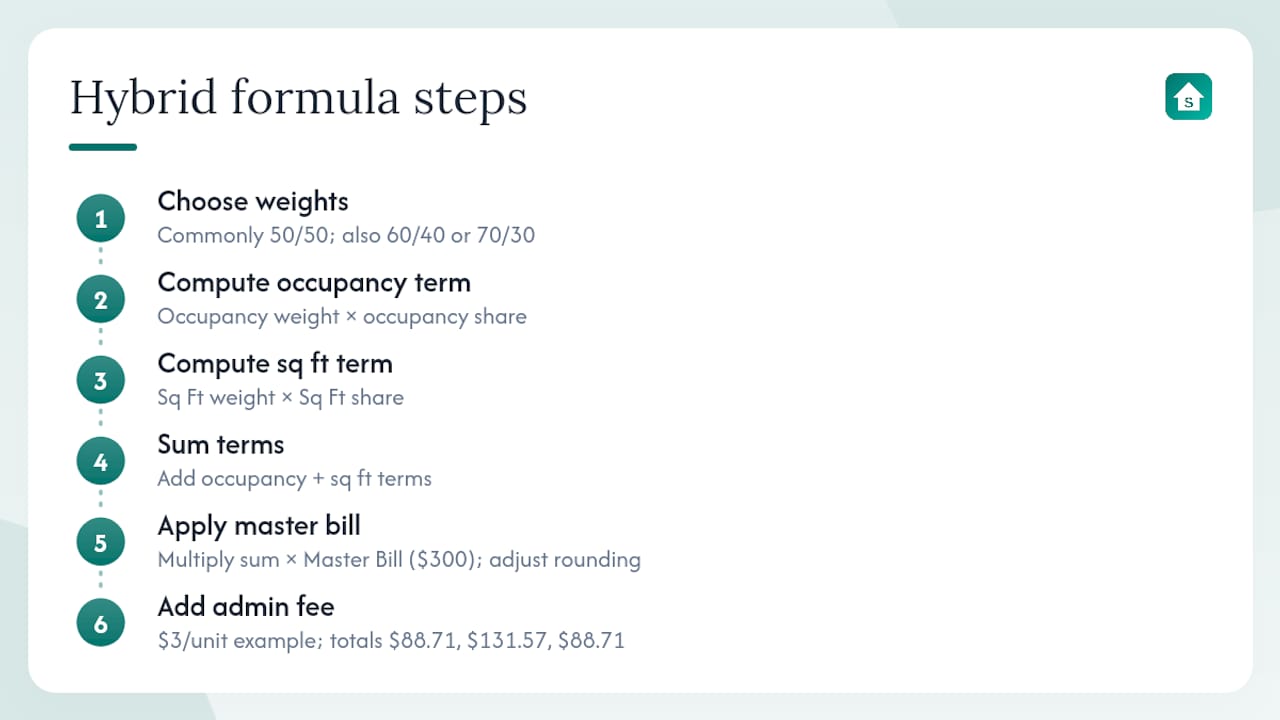
Tenant Share = [(Occupancy Weight × Occupancy Share) + (Sq Ft Weight × Sq Ft Share)] × Master Bill
Operators commonly weight hybrid formulas 50/50 (occupancy and square footage) to balance perceived fairness across water-focused and energy-focused billing. You can adjust the weights to 60/40 or 70/30 depending on which factor better reflects actual usage patterns at your property.
Worked example: 3-unit property, occupancy-based allocation
Assume a monthly water/sewer master bill of $300 and the following unit data:
The $0.01 rounding difference is handled by adjusting one unit’s invoice by one cent. The aggregate billed never exceeds $300.00.
Admin fees are added on top: if your jurisdiction permits a $3/unit/month admin fee (Texas’s cap, for example), each unit’s invoice shows the utility share plus $3.00 separately, for a total of $88.71, $131.57, and $88.71 respectively.
Notes on common-area usage: Some operators exclude common-area utility consumption from the RUBS pool and absorb it separately, which reduces the per-unit allocation and lowers dispute risk. Others include it in the master bill total. Either approach is defensible as long as it is disclosed in the lease addendum and applied consistently.
This prevents a single large-unit tenant from subsidizing a high-occupancy smaller unit, and it tends to generate fewer disputes than a pure square-footage split on water/sewer billing.*
What are the state and local RUBS rules for 2024-2026?
Most U.S. states permit RUBS with disclosure and no-overbilling requirements, but several have added significant restrictions in the past two years. The regulatory picture shifted meaningfully in Minnesota, Colorado, Texas, and California, and local municipal rules can be stricter than state law.
| State / Jurisdiction | Rule Type | Key Requirement | Statute / Citation |
|---|---|---|---|
| Texas | Permitted with caps | Admin fee capped at $3/unit/month; master bill and methodology must be in signed lease or addendum; tenants may request records | Texas Property Code §92.201 |
| Minnesota | Restricted (electricity banned for new leases) | Electricity apportionment banned for leases signed after Jan 1, 2025; gas and water permitted with strict disclosure and annual tenant notices | Minnesota statute referenced. |
| Colorado | Permitted for existing buildings; metering required for new construction | Existing multifamily may continue RUBS under guardrails; new residential premises permitted on or after July 1, 2027 must have metered utility systems | HB 26-1013 (signed March 26, 2026) |
| California | Permitted with detailed invoice requirements | Resident invoices must include master bill total, service period, and account number; some cities (e.g., Los Angeles) impose additional restrictions | State PUC rules; local ordinances |
| Most other states | Generally permitted | Lease disclosure, itemized invoices, no overbilling; check state utility commission rules | Varies by state |
Colorado’s HB 26-1013, signed March 26, 2026, is the most significant recent change for multifamily operators. Existing properties can continue using RUBS under specific guardrails, but any new residential building that applies for permits on or after July 1, 2027 must install metered utility systems. If you own or are acquiring Colorado multifamily assets, factor that metering requirement into your renovation and acquisition underwriting now.
Texas caps administrative fees at $3 per unit per month and requires the master bill total, calculation methodology, and each tenant’s share to appear in a signed lease or addendum. Tenants in Texas have the right to request the master bill and allocation records, so your recordkeeping must be audit-ready from day one.
California requires resident invoices to include the property’s master bill detail, including total amount, service period, and account number, in many jurisdictions. Cities like Los Angeles layer additional restrictions on top of state rules, so a California-specific legal review is worth the cost before you launch.
Legal compliance checklist:
- Confirm RUBS is permitted for your specific utility type in your state and city.
- Add a signed lease addendum before the first billing cycle, not mid-lease.
- Disclose the utility list, allocation formula, billing frequency, and admin fee in the addendum.
- Provide tenants access to the master bill upon request.
- Keep monthly master-bill copies, allocation worksheets, and signed addenda for at least three years (longer if your state requires it).
- Send annual tenant notices where required (Minnesota mandates these under §504B.216).
- Verify local rules with your state utility commission website or municipal housing department annually, since rules change.
Pro Tip: When operating across multiple states, centralize documentation, monthly master-bill copies, allocation worksheets, tenant invoices, and signed addenda, in a single retrievable archive. Responding to a tenant audit request in 48 hours is far easier when everything is in one folder per property per month.
How do you implement RUBS step by step?
Phase RUBS in over lease renewals rather than mid-lease. Implementing mid-lease is almost never legally sound and generates the disputes most likely to end in a housing court complaint. A 12-24 month phase-in aligned with natural turnover is the standard industry approach.
Pre-launch checklist
- Confirm legality. Verify that RUBS is permitted for your target utilities in your state and city. Check your state utility commission’s website and your municipal housing code.
- Choose your allocation formula. Decide between occupancy-based, square-footage-based, or hybrid. Document the rationale.
- Collect unit data. Record each unit’s square footage and current occupancy. Update this data whenever a new lease is signed.
- Select billing software or a billing vendor. Software options that produce itemized invoices and store master-bill records reduce manual error and audit risk significantly.
- Set your admin fee within local limits. Keep it transparent, itemized, and within the common local market range. Texas caps it at $3/unit/month; other states vary. Track and justify the fee as a true cost of billing administration.
- Draft your lease addendum. Have a housing attorney review it before you use it.
Sample lease addendum language (adapt with attorney review)
Utility Billing Addendum
Resident agrees that the following utilities are billed using a Ratio Utility Billing System (RUBS): [water / sewer / trash / other]. The resident’s monthly share is calculated using [occupancy-based / square-footage-based / hybrid] allocation. The resident’s share will not exceed the property’s actual utility cost allocated to this unit. A billing administration fee of $[amount] per month is charged separately and is not included in the utility allocation. Resident may request a copy of the master utility bill at any time. Billing occurs [monthly / quarterly]. This addendum supersedes any prior utility billing agreement and takes effect on [date].
Resident invoice template checklist
Every invoice you send must include:
- Property name and address
- Resident name and unit number
- Service period (start and end date)
- Master bill total for the property
- Allocation method used
- Resident’s computed share (show the math)
- Admin fee as a separate line item
- Total amount due
- Payment due date
- Contact information for billing disputes
Recordkeeping timeline
Keep the following for a minimum of three years (longer where state law requires):
- Monthly master utility bills (originals or certified copies)
- Allocation worksheets showing the formula applied each month
- Copies of all resident invoices issued
- Signed lease addenda for every unit
- Records of any tenant disputes and their resolution
Worked example: full RUBS allocation reconciled to the master bill
Assumptions: 4-unit building, water/sewer master bill of $480/month, occupancy-based allocation, $3/unit/month admin fee (within Texas’s statutory cap as a reference benchmark).
Reconciliation check: Utility allocations sum to $53.33 + $106.67 + $160.00 + $160.00 = $480.00. This matches the master bill exactly. Admin fees ($3.00 × 4 units = $12.00) are collected separately and do not inflate the utility total. No overbilling occurs.
The rental property calculator at Cashflowcalcs lets you plug in your current NOI and model how recovering $480/month in utility costs changes your cash flow, cap rate, and annual return. Every formula is visible in the calculator so you can verify the math rather than trust a black box.
To compare how RUBS recovery affects two different properties side by side, the rental property comparison calculator runs both scenarios simultaneously. You can also use the cap rate calculator to translate an NOI improvement from RUBS into a valuation change at your target cap rate.
Model your RUBS impact with Cashflowcalcs
Cashflowcalcs offers a free, browser-based suite of rental property calculators that lets you see exactly how RUBS utility recovery changes your numbers before you commit to implementation. Plug your current NOI into the rental property calculator and add your projected monthly utility recovery to see the cash-flow and cap-rate impact in seconds. No sign-up, no download, and every formula is shown so you can check the arithmetic yourself. For multi-property operators, the deal analysis tools let you run multiple RUBS scenarios across your portfolio. These calculators provide educational estimates, not legal or tax advice. For binding guidance on RUBS compliance, consult a licensed housing attorney or accountant familiar with your state’s rules.
Primary sources and further reading
The sources below are the primary references for the legal citations, compliance requirements, and implementation guidance in this article. Use the statute links to verify current text and the industry guides for implementation templates.
- RUBS: Ratio Utility Billing System Explained for 2026 (National Center for Housing Management): foundational explainer covering RUBS as an estimation method tailored per utility type, with disclosure and lease language guidance.
- An Introduction to Ratio Utility Billing Systems for Tenant Advocates (National Consumer Law Center): the authoritative source on the no-overbilling rule and tenant rights to inspect records.
- Existing Colorado Multifamily Housing Developments Can Continue (Holland & Knight): primary legal summary of Colorado HB 26-1013 and Minnesota Minnesota statute referenced..
- Is RUBS Legal? State-by-State Guide for Multifamily Operators (UtilityRanger): state-by-state legality overview including Texas’s $3/unit/month admin fee cap and California invoice requirements.
- What Is RUBS Utility Billing? (RentCafe): renter-facing explanation of RUBS, useful for drafting tenant communications and FAQ language.
- RUBS Utility Billing vs. Submetering: A Decision Guide (Conservice): side-by-side comparison of RUBS and submetering on cost, accuracy, and implementation.
Use the statute text links for legal verification and the industry guides for implementation templates. Rules change, so confirm current requirements with your state utility commission or a licensed housing attorney before implementing.
This article is general information, not a substitute for advice from a qualified lawyer. Consult a qualified legal professional about your own circumstances before acting on anything here.
Sources
- Existing Colorado multifamily housing developments can continue
- Is RUBS Legal? State-by-State Guide for Multifamily Operators
- What is RUBS utility billing?
FAQ
What is RUBS billing in rental properties?
RUBS (Ratio Utility Billing System) allocates a property’s master-metered utility bill among tenants using a formula based on occupancy, square footage, or a hybrid of both. It is commonly used for water, sewer, and trash on properties without individual unit meters.
Is RUBS legal in all U.S. states?
Most states permit RUBS with disclosure and no-overbilling requirements, but rules vary significantly. Minnesota banned electricity apportionment for new leases after January 1, 2025, Colorado requires metering for new construction permitted after July 1, 2027, and California imposes detailed invoice requirements. Always verify your state and local rules before implementing.
Can a landlord charge an admin fee on top of the utility allocation?
Yes, in most jurisdictions, but the fee must be itemized separately on the invoice and kept within local limits. Texas, for example, caps the admin fee at $3 per unit per month under Texas Property Code §92.201.
How do you prevent overbilling under RUBS?
The aggregate utility amount billed to all tenants must not exceed the total on the master utility bill from the provider. Run a reconciliation check each billing cycle (sum all unit allocations and confirm they equal the master bill total), and keep admin fees as a separate line item that does not inflate the utility total.
Which allocation method is fairest for water and sewer billing?
Occupancy-based allocation is generally considered the fairest for water and sewer because consumption correlates more closely with the number of residents than with unit size. A 50/50 hybrid (occupancy and square footage) is a common compromise when the property has a wide mix of unit sizes and occupancy levels.