Landlord Tools
Rent Roll Basics: A Practical Guide for US Landlords

A rent roll is a tenant-by-tenant income summary that lists every unit, the rent each tenant pays, key lease dates, and occupancy status. It is the first document buyers, lenders, and brokers read to understand a property’s contracted income. If you manage rentals, build a dated rent roll and refresh it monthly. For sale or financing, keep it current within 30 days, and tie every value to its lease clause.
Key Takeaways
A rent roll is only as reliable as the leases and ledger entries it was built from, so every value needs a source document behind it.
| Point | Details |
|---|---|
| Date every version | A roll without a clear “as of” date is unverifiable; update monthly for operations, within 30 days for sale or financing. |
| Tie values to lease clauses | Link each rent, escalation, and deposit figure to the specific lease clause so reviewers can verify quickly. |
| Include vacant units | List every unit, occupied or not; $0 rows for vacancies make true occupancy and income exposure visible. |
| Use effective rent for underwriting | Adjust contract rent for concessions and free-rent periods; lenders and buyers rely on effective rent, not headline figures. |
| Cashflowcalcs cross-check | Run roll totals through the free Cashflowcalcs rental property calculator to verify NOI, cap rate, and DSCR inputs before sharing. |
Table of Contents
- Who reads a rent roll and what decisions does it drive?
- What fields should every rent roll include?
- How to build a rent roll that reconciles to leases and accounting
- A filled rent roll example for a 6-unit property
- How to read and verify a rent roll quickly
- How often should you update a rent roll?
- Common mistakes that distort a rent roll
- Faster workflows: spreadsheets, lease abstraction, and calculators
- Legal considerations and tenant privacy in US rent rolls
- Cross-check your rent roll numbers with free Cashflowcalcs calculators
- Sources
- FAQ
Who reads a rent roll and what decisions does it drive?
A rent roll serves a different purpose depending on who is holding it. Here is a quick breakdown of the primary stakeholders:
- Landlord: tracks collections, monitors lease expirations, and spots delinquency early.
- Property manager: runs day-to-day operations, manages renewals, and reports income to owners.
- Investor or buyer: underwrites the deal, checks occupancy, and verifies contracted income before closing.
- Lender: calculates DSCR and NOI inputs, confirms lease terms, and sets loan sizing.
- Broker: builds the income section of an offering memorandum and supports list-price justification.
- Accountant: reconciles rent receipts to the general ledger and supports tax reporting.
Residential and commercial rolls differ in complexity. A residential roll typically runs 10 to 15 columns and focuses on unit number, tenant name, in-place rent, lease end date, and concessions. A commercial roll can run 20 to 30 columns and adds rentable area, rent per square foot, CAM recoveries, escalations, and options. Both formats must carry a “dated as of” field and the preparer’s name and contact.
What fields should every rent roll include?
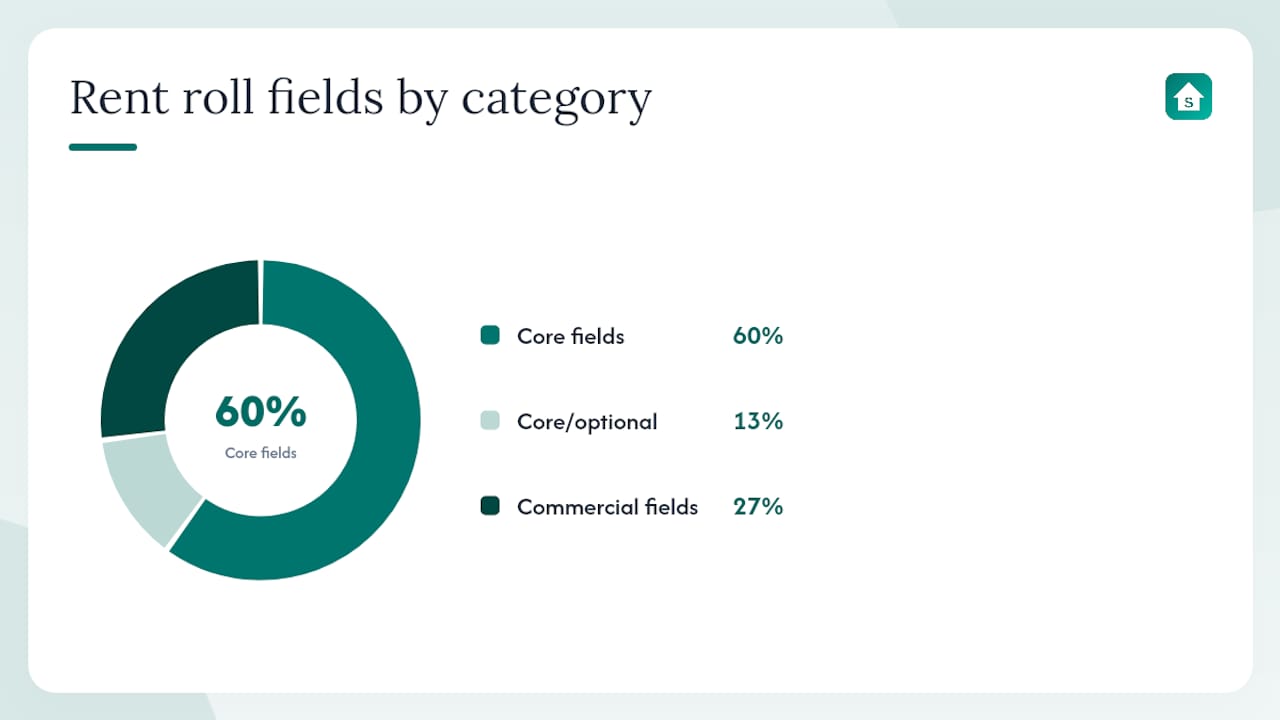
The columns below represent the standard field set. Core fields apply to every property type; commercial-only fields apply when the leases include recoveries, percentage rent, or tenant improvement allowances.
| Column | Type | Notes |
|---|---|---|
| Property address | Core | Identifies the asset; critical in a portfolio roll |
| Unit ID | Core | Apartment number, suite, or parcel identifier |
| Tenant name or company | Core | Legal name as it appears on the lease |
| Lease start date | Core | Commencement date from the executed lease |
| Lease end date | Core | Expiration or current term end |
| Contract (headline) rent | Core | Monthly rent per the lease, before concessions |
| Paid-to date / arrears | Core | Last payment date; balance owed if delinquent |
| Security deposit held | Core | Amount on deposit; state law governs how it is held |
| Occupancy status | Core | Occupied, vacant, or notice given |
| Market rent | Core/optional | Current market rate for the unit; used for loss-to-lease |
| Effective rent | Core/optional | Contract rent adjusted for concessions or free-rent periods |
| Rentable area (sq ft) | Commercial | Leased square footage per the lease |
| Rent per sq ft | Commercial | Contract rent divided by rentable area |
| CAM / recovery structure | Commercial | Fixed, pro-rata, or capped; cap amount if applicable |
| Escalation schedule | Commercial | Annual step-ups, CPI adjustments, or percentage increases |
| Percentage rent | Commercial | Breakpoint and percentage, if applicable |
| TI allowance | Commercial | Tenant improvement dollars committed; amount remaining |
| Concessions / free rent | Commercial | Free-rent months, abatements, or landlord contributions |
| Renewal / termination options | Commercial | Option terms, notice deadlines, and strike rents |
| Next rent increase date | Optional | Useful for operations and collections planning |
| Payment method | Optional | ACH, check, or portal |
| Notes / document link | Optional | Lease clause reference or amendment number |
At the bottom of the roll, add metadata: roll date, preparer name and contact, and the source documents used (executed leases, rent ledger, bank statements).
How to build a rent roll that reconciles to leases and accounting
A defensible rent roll starts with source documents, not with memory or a prior version of the roll. Follow these six steps:
-
Gather source documents. Collect every executed lease and amendment, the rent ledger or property management system export, and three to six months of bank deposit records. These are your ground truth.
-
Choose your format. A single-asset spreadsheet works for one property. If you manage a portfolio, build a master roll with one row per unit across all properties. Standardize column headings before you enter a single number.
-
Abstract each lease. For each lease, extract rent, commencement and expiration dates, escalations, recoveries, concessions, renewal options, and any TI obligations. Record the specific lease clause or section number next to each value. This step is what lease abstraction formalizes, and it is the reason buyers and lenders can verify your roll quickly.
-
Enter abstracts into the roll. Import or type each abstracted value into the corresponding column. Do not round or estimate. If a field is unknown, mark it “TBD” and flag it for follow-up rather than leaving it blank.
-
Validate totals. Sum the contract rent column and compare it to the rent ledger total for the same period. Then compare both to bank deposits. Discrepancies larger than a few dollars need an explanation before the roll leaves your desk. Creating the roll from primary source data and reconciling it to the ledger is what separates a defensible roll from a rough estimate.
-
Date, version, and redact. Name the file with the property identifier and the “as of” date (for example, “123MainSt_RentRoll_2026-06-01”). For external recipients, prepare a share-safe copy that removes personal tenant identifiers (Social Security numbers, date of birth, personal phone numbers) while keeping rent and lease-term fields intact.
Pro Tip: Link each roll value to the lease clause or ledger line number in a “Notes” column. When a lender or buyer asks to verify a figure, you can point them directly to the source instead of hunting through a lease PDF.
A filled rent roll example for a 6-unit property
The table below shows a complete residential rent roll for a hypothetical 6-unit building. All figures are computed and reconcile to the totals row.
Worked calculations:
- Total monthly contract rent (occupied units): $1,400 + $1,350 + $1,500 + $1,300 + $1,450 = $7,000
- Total monthly effective rent: $1,400 + $1,350 + $1,475 + $1,300 + $1,450 = $6,975 (Unit 103 concession: $150 x 2 months / 12 = $25/mo amortized reduction)
- Annualized contract rent: $7,000 x 12 = $84,000
- Annualized effective rent: $6,975 x 12 = $83,700
- Vacancy allowance: Unit 104 at $0 rent; physical vacancy rate = 1/6 = 16.7%
- NOI input: Start with $83,700 annualized effective rent, then subtract operating expenses to arrive at NOI for cap rate calculations.
Unit 104 appears as a $0 row rather than being omitted. Listing only occupied units inflates perceived income and hides vacancy exposure from any reviewer.
Reconciliation checklist:
- Total roll rent matches rent ledger for the same month.
- Total roll rent matches bank deposits (net of any timing differences).
- Each lease start and end date matches the executed lease.
- Security deposits match the trust account or escrow balance.
- Concessions are documented with the lease clause reference.
- Escalation dates and amounts are noted for leases with step-ups.
How to read and verify a rent roll quickly
Start with a 60-second scan before you dig into the details.
60-second read checklist:
- Occupancy rate: divide occupied units by total units. Below 90% on a stabilized property warrants explanation.
- Top-tenant concentration: if one tenant represents more than 20% of total rent, that is a concentration risk worth flagging.
- Upcoming expirations: count leases expiring within 12 months. High rollover risk affects both income stability and refinancing.
- Delinquency total: check the “paid-to date” column. Any tenant more than 30 days past due is a cash flow gap.
Once the 60-second scan is done, run a deeper verification:
- Pull three to five leases at random and confirm that the rent, escalation schedule, concessions, and security deposit on the roll match the executed documents.
- Compare the roll’s total rent to the trailing 12-month (T-12) income statement. Persistent gaps between contracted rent and actual receipts signal chronic delinquency or undisclosed concessions.
- Reconcile security deposits on the roll to the actual trust account or escrow balance.
- For commercial leases, confirm that CAM recovery structures and caps are captured correctly. Effective rent adjusts headline rent for concessions and TI amortization, and it is the figure lenders and buyers use to understand real cash flow from a lease.
Red flags to watch for:
- Unexplained concessions with no lease clause reference.
- Missing CAM or recovery detail on a commercial roll.
- Blank “market rent” fields that prevent loss-to-lease analysis.
- Large concentration in one tenant with a near-term expiration.
- Roll date that is more than 30 days old when presented for financing or sale.
How often should you update a rent roll?
The right cadence depends on how the roll is being used.
For day-to-day operations, update the roll monthly. Tie each update to the rent collection cycle so delinquency and paid-to-date fields stay current. For sale or financing, buyers and lenders typically want a roll dated within the last 30 days. A stale roll signals poor record-keeping and slows underwriting.

Property management software that integrates with a rent ledger can maintain a near-real-time roll automatically. For smaller landlords using spreadsheets, a monthly update discipline is sufficient.
Governance basics:
- Assign one owner (property manager or lease administrator) who is responsible for each update.
- Use a consistent file-naming convention that includes the property identifier and the “as of” date.
- Keep prior versions archived, not deleted. Version history matters when a dispute arises over what the roll showed at a specific point in time.
- For sale or financing readiness, the roll should include: a clear “dated as of” field, preparer contact information, a reconciled T-12, lease abstracts or clause links for each row, and a signed attestation if the lender or buyer requires one.
Common mistakes that distort a rent roll
These errors come up repeatedly in underwriting disputes and lender reviews.
- Omitting vacant units. A roll that shows only occupied units makes a property look fully leased. Every unit belongs on the roll, occupied or not, with $0 rent for vacancies.
- Using headline rent without documenting concessions. If Unit 103 has two months of free rent, the roll must show both the contract rent and the effective rent. Presenting only the headline figure overstates income.
- Missing escalations and options. A lease with a 3% annual step-up or a renewal option at a below-market strike rent has material value (or risk) that disappears if those fields are blank.
- No reconciliation to the ledger or bank statements. A roll that has never been compared to actual receipts is an estimate, not a verified document.
- Poor version control. A roll with no date and no preparer name is nearly useless for diligence. Reviewers cannot tell whether it reflects current conditions or conditions from six months ago.
Faster workflows: spreadsheets, lease abstraction, and calculators
The right tool depends on portfolio size and how the roll will be used.
Manual spreadsheets work well for landlords with fewer than 10 units. Google Sheets or Excel give you full control over columns and formatting, and the cost is zero. The risk is human error on data entry and version drift when multiple people edit the same file. A shared, locked template with formula-protected totals rows reduces both problems.
Lease abstraction plus structured export is the better path for commercial portfolios or any situation where the roll will be used in formal diligence. Lease abstraction services extract every material term from each lease into a structured data set, which then populates the roll automatically. The result is a roll where every value traces back to a specific lease clause. As portfolios grow, automation becomes essential because manual entry does not scale and the cost of a missed escalation or a misread CAM cap compounds quickly.
In-browser calculators serve a different function: they cross-check the math after the roll is built. Feed the roll’s total monthly rent into a rental property calculator to compute NOI, cap rate, and cash-on-cash return. Use a rental yield calculator to confirm annualized income. These checks catch arithmetic errors before the roll reaches a lender or buyer.
Pro Tip: Run the roll totals through a deal-analysis calculator before sharing externally. A five-minute check against cap rate and DSCR benchmarks will surface any data-entry errors that are large enough to affect underwriting.
Legal considerations and tenant privacy in US rent rolls
Rent rolls contain personal information about tenants, and that creates compliance obligations that vary by state. At the federal level, the Fair Housing Act governs how tenant data can be used in screening and reporting, but it does not prescribe a specific rent roll format. State laws, particularly in California, New York, and Illinois, impose stricter rules on how landlords store, share, and dispose of tenant personal information.
The practical implication is straightforward: the internal version of your roll can include full tenant names, contact information, and payment history. The external version shared with buyers, lenders, or brokers should be redacted to remove Social Security numbers, dates of birth, personal phone numbers, and any other personally identifiable information beyond what is needed to verify the lease terms. Most buyers and lenders need the unit, the rent, the lease dates, and the deposit amount. They do not need a tenant’s personal contact details.
For sale transactions, some states require seller disclosure of material lease terms to buyers. Consult a licensed real estate attorney in your state before sharing a rent roll as part of a transaction, particularly if the roll includes commercial tenants with confidential lease terms or non-disclosure clauses. Security deposit records are subject to state-specific rules on how deposits must be held (separate trust accounts in many states) and what documentation landlords must provide to tenants. The roll’s security deposit column should match the actual trust account balance, and any discrepancy is a legal exposure, not just an accounting one.
This section is general information, not legal advice. Consult a licensed attorney for guidance specific to your state and transaction.
Cross-check your rent roll numbers with free Cashflowcalcs calculators
Once your rent roll is built and reconciled, the next step is running the numbers through a deal-analysis framework to see whether the property actually cash flows.
Cashflowcalcs offers a free, browser-based suite of calculators built specifically for US rental property investors and landlords. No sign-up, no downloads, and your numbers stay private in your browser. The rental property calculator takes your roll’s total monthly rent, adds your expense inputs, and outputs NOI, cap rate, and cash-on-cash return with the formula shown at every step. The deal analysis calculators also include a DSCR loan calculator, a rental yield calculator, and a 1% rule screener, all of which use rent-roll-driven income figures as their starting point. Run your roll totals through these tools before sharing with a lender or investor to catch any math errors that could slow underwriting. Results are educational estimates, not financial advice.
Sources
- What Is a Rent Roll? What It Includes and How to Build One - Blog - LeaseAbstractors
- How to Make a Rent Roll: A Practical 2026 Guide for Property Managers
- Rent Roll: What It Is and How to Read One | Lev
- What Is a Rent Roll? - Zumper
FAQ
What should a rent roll include?
A rent roll should include unit ID, tenant name, lease start and end dates, contract rent, effective rent (after concessions), security deposit held, paid-to date, and occupancy status. Commercial rolls add rentable area, rent per square foot, CAM recovery structure, escalations, and renewal options.
What is the 2% rule for rentals?
A property’s required monthly rent to pass depends on its purchase price and specific financial goals. This rough filter is not a substitute for full cash flow analysis using actual rent-roll figures.
What is the 50/30/20 rule for rent?
It is a tenant-side budgeting concept, not a landlord underwriting metric.
What are common mistakes to avoid when creating a rent roll?
The most damaging mistakes are omitting vacant units (which hides vacancy exposure), listing headline rent without documenting concessions (which overstates effective income), and failing to reconcile roll totals to the rent ledger and bank deposits. Missing a “dated as of” field is also a frequent issue that makes the roll unusable for diligence.
How often should a rent roll be updated?
Update the roll monthly for operations, and within 30 days before any sale or financing event. Buyers and lenders typically require a roll dated within the last 30 days to confirm current income and occupancy conditions.