Landlord Tools
What Percentage Do Property Managers Really Charge?

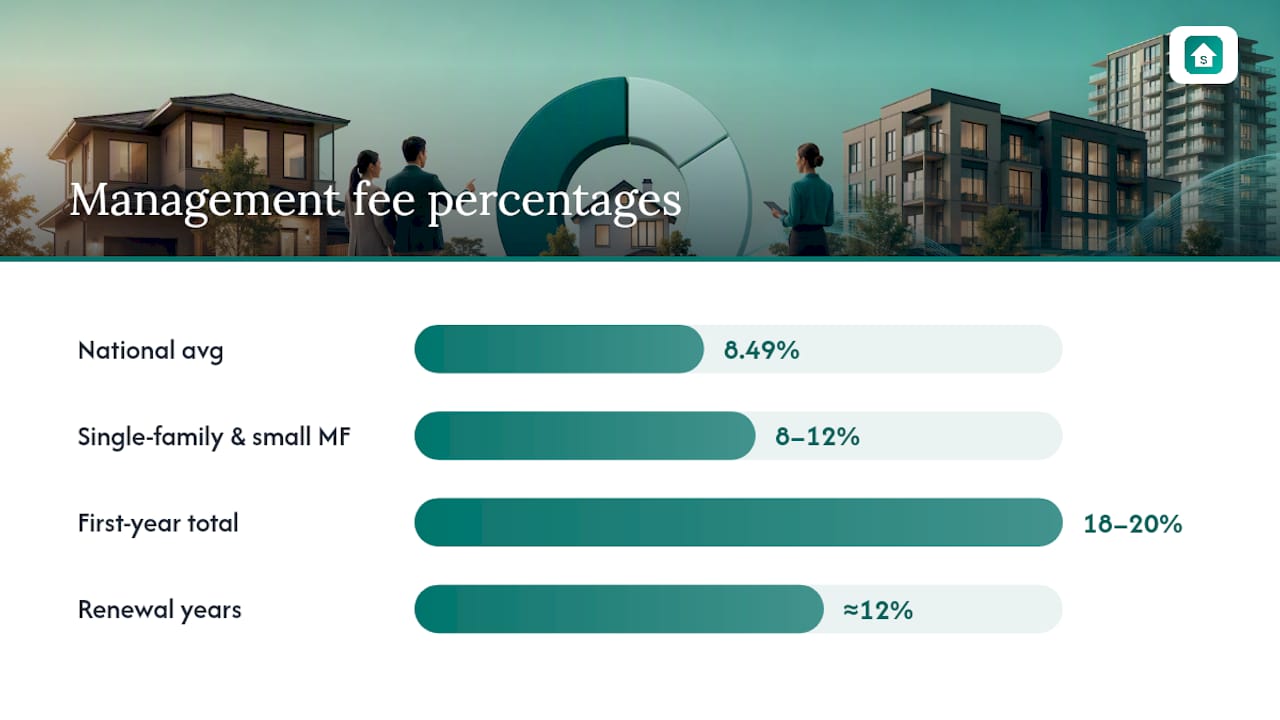
Most property managers charge between 8% and 12% of monthly rent, with the national average landing around 8.49% according to industry survey samples. Short-term and vacation rental managers charge far more, typically 20% to 35%, because the workload of turning over a unit every few days looks nothing like managing a year-long lease.
Quick math: On a $2,000 monthly rent, an 8.5% fee costs $170 a month. At 12%, that’s $240. That $70 gap adds up to $840 a year, before you even factor in leasing fees or maintenance markups.
Key Takeaways
| Point | Details |
|---|---|
| National average sits near 8.5% | Industry surveys put the average management fee at 8.49% of collected rent, with ranges from 3.75% to 14%. |
| Property type changes the rate | Single-family and small multifamily run 8 to 12%, while larger buildings often shift to flat per-unit pricing. |
| Ancillary fees drive up year one | Leasing fees (50 to 100% of a month’s rent), setup, and inspection charges push first-year costs to 18% to 20% of gross rent. |
| Renewal years cost less | Once leasing and setup fees drop off, ongoing annual cost typically settles near 12% of gross rent. |
| Compare with a calculator, not a quote sheet | Cashflowcalcs’ free Rental Property Comparison Calculator models first-year versus renewal-year cost using your own numbers. |
This article is general information, not a substitute for advice from a qualified financial advisor. Consult a qualified financial professional about your own circumstances before acting on anything here.
Table of Contents
- Property Management Fees Percentage by Property Type and Portfolio Size
- What Does the Percentage Actually Cover?
- What Factors Should Change Your Expected Fee?
- A Worked Example: Turning the Percentage Into a Real Annual Cost
- How Do You Compare Management Quotes and Spot Red Flags?
- Model It Yourself With Cashflowcalcs
- Test Any Quote Before You Sign
- Sources
- FAQ
Property Management Fees Percentage by Property Type and Portfolio Size
The headline percentage shifts depending on what you own and how much of it. A single rental house gets priced differently than a 40 unit apartment building, and portfolio size changes your leverage.
- Single-family homes and small multifamily (2 to 4 units): Expect 8% to 12% of monthly rent, with 10% being the most common landing point in mid-size metro markets.
- Mid-size and larger multifamily properties: Many managers switch to a lower percentage (4% to 7%) or a flat per-unit fee, often $75 to $125 per unit per month, since economies of scale reduce the workload per door.
- Short-term and vacation rentals: Fees commonly run 20% to 35% of booking revenue, reflecting guest turnover, cleaning coordination, and dynamic pricing work that a standard lease never requires.
- High-rent markets: These often show somewhat lower percentages because the dollar amount collected on a percentage basis already covers the manager’s costs at a lower rate.
- Lower-rent markets: These tend toward higher percentages, since fixed costs like inspections and tenant screening don’t scale down with rent, pushing managers to charge a bigger slice to break even.
A $3,500 rent at 8% nets the manager $280.
What Does the Percentage Actually Cover?
The monthly percentage is meant to pay for the ongoing work of running your rental: collecting rent, fielding tenant calls, coordinating routine repairs, and sending you a monthly statement. It is not a catch-all. Almost every management company layers additional charges on top, and understanding those layers is where most owners get surprised.
- Leasing or placement fee: Charged when a new tenant signs a lease, typically 50% to 100% of one month’s rent. This is the single biggest ancillary cost most owners face.
- Setup or onboarding fee: A one-time charge when you first hire the manager, averaging around $185 in national samples, though ranges of $100 to $350 are common.
- Lease renewal fee: Charged when an existing tenant renews, averaging around $212, generally in the $100 to $350 range.
- Inspection fees: Move-in, move-out, or periodic inspections average around $107, often quoted as $75 to $150 per visit.
- Eviction coordination fee: Ranges from $200 to $500 to handle paperwork and court coordination on top of any attorney or filing costs.
- Maintenance markup: A 10% to 20% surcharge on vendor invoices for coordinating repairs, which is where a lot of the “hidden” cost lives.
These ancillaries hit hardest in year one, when leasing and setup fees stack on top of the monthly percentage. By the renewal year, several of them disappear entirely, which is why your effective cost drops once a tenant has settled in.
What Factors Should Change Your Expected Fee?
A quoted percentage only means something in context. Before you compare two proposals side by side, weigh the variables that legitimately justify a higher or lower rate.
- Geography: Labor costs, vendor availability, and local rent levels all shift what a manager needs to charge to stay profitable in your market.
- Property type and complexity: A single-family home is simpler to manage than a duplex with shared systems, and a 20-unit building brings different economies of scale than either.
- Turnover frequency and tenant profile: Student housing or short-term stays mean more move-ins, more inspections, and more leasing fees per year, which drives the effective cost up even if the monthly percentage looks similar.
- Portfolio size: Owners with five or more doors often negotiate lower per-unit rates, since the manager’s fixed costs spread across more units.
- Scope of services: A full-service package (marketing, screening, maintenance, accounting, evictions) costs more than a rent-collection-only arrangement.
- Fee basis: Some managers charge on rent actually collected; others charge on scheduled rent whether or not the tenant pays. This distinction alone can change your annual cost by hundreds of dollars if you ever have a late or non-paying tenant.
Pro Tip: Ask every prospective manager whether their fee is based on collected rent or scheduled rent. A “collected rent” clause protects you during vacancies and non-payment; a “scheduled rent” clause means you pay the fee even when the unit sits empty or the tenant defaults.
A Worked Example: Turning the Percentage Into a Real Annual Cost
This lines up closely with what industry data shows more broadly: first-year all-in costs commonly land around 18% to 20% of gross rent, while renewal years settle closer to 12% once leasing and setup fees drop off. Your exact numbers will move based on leasing fee terms and maintenance volume, but the pattern holds. The real question isn’t “what’s the percentage,” it’s “what does this do to my net operating income,” since analysts consistently point owners toward NOI rather than the headline rate alone.

How Do You Compare Management Quotes and Spot Red Flags?
Get every fee in writing before you sign anything.
- Fee basis: Collected rent or scheduled rent, and how vacancies are handled.
- Maintenance markup policy: The exact percentage, and whether you can request pass-through vendor invoices instead.
- Vendor selection: Whether you can use your own contractors or must use the manager’s approved list.
- Vacancy fee policy: Some managers still charge a reduced fee even when the unit is empty.
- Termination terms: Notice period required and whether the contract auto-renews.
- Reporting frequency: Monthly statements are standard; anything less frequent makes it harder to catch billing errors.
On negotiation, ask for a cap on the maintenance markup, request a blended rate if you own multiple properties, and see if the setup fee can be waived for a new client relationship. Negotiating caps and blended pricing is common practice, not an unusual ask.
Pro Tip: Treat vague answers as a warning sign. If a manager won’t itemize their maintenance markup or hesitates to put the leasing fee in writing, that reluctance usually predicts how transparent their monthly statements will be too. For screening and eviction procedures, HUD’s fair housing guidance is worth reviewing so any manager you hire stays compliant on your behalf.
Model It Yourself With Cashflowcalcs
You don’t have to trust a sales pitch to know whether a quoted fee makes sense. Cashflowcalcs’ Rental Property Comparison Calculator lets you enter a headline percentage alongside leasing, setup, and maintenance markup fees to see the first-year versus renewal-year impact side by side. The NOI Calculator and Cash-on-Cash Calculator show how that fee moves your actual returns, not just the percentage on paper. Every calculator runs in your browser, requires no sign-up, and exists for education, not financial advice.
Test Any Quote Before You Sign
A property manager’s pitch will always sound reasonable on a phone call. The numbers only tell the truth once you run them. Cashflowcalcs gives you a faster, more transparent way to check a quote than trusting a sales sheet: plug in the headline percentage, leasing fee, setup cost, and maintenance markup, and see your real first-year and renewal-year cost in seconds, with the formula shown so you can verify it yourself.
The Rental Property Comparison Calculator is the fastest way to test any property manager’s quote. It displays your first-year all-in percentage, projected NOI, and cash-on-cash return, all calculated in your browser with nothing saved or uploaded. For binding tax or legal decisions tied to your rental property, talk to a licensed tax professional or attorney. This tool is educational, not financial advice.
Sources
- Average Property Management Fees (2026): by Type & by State
- How Much Do Rental Property Managers Charge in 2026?
- Property Management Fees in 2026: Average % + Real Cost Breakdown
- HUD, Office of Fair Housing and Equal Opportunity
FAQ
What percentage do most property management companies charge?
Most companies charge between 8% and 12% of monthly rent, with a national average near 8.49% once you average across property types and markets.
Is 1% a high management fee?
What is the 2% rule for properties?
What is the 50% rule in rental property?
How do I know if a management quote is fair?
Compare the headline percentage against the full ancillary fee schedule (leasing, setup, renewal, and maintenance markup), and run the numbers through a tool like the Rental Property Comparison Calculator to see your true first-year cost.