Financing
Hard Money Loan Points: What They Cost and How to Calculate Them

Points on a hard money loan are upfront lender fees, each equal to 1% of the loan amount, charged in addition to the interest rate. Most hard-money borrowers pay between 1 and 5 points, with 2 to 4 points being the most common range for first-position loans. The detail that trips up a lot of investors: points are typically netted from your loan proceeds at closing, so you receive less cash upfront while still paying interest on the full loan amount.
That gap between what you borrow and what you actually receive is the single biggest reason two loans with the same interest rate can have very different real costs.
- 1 point = 1% of the loan amount. One point equals 1% of the loan amount.
- Typical range: 1 to 5 points, with many lenders landing at 2 to 4 for standard fix-and-flip and bridge deals.
- Points reduce net proceeds, not your loan balance, which raises your effective borrowing cost above the stated interest rate.
Quick math: A $300,000 hard money loan at 3 points costs $9,000 upfront. If that loan funds a six-month flip, those $9,000 in points alone add roughly 6% to your annualized cost of capital before you even count interest.
Key Takeaways
| Point | Details |
|---|---|
| Points are upfront, not amortized rate | One point equals 1% of the loan, deducted at closing rather than spread into your monthly payment. |
| Netting reduces working capital | You pay interest on the full principal even though points cut your actual cash received. |
| Short holds punish upfront fees | Annualizing points shows a 6-month loan absorbs the same point cost twice as hard as a 12-month loan. |
| Points are rarely refundable | Early payoff usually doesn’t return unearned points, and minimum interest periods can apply on top. |
| Negotiate the structure, not just the number | Trading rate for points, or asking about repeat-borrower programs, can lower your total cost more than haggling on price alone. |
This article is general information, not a substitute for advice from a qualified financial advisor. Consult a qualified financial professional about your own circumstances before acting on anything here.
Table of Contents
- What Are Hard Money Loan Points, Origination Fees, and Discount Points?
- How Hard Money Points Actually Get Charged at Closing
- How to Annualize Points to Find Your True Cost of Capital
- Typical Point Ranges by Loan Type and Borrower Profile
- Negotiation Levers That Actually Move the Points Number
- Worked Examples: Modeling Points on Your Own Deal
- How the IRS Treats Points on an Investment Property Loan
- Questions to Ask Your Lender Before You Sign
- Sources
- FAQ
What Are Hard Money Loan Points, Origination Fees, and Discount Points?
Hard money lenders generally charge two categories of points, though only one shows up in most deals you’ll see. Understanding what are loan points and how they’re labeled on your term sheet keeps you from getting surprised at closing.
- Origination points. This is the standard fee lenders charge for underwriting, funding, and servicing the loan. It’s the lender’s compensation for taking on a short-term, asset-based loan with faster underwriting than a conventional mortgage. Nearly every hard money loan carries origination points, commonly 1 to 3 points on first-position deals, and this is the fee investors mean when they talk about “points” in casual conversation.
- Discount points. In conventional mortgage lending, discount points let a borrower prepay interest upfront to lower the rate over a 15 or 30 year term. On a hard money loan, this trade almost never makes sense. Discount points rarely save money on short-term loans because the hold period, often 6 to 18 months, is too short for the upfront cost to be recovered through lower monthly interest. You’d need years to break even on a rate buydown you’ll never live long enough (loan-wise) to benefit from.
Beyond points, hard money lending costs typically include:
- Processing or underwriting fees (flat dollar amounts, separate from points)
- Document preparation fees
- Per-draw inspection fees on rehab or construction loans
- Extension fees if you need more time before payoff
- Exit fees charged at payoff, sometimes structured as an additional point
Some lenders bundle several of these into a single “origination fee” line; others itemize each charge separately on the closing disclosure. Ask for the itemized version before you sign anything.
How Hard Money Points Actually Get Charged at Closing
Points don’t work the way a lot of first-time hard money borrowers assume. You don’t write a separate check for them. Instead, the lender deducts points directly from your loan proceeds at closing, a process called netting.
Here’s the arithmetic on a $250,000 loan at 3 points and 11% interest:
- Loan amount: $250,000
- Points due: 3% × $250,000 = $7,500
- Cash you actually receive at closing: $250,000 − $7,500 = $242,500
- Interest you pay: calculated on the full $250,000, not the $242,500 you received
That mismatch is the core mechanic that makes hard money lending costs higher than the headline rate suggests. You’re paying interest on money you never had in hand to deploy.
Statistic callout: Rate surveys show first-position hard money loans running 9.5% to 13% in interest, with points and fees adding another 2% to 5% to the effective cost of a short-term deal.
Two more mechanics catch borrowers off guard:
- Points are typically non-refundable. If you pay off your loan in month two instead of month six, you don’t get a prorated refund of the points. The lender earns the points fully at funding, regardless of how quickly you exit.
- Minimum interest guarantees. Many lenders write a minimum interest period, often 3 to 6 months, into the note. Pay off early and you still owe interest through that minimum window, functioning as an additional guaranteed yield for the lender on top of the points already collected.
Both of these terms live in the fine print of your loan agreement, not the term sheet summary. Read the promissory note itself before you assume an early payoff saves you money.
How to Annualize Points to Find Your True Cost of Capital
A quoted interest rate tells you almost nothing useful on its own. What matters is the annualized cost once you fold points into the math, because a 9% rate with 4 points on a six-month loan is far more expensive than a 12% rate with 1 point on the same term.

The formula:
Annualized point cost = (Points as a percent of loan) × (12 ÷ hold period in months)
Add that figure to your stated interest rate to get your effective annualized cost. This assumes you’re measuring against the gross loan amount, since that’s what accrues interest, even though your net cash in hand is lower after netting.
Here’s how it plays out across two common hard money structures:
| Scenario | Loan amount | Points | Interest rate | Hold period | Point cost annualized | Effective annualized cost |
|---|---|---|---|---|---|---|
| 6-month fix-and-flip | $200,000 | 3 points ($6,000) | 11% | 6 months | 3% × (12÷6) = 6% | 11% + 6% = 17% |
| 12-month bridge loan | $350,000 | 2 points ($7,000) | 10.5% | 12 months | 2% × (12÷12) = 2% | 10.5% + 2% = 12% |
The step-by-step for the flip example:
- Points cost: 3% × $200,000 = $6,000
- Annualize the point cost: 3% × (12 months ÷ 6 months) = 6%
- Add to the stated rate: 11% + 6% = 17% effective annualized cost
- Compare to the net proceeds you actually deploy: $200,000 − $6,000 = $194,000, which is your real working capital
This is where APR calculations can mislead you. A federal APR disclosure spreads points across the loan’s full contractual term, which might be stated as 30 years even though you plan to exit in six months. That produces an artificially low-looking APR that has nothing to do with your real short-hold cost. Always run your own annualized number based on your actual expected hold period, not the contractual term printed on the note.
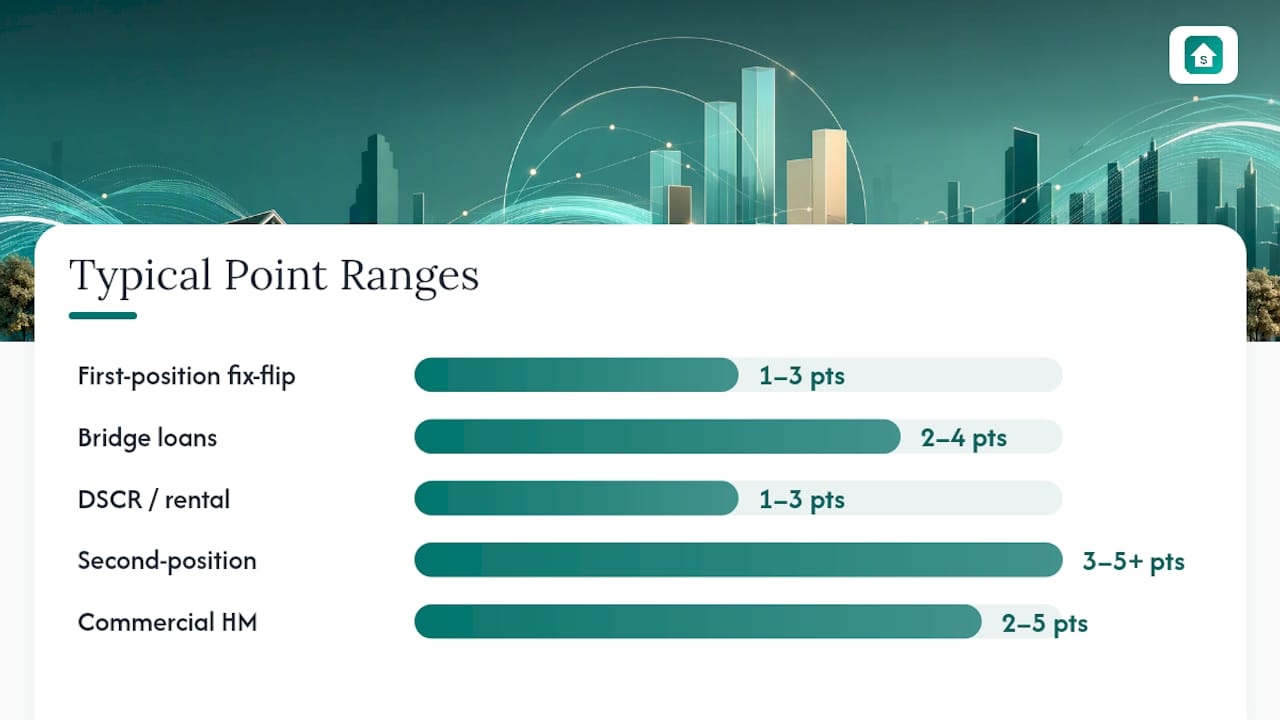
Typical Point Ranges by Loan Type and Borrower Profile
Points on a hard money loan vary by product and by how much risk the lender is taking on your specific deal. A few patterns hold up across most of the market:
- First-position fix-and-flip loans: 1 to 3 points is standard, with experienced borrowers on strong deals sometimes landing at the low end.
- Bridge loans: Generally 2 to 4 points, reflecting slightly longer holds and more underwriting complexity than a straightforward flip.
- DSCR and rental-backed hard money loans: Often 1 to 3 points, since these loans are underwritten more on cash flow than rehab risk.
- Second-position loans: Routinely 3 to 5 points or higher, since subordinate lenders take on more risk if the deal goes sideways.
- Commercial hard money: Can run 2 to 5 points depending on property type, tenant mix, and loan size.
Four factors move you up or down within these ranges: loan-to-value or after-repair-value ratio (lower LTV/ARV usually earns fewer points), your track record as a borrower (repeat, successful borrowers get better pricing), property type (raw land and specialty properties cost more than standard single-family rehabs), and loan position (first position is always cheaper than second).
Statistic callout: Some lenders now offer pro-borrower structures like a 1-and-1 program, meaning 1% origination point plus 1% collected at exit, instead of front-loading 3 or 4 points at closing. These programs change the math meaningfully for borrowers who expect a fast payoff.
Negotiation Levers That Actually Move the Points Number
Points on a hard money loan are rarely a fixed, take-it-or-leave-it number. Lenders have room to move, especially with borrowers who present a clean deal.
- Trade rate for points, or points for rate. If you’re confident in a fast exit, ask to shift cost from points into a slightly higher rate. Since points hit you at closing regardless of hold length while rate only accrues for the time you actually borrow, a short hold favors more rate and fewer points.
- Offer a lower LTV. Bringing more of your own capital to the deal reduces the lender’s risk and is one of the most reliable ways to shave a point or more off the origination fee.
- Show a documented exit plan. A signed listing agreement, a refinance pre-approval, or a track record of on-time payoffs gives the lender confidence to price you closer to the low end of their range.
- Ask for an itemized closing disclosure. Don’t accept a single bundled “origination fee” line. Request a breakdown separating points from processing fees, doc prep, and any exit or extension charges.
- Get the minimum interest period in writing. If you plan to pay off early, know exactly what floor you’re up against before you close, not after.
Pro Tip: Ask every lender you’re comparing for the same three numbers in writing: total points in dollars, the minimum interest period in months, and any exit fee as a percentage. Lenders quote these inconsistently, and having all three side by side is the fastest way to spot which offer is actually cheaper.
Worked Examples: Modeling Points on Your Own Deal
Numbers land better when you can trace every step. Here are two full examples, one for a short flip and one for a longer bridge loan, that you can rebuild with your own figures.
Example 1: Six-month fix-and-flip. You borrow $180,000 at 3 points and 12% interest to renovate and resell a property.
| Line item | Amount |
|---|---|
| Loan amount | $180,000 |
| Points (3%) | $5,400 |
| Net proceeds at closing | $174,600 |
| Interest over 6 months (12% ÷ 2) | $10,800 |
| Total financing cost (points + interest) | $16,200 |
| Effective annualized cost | 12% + 6% = 18% |
| Line item | Amount |
|---|---|
| Loan amount | $350,000 |
| Points (2%) | $7,000 |
| Net proceeds at closing | $343,000 |
| Interest over 12 months (10.5%) | $36,750 |
| Total financing cost (points + interest) | $43,750 |
| Effective annualized cost | 10.5% + 2% = 12.5% |
To reproduce either example with your own numbers, plug your purchase price, rehab budget, and financing terms into the Fix and Flip Calculator, which shows the formula behind every output so you can verify the math yourself instead of trusting a black box. If your deal is closer to a long-hold bridge into a rental, the DSCR Loan Calculator models how points and rate together affect your debt service coverage once the property is rented. Both tools run entirely in your browser with no sign-up required. This is educational modeling, not financial advice, so confirm final terms directly with your lender before you close.
How the IRS Treats Points on an Investment Property Loan
Points on a loan secured by your primary residence follow special rules that let many homeowners deduct the full amount in the year paid. Investment property works differently, and the distinction matters if you’re used to the owner-occupied rules from a personal mortgage.
-
For a rental or investment property, points are generally not deducted in full in the year paid. Instead, they’re typically amortized (deducted ratably) over the life of the loan, per the guidance in IRS Publication 527 on rental property expenses.
-
If you refinance or pay off the loan early, any remaining unamortized points are usually deductible in full in the year the loan is paid off, since you can no longer spread a cost over a loan that no longer exists.
-
Short hard-money loans complicate this only slightly: because the hold period is often under a year, the full amortization schedule and the early-payoff deduction can end up happening in the same tax year.
Statistic callout: With hard money hold periods frequently running 6 to 12 months, many investors end up deducting the bulk of their points in a single tax year simply because the loan doesn’t last long enough to spread the cost meaningfully.
None of this substitutes for professional advice. Loan structure, entity type (LLC vs. individual), and how the property is classified all affect the specific treatment. Confirm your situation with a CPA before you file.
Questions to Ask Your Lender Before You Sign
Bring this list to your next lender call or your closing table. It takes five minutes and can save you thousands.
- What is the exact point amount in dollars, not just the percentage?
- Are points netted from my proceeds, or do I pay them separately at closing?
- Are the points refundable in any scenario, including early payoff?
- Is there a minimum interest period, and how many months does it cover?
- What are the exit and extension fees, stated as exact dollar amounts or percentages?
- Is there a per-draw inspection fee on rehab funds, and how much per draw?
- Can I get an itemized closing disclosure that separates points from all other fees?
- Can you provide a sample payoff schedule showing what I’d owe at 3, 6, and 9 months?
Pro Tip: Treat vague answers as a red flag. A lender who won’t itemize points, fees, and the minimum interest period in writing before closing is usually the same lender who’ll surprise you with an exit fee you didn’t see coming. For a broader look at what closing costs commonly include on the real estate side of a transaction, this overview of seller closing costs is a useful companion reference, even though it’s written from the seller’s side of the table.
Sources
- What Are Points on a Hard Money Loan? Costs Explained - LegalClarity
- 2026 Hard Money Loan Rates, Fix-and-Flip, Bridge & Rental | Hard Money Scout
- Hard Money Loans | Private Lender Link
FAQ
What Are Points on a Hard Money Loan?
They’re typically netted directly from your loan proceeds rather than paid as a separate check.
How Much Is 2 Points on a $50,000 Loan?
That amount is usually deducted from your proceeds at closing, so you’d receive $49,000 in cash while still owing interest on the full $50,000.
What Is the 70% Rule for Hard Money Loans?
It’s separate from points and interest rates, but it affects how much leverage, and how many points, you’ll be offered on a given deal.
How Much Commission Do Loan Officers Make on a $500,000 Loan?
Loan officer compensation typically comes out of the origination points charged on the loan, and structures vary widely by lender and by whether the officer is salaried, commissioned, or a mix of both. On a $500,000 loan with 3 origination points ($15,000 total), the officer’s specific cut depends on their individual compensation agreement with the lender, which isn’t standardized across the industry.